Department of Biomedical and Molecular Sciences, Queen's University, Kingston, Ontario, Canada.
School of Computing, Queen's University, Kingston, Ontario, Canada.
BMC Cancer. 2020 May 13;20(1):413. doi: 10.1186/s12885-020-06922-1.
A major impediment in the treatment of ovarian cancer is the relapse of chemotherapy-resistant tumors, which occurs in approximately 25% of patients. A better understanding of the biological mechanisms underlying chemotherapy resistance will improve treatment efficacy through genetic testing and novel therapies.
Using data from high-grade serous ovarian carcinoma (HGSOC) patients in the Cancer Genome Atlas (TCGA), we classified those who remained progression-free for 12 months following platinum-taxane combination chemotherapy as "chemo-sensitive" (N = 160) and those who had recurrence within 6 months as "chemo-resistant" (N = 110). Univariate and multivariate analysis of expression microarray data were used to identify differentially expressed genes and co-expression gene networks associated with chemotherapy response. Moreover, we integrated genomics data to determine expression quantitative trait loci (eQTL).
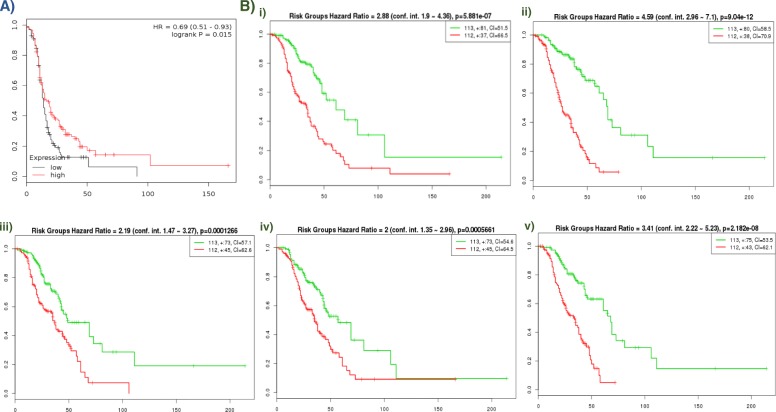
Differential expression of the Valosin-containing protein (VCP) gene and five co-expression gene networks were significantly associated with chemotherapy response in HGSOC. VCP and the most significant co-expression network module contribute to protein processing in the endoplasmic reticulum, which has been implicated in chemotherapy response. Both univariate and multivariate analysis findings were successfully replicated in an independent ovarian cancer cohort. Furthermore, we identified 192 cis-eQTLs associated with the expression of network genes and 4 cis-eQTLs associated with BRCA2 expression.
This study implicates both known and novel genes as well as biological processes underlying response to platinum-taxane-based chemotherapy among HGSOC patients.
卵巢癌治疗的一个主要障碍是化疗耐药肿瘤的复发,约 25%的患者会出现这种情况。更好地了解化疗耐药的生物学机制将通过基因检测和新疗法提高治疗效果。
我们使用癌症基因组图谱(TCGA)中高级别浆液性卵巢癌(HGSOC)患者的数据,将接受铂类紫杉醇联合化疗后 12 个月无进展的患者分为“化疗敏感”(N=160),6 个月内复发的患者分为“化疗耐药”(N=110)。我们使用表达微阵列数据进行单变量和多变量分析,以鉴定与化疗反应相关的差异表达基因和共表达基因网络。此外,我们整合基因组学数据来确定表达数量性状基因座(eQTL)。
VCP 基因和五个共表达基因网络的差异表达与 HGSOC 中的化疗反应显著相关。VCP 和最显著的共表达网络模块有助于内质网中的蛋白质加工,这与化疗反应有关。单变量和多变量分析的发现均在独立的卵巢癌队列中得到成功复制。此外,我们鉴定了 192 个与网络基因表达相关的顺式 eQTLs 和 4 个与 BRCA2 表达相关的顺式 eQTLs。
本研究表明,在 HGSOC 患者中,铂类紫杉醇化疗反应的基础涉及已知和新的基因以及生物学过程。