Hou Qiu-Ke, Huang Yong-Quan, Luo Yi-Wen, Wang Bin, Liu Ya-Mei, Deng Ru-Dong, Zhang Sai-Xia, Lai Ying-Tao, Li Wang-Yang, Chen Dong-Feng
Department of Anatomy, Guangzhou University of Traditional Chinese Medicine, Guangzhou, Guangdong 510000, P.R. China.
Department of Gastroenterology, The First Affiliated Hospital of Guangzhou University of Chinese Medicine, Guangzhou, Guangdong 510000, P.R. China.
Exp Ther Med. 2017 May;13(5):1841-1849. doi: 10.3892/etm.2017.4200. Epub 2017 Mar 8.
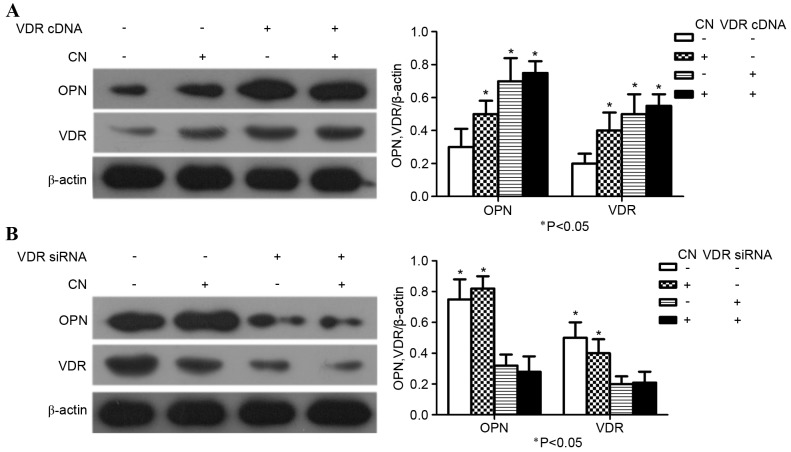
In our previous reports, it was revealed that steroids in traditional Chinese medicine (TCM) have the therapeutic potential to treat bone disease. In the present study, an model of a vitamin D receptor response element (VDRE) reporter gene assay in mesenchymal stem cells (MSCs) was used to identify steroids that enhanced osteogenic differentiation of MSCs. (+)-cholesten-3-one (CN), which possesses a ketone group that is modified in cholesterol and cholesterol myristate, effectively promoted the activity of the VDRE promoter. Phenotypic cellular analysis indicated that CN induced differentiation of MSCs into osteogenic cells and increased expression of specific osteogenesis markers, including alkaline phosphatase, collagen II and Runt-related transcription factor 2. Furthermore, CN significantly increased the expression of osteopontin, the target of the vitamin D receptor (VDR), which indicated that CN may activate vitamin D receptor signaling. Over-expression of VDR or knockdown studies with VDR-small interfering RNA revealed that the pro-differentiation effects induced by CN required VDR. Furthermore, the present study determined that the C-terminal region of the VDR is responsible for the action of CN. Taken together, the present findings demonstrated that CN induced osteogenic differentiation of MSCs by activating VDR. The present study explored the regulation of stem cells by using a series of similar steroids and provided evidence to support a potential strategy for the screening of novel drugs to treat bone disease in the future.
在我们之前的报告中,已揭示中药中的类固醇具有治疗骨疾病的潜力。在本研究中,利用间充质干细胞(MSCs)中维生素D受体反应元件(VDRE)报告基因检测模型来鉴定增强MSCs成骨分化的类固醇。(+)-胆甾-3-酮(CN),其具有在胆固醇和肉豆蔻酸胆固醇中被修饰的酮基,有效促进了VDRE启动子的活性。细胞表型分析表明,CN诱导MSCs分化为成骨细胞,并增加了包括碱性磷酸酶、胶原蛋白II和Runt相关转录因子2在内的特定成骨标志物的表达。此外,CN显著增加了维生素D受体(VDR)的靶标骨桥蛋白的表达,这表明CN可能激活维生素D受体信号通路。VDR的过表达或用VDR小干扰RNA进行的敲低研究表明,CN诱导的促分化作用需要VDR。此外,本研究确定VDR的C末端区域负责CN的作用。综上所述,本研究结果表明CN通过激活VDR诱导MSCs的成骨分化。本研究利用一系列类似的类固醇探索了干细胞的调控,并为未来筛选治疗骨疾病的新药的潜在策略提供了证据支持。