Uderhardt Stefan, Ackermann Jochen A, Fillep Tobias, Hammond Victoria J, Willeit Johann, Santer Peter, Mayr Manuel, Biburger Markus, Miller Meike, Zellner Katie R, Stark Konstantin, Zarbock Alexander, Rossaint Jan, Schubert Irene, Mielenz Dirk, Dietel Barbara, Raaz-Schrauder Dorette, Ay Cihan, Gremmel Thomas, Thaler Johannes, Heim Christian, Herrmann Martin, Collins Peter W, Schabbauer Gernot, Mackman Nigel, Voehringer David, Nadler Jerry L, Lee James J, Massberg Steffen, Rauh Manfred, Kiechl Stefan, Schett Georg, O'Donnell Valerie B, Krönke Gerhard
Department of Internal Medicine 3 - Rheumatology and Immunology, Friedrich-Alexander-University Erlangen-Nürnberg (FAU) and Universitätsklinikum Erlangen, Erlangen, Germany.
Nikolaus Fiebiger Center of Molecular Medicine, Friedrich-Alexander-University Erlangen-Nürnberg (FAU) and Universitätsklinikum Erlangen, Erlangen, Germany.
J Exp Med. 2017 Jul 3;214(7):2121-2138. doi: 10.1084/jem.20161070. Epub 2017 May 31.
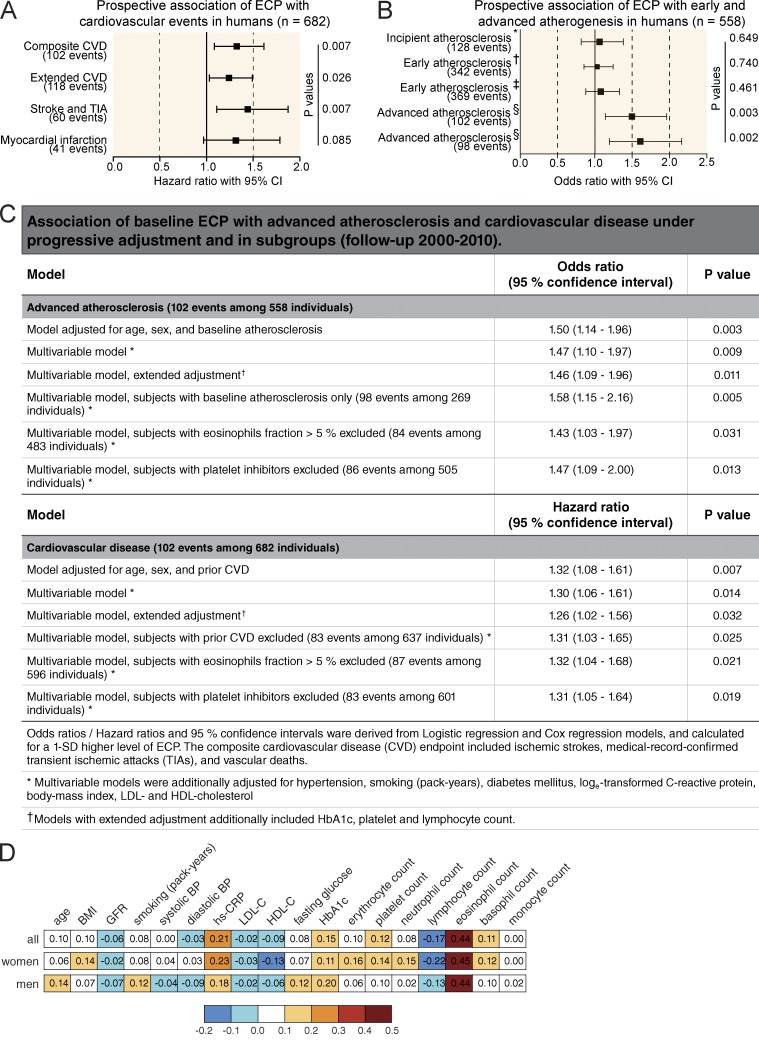
Blood coagulation is essential for physiological hemostasis but simultaneously contributes to thrombotic disease. However, molecular and cellular events controlling initiation and propagation of coagulation are still incompletely understood. In this study, we demonstrate an unexpected role of eosinophils during plasmatic coagulation, hemostasis, and thrombosis. Using a large-scale epidemiological approach, we identified eosinophil cationic protein as an independent and predictive risk factor for thrombotic events in humans. Concurrent experiments showed that eosinophils contributed to intravascular thrombosis by exhibiting a strong endogenous thrombin-generation capacity that relied on the enzymatic generation and active provision of a procoagulant phospholipid surface enriched in 12/15-lipoxygenase-derived hydroxyeicosatetraenoic acid-phosphatidylethanolamines. Our findings reveal a previously unrecognized role of eosinophils and enzymatic lipid oxidation as regulatory elements that facilitate both hemostasis and thrombosis in response to vascular injury, thus identifying promising new targets for the treatment of thrombotic disease.
血液凝固对于生理性止血至关重要,但同时也会导致血栓形成疾病。然而,控制凝血起始和传播的分子和细胞事件仍未完全明确。在本研究中,我们证明了嗜酸性粒细胞在血浆凝血、止血和血栓形成过程中发挥了意想不到的作用。通过大规模流行病学方法,我们确定嗜酸性粒细胞阳离子蛋白是人类血栓形成事件的独立预测风险因素。同时进行的实验表明,嗜酸性粒细胞通过展现强大的内源性凝血酶生成能力促进血管内血栓形成,这种能力依赖于富含12/15-脂氧合酶衍生的羟基二十碳四烯酸-磷脂酰乙醇胺的促凝磷脂表面的酶促生成和活性提供。我们的研究结果揭示了嗜酸性粒细胞和酶促脂质氧化作为调节因子的先前未被认识的作用,它们在血管损伤时促进止血和血栓形成,从而为血栓形成疾病的治疗确定了有前景的新靶点。