Müller Norbert
Department of Psychiatry and Psychotherapy, Ludwig-Maximilian University Munich, Munich, Germany.
Dialogues Clin Neurosci. 2017 Mar;19(1):55-63. doi: 10.31887/DCNS.2017.19.1/nmueller.
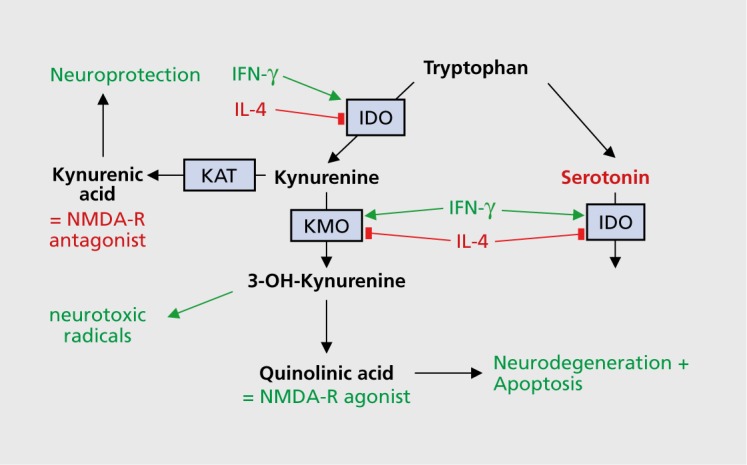
Schizophrenia and major depression (MD) have been associated with immune system dysfunction. One example of this is the altered level of cytokines-important inflammatory mediators-in blood, and a proinflammatory immune state has been described in some subgroups of patients. A knock to the immune system in early life might trigger a life-long increased immune reactivity, and infections and autoimmune disorders are now known to be risk factors for development of schizophrenia and MD. Pro- and anti-inflammatory cytokines mediate indoleamine 2,3-dioxygenase activity; this enzyme drives metabolism of tryptophan and kynurenin in the central nervous system and degrades serotonin. Alterations of serotonergic, noradrenergic, and glutamatergic neurotransmission have been associated with low-level neuroinflammation, and anti-inflammatory compounds have a therapeutic benefit in MD and schizophrenia, as shown in meta-analyses. Moreover, antidepressants and antipsychotics have intrinsic immunomodulatory effects. With evidence pointing to the role inflammatory processes play in the pathogenesis of major psychiatric disorders, this review will look at various immunological aspects of treatment of such disorders.
精神分裂症和重度抑郁症(MD)与免疫系统功能障碍有关。其中一个例子是细胞因子(重要的炎症介质)在血液中的水平发生改变,并且在一些患者亚组中已描述了促炎免疫状态。早年对免疫系统的一次冲击可能会引发终身的免疫反应性增加,并且现在已知感染和自身免疫性疾病是精神分裂症和MD发病的危险因素。促炎和抗炎细胞因子介导吲哚胺2,3-双加氧酶活性;这种酶驱动中枢神经系统中色氨酸和犬尿氨酸的代谢并降解血清素。血清素能、去甲肾上腺素能和谷氨酸能神经传递的改变与低水平神经炎症有关,并且如荟萃分析所示,抗炎化合物在MD和精神分裂症中具有治疗益处。此外,抗抑郁药和抗精神病药具有内在的免疫调节作用。鉴于有证据表明炎症过程在主要精神疾病的发病机制中所起的作用,本综述将探讨此类疾病治疗的各种免疫学方面。