Gréa Hélène, Scheid Isabelle, Gaman Alexandru, Rogemond Véronique, Gillet Sandy, Honnorat Jérôme, Bolognani Federico, Czech Christian, Bouquet Céline, Toledano Elie, Bouvard Manuel, Delorme Richard, Groc Laurent, Leboyer Marion
University of Bordeaux, Interdisciplinary Institute for Neuroscience (HNS), Mixed Research Unit (UMR) 5297, Bordeaux, France; National Center for Scientific Research (CNRS), IINS UMR 5297, Bordeaux, France (Equal contribution).
University Paris Est Créteil, Psychiatry department, University Hospital Henri Mondor, Public Hospitals of Paris (AP-HP), University Hospital Department of Personalized Neurology and Psychiatry (DHU PePSY), France; Translational Psychiatry Laboratory, National Institute of Health and Medical Research (Inserm) U955, France; FondaMental Foundation, France.
Dialogues Clin Neurosci. 2017 Mar;19(1):65-70. doi: 10.31887/DCNS.2017.19.1/mleboyer.
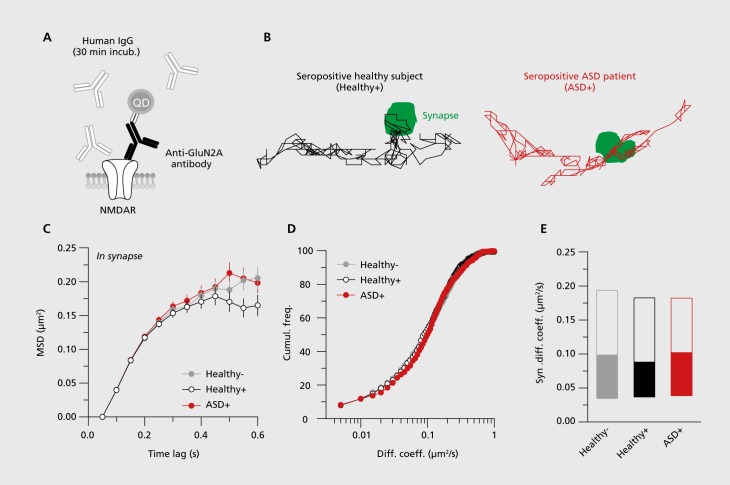
Autism spectrum disorder (ASD) is a neurodevelopmental disorder characterized by dysfunctions in social interactions resulting from a complex interplay between immunogenetic and environmental risk factors. Autoimmunity has been proposed as a major etiological component of ASD. Whether specific autoantibodies directed against brain targets are involved in ASD remains an open question. Here, we identified within a cohort an ASD patient with multiple circulating autoantibodies, including the well-characterized one against glutamate NMDA receptor (NMDAR-Ab). The patient exhibited alexithymia and previously suffered from two major depressive episodes without psychotic symptoms. Using a single molecule-based imaging approach, we demonstrate that neither NMDAR-Ab type G immunoglobulin purified from the ASD patient serum, nor that from a seropositive healthy subject, disorganize membrane NMDAR complexes at synapses. These findings suggest that the autistic patient NMDAR-Abs do not play a direct role in the etiology of ASD and that other autoantibodies directed against neuronal targets should be investigated.
自闭症谱系障碍(ASD)是一种神经发育障碍,其特征是免疫遗传和环境风险因素之间复杂相互作用导致社交互动功能障碍。自身免疫被认为是ASD的主要病因成分。针对脑靶点的特异性自身抗体是否参与ASD仍是一个悬而未决的问题。在此,我们在一个队列中鉴定出一名患有多种循环自身抗体的ASD患者,包括特征明确的针对谷氨酸N-甲基-D-天冬氨酸受体的抗体(NMDAR-Ab)。该患者表现出述情障碍,且此前曾经历过两次无精神病症状的重度抑郁发作。使用基于单分子的成像方法,我们证明,从ASD患者血清中纯化的NMDAR-Ab G型免疫球蛋白,以及血清反应阳性健康受试者的该种免疫球蛋白,均不会破坏突触处的膜NMDAR复合物。这些发现表明,自闭症患者的NMDAR-Ab在ASD病因中不发挥直接作用,应研究针对神经元靶点的其他自身抗体。