Agarwal Poojan, Kumar Vijay, Kaushal Manju, Kumari Manju, Chaudhary Arvind
Address: Department of Pathology, Post Graduate Institute of Medical Education and Research, Dr. RML Hospital, New Delhi, India.
Department of Medicine, Post Graduate Institute of Medical Education and Research, Dr. RML Hospital, New Delhi, India.
Cytojournal. 2017 Apr 28;14:9. doi: 10.4103/1742-6413.205312. eCollection 2017.
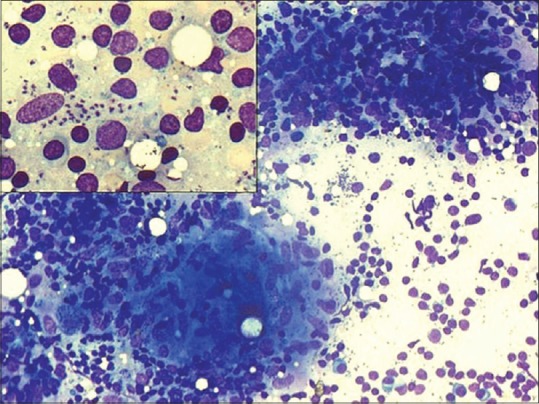
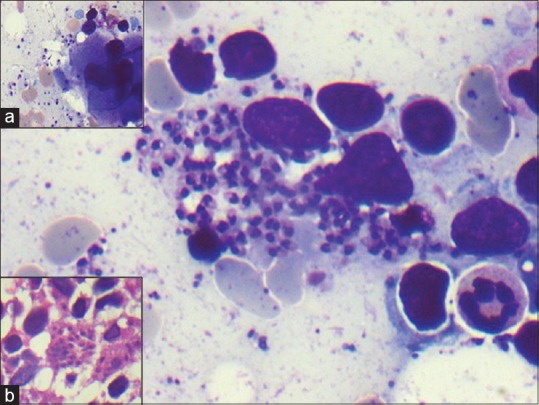
Visceral leishmaniasis (VL), also known as kala-azar, is a life-threatening systemic disease caused by the obligate intracellular protozoan, , and transmitted to humans by the female phlebotomine sand fly (). The disease is fatal, if left untreated. We report a case of a patient clinically suspected of disseminated tuberculosis, but fine needle aspiration cytology of cervical and axillary lymph nodes yielded a diagnosis of leishmaniasis. Diagnosis of VL was challenging as the disease closely mimicked tuberculosis in the setting of extensive lymphadenopathy including conglomerate of mesenteric lymph nodes, on and off fever, and granulomatous lymphadenitis on aspiration. Bone marrow examination was further performed. A detailed workup revealed patient to be severely immunocompromised and newly diagnosed human immunodeficiency virus (HIV) positive. Worldwide, India has the largest number of VL cases, accounting for 40%-50% of world's disease burden and the second largest HIV-infected population, accounting for approximately 10% of the global disease burden. HIV increases the risk of developing VL by 100-2320 times in endemic areas and concurrently VL promotes the clinical progression of HIV disease. Co-infection with HIV alters the body's immune response to leishmaniasis thus leading to unusual presentations. This case highlights the diagnostic problem in the aforesaid setting. Moreover, co-infection with HIV in VL can be a potential source of drug resistance. An early diagnosis and intensified treatment is the key to patient management.
内脏利什曼病(VL),又称黑热病,是一种由专性细胞内原生动物利什曼原虫引起的危及生命的全身性疾病,通过雌性白蛉传播给人类。如果不治疗,该疾病会致命。我们报告一例临床疑似播散性结核病的患者,但颈部和腋窝淋巴结细针穿刺细胞学检查确诊为利什曼病。VL的诊断具有挑战性,因为在广泛淋巴结病的情况下,该疾病与结核病极为相似,包括肠系膜淋巴结融合、间歇性发热以及穿刺显示肉芽肿性淋巴结炎。进一步进行了骨髓检查。详细检查发现患者严重免疫功能低下,且新诊断为人类免疫缺陷病毒(HIV)阳性。在全球范围内,印度的VL病例数最多,占全球疾病负担的40%-50%,同时印度也是第二大HIV感染人群,约占全球疾病负担的10%。在流行地区,HIV使患VL的风险增加100-2320倍,同时VL会促进HIV疾病的临床进展。HIV合并感染会改变人体对利什曼病的免疫反应,从而导致不寻常的表现。该病例突出了上述情况下的诊断问题。此外,VL合并HIV感染可能是耐药性的潜在来源。早期诊断和强化治疗是患者管理的关键。