Sherman Gayle G, Mazanderani Ahmad Haeri, Barron Peter, Bhardwaj Sanjana, Niit Ronelle, Okobi Margaret, Puren Adrian, Jackson Debra J, Goga Ameena Ebrahim
Centre for HIV and STI, National Institute for Communicable Diseases, a division of the National Health Laboratory Services, Johannesburg, South Africa.
Department of Paediatrics and Child Health, Faculty of Health Sciences, University of the Witwatersrand, Johannesburg, South Africa.
J Glob Health. 2017 Jun;7(1):010701. doi: 10.7189/jogh.07.010701.
South Africa has utilized three independent data sources to measure the impact of its program for the prevention of mother-to-child transmission (PMTCT) of HIV. These include the South African National Health Laboratory Service (NHLS), the District Health Information System (DHIS), and South African PMTCT Evaluation (SAPMTCTE) surveys. We compare the results of each, outlining advantages and limitations, and make recommendations for monitoring transmission rates as South Africa works toward achieving elimination of mother-to-child transmission (eMTCT).
HIV polymerase chain reaction (PCR) test data, collected between 1 January 2010 to 31 December 2014, from the NHLS, DHIS and SAPMTCTE surveys were used to compare early mother-to-child transmission (MTCT) rates in South Africa. Data from the NHLS and DHIS were also used to compare early infant diagnosis (EID) coverage.
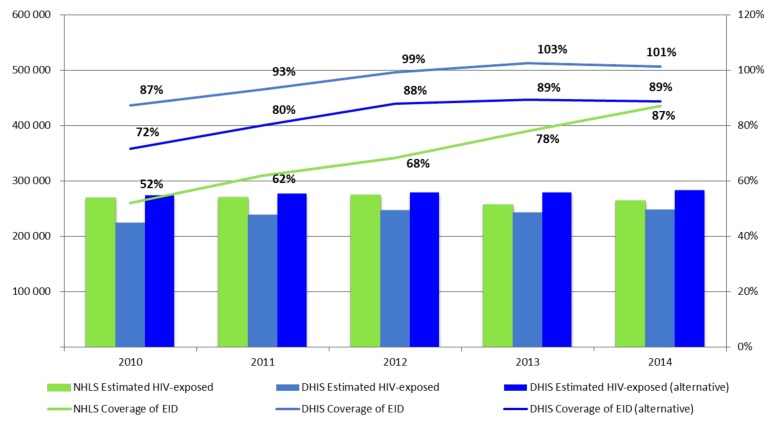
The age-adjusted NHLS early MTCT rates of 4.1% in 2010, 2.6% in 2011 and 2.3% in 2012 consistently fall within the 95% confidence interval as measured by three SAPMTCTE surveys in corresponding time periods. Although DHIS data over-estimated MTCT rates in 2010, the MTCT rate declines thereafter to converge with age-adjusted NHLS MTCT rates by 2012. National EID coverage from NHLS data increases from around 52% in 2010 to 87% in 2014. DHIS data over-estimates EID coverage, but this can be corrected by employing an alternative estimate of the HIV-exposed infant population.
NHLS and DHIS, two routine data sources, provide very similar early MTCT rate estimates that fall within the SAPMTCTE survey confidence intervals for 2012. This analysis validates the usefulness of routine data sources to track eMTCT in South Africa.
南非利用三个独立的数据源来衡量其预防母婴传播艾滋病毒(PMTCT)项目的影响。这些数据源包括南非国家卫生实验室服务机构(NHLS)、地区卫生信息系统(DHIS)以及南非母婴传播评估(SAPMTCTE)调查。我们比较了每个数据源的结果,概述了其优缺点,并在南非努力实现消除母婴传播(eMTCT)的过程中,就监测传播率提出建议。
利用2010年1月1日至2014年12月31日期间从NHLS、DHIS和SAPMTCTE调查中收集的艾滋病毒聚合酶链反应(PCR)检测数据,比较南非早期母婴传播(MTCT)率。NHLS和DHIS的数据还用于比较早期婴儿诊断(EID)覆盖率。
经年龄调整后,NHLS的早期MTCT率在2010年为4.1%,2011年为2.6%,2012年为2.3%,在相应时间段内的三次SAPMTCTE调查所测量的95%置信区间内持续下降。尽管DHIS数据在2010年高估了MTCT率,但此后MTCT率下降,到2012年与经年龄调整后的NHLS MTCT率趋于一致。NHLS数据显示的全国EID覆盖率从2010年的约52%增至2014年的87%。DHIS数据高估了EID覆盖率,但通过采用对暴露于艾滋病毒的婴儿群体的替代估计可以对此进行校正。
NHLS和DHIS这两个常规数据源提供了非常相似的早期MTCT率估计值,且在2012年SAPMTCTE调查的置信区间内。该分析验证了常规数据源在南非追踪eMTCT方面的有用性。