Stavropoulos Dimitri J, Merico Daniele, Jobling Rebekah, Bowdin Sarah, Monfared Nasim, Thiruvahindrapuram Bhooma, Nalpathamkalam Thomas, Pellecchia Giovanna, Yuen Ryan K C, Szego Michael J, Hayeems Robin Z, Shaul Randi Zlotnik, Brudno Michael, Girdea Marta, Frey Brendan, Alipanahi Babak, Ahmed Sohnee, Babul-Hirji Riyana, Porras Ramses Badilla, Carter Melissa T, Chad Lauren, Chaudhry Ayeshah, Chitayat David, Doust Soghra Jougheh, Cytrynbaum Cheryl, Dupuis Lucie, Ejaz Resham, Fishman Leona, Guerin Andrea, Hashemi Bita, Helal Mayada, Hewson Stacy, Inbar-Feigenberg Michal, Kannu Peter, Karp Natalya, Kim Raymond, Kronick Jonathan, Liston Eriskay, MacDonald Heather, Mercimek-Mahmutoglu Saadet, Mendoza-Londono Roberto, Nasr Enas, Nimmo Graeme, Parkinson Nicole, Quercia Nada, Raiman Julian, Roifman Maian, Schulze Andreas, Shugar Andrea, Shuman Cheryl, Sinajon Pierre, Siriwardena Komudi, Weksberg Rosanna, Yoon Grace, Carew Chris, Erickson Raith, Leach Richard A, Klein Robert, Ray Peter N, Meyn M Stephen, Scherer Stephen W, Cohn Ronald D, Marshall Christian R
Genome Diagnostics, Department of Paediatric Laboratory Medicine, The Hospital for Sick Children, Toronto, Ontario, Canada.
Laboratory Medicine and Pathobiology, University of Toronto, Toronto, Ontario, Canada.
NPJ Genom Med. 2016 Jan 13;1:15012-. doi: 10.1038/npjgenmed.2015.12.
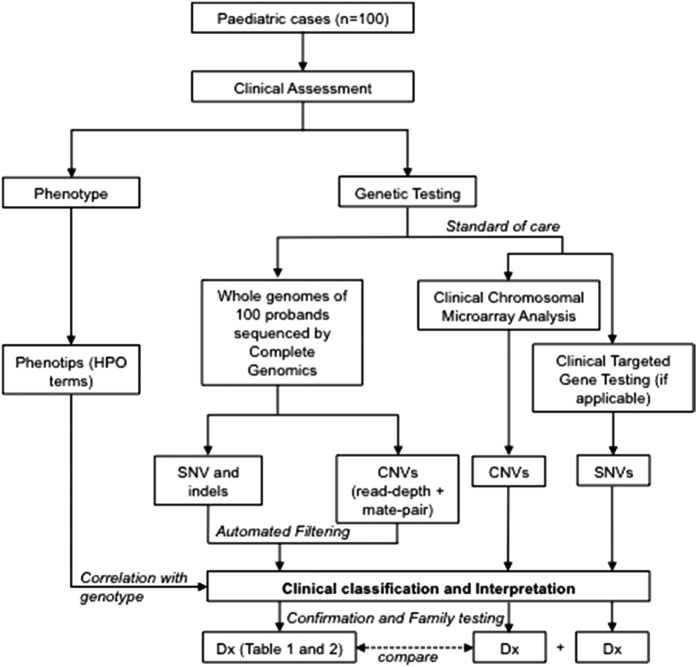
The standard of care for first-tier clinical investigation of the etiology of congenital malformations and neurodevelopmental disorders is chromosome microarray analysis (CMA) for copy number variations (CNVs), often followed by gene(s)-specific sequencing searching for smaller insertion-deletions (indels) and single nucleotide variant (SNV) mutations. Whole genome sequencing (WGS) has the potential to capture all classes of genetic variation in one experiment; however, the diagnostic yield for mutation detection of WGS compared to CMA, and other tests, needs to be established. In a prospective study we utilized WGS and comprehensive medical annotation to assess 100 patients referred to a paediatric genetics service and compared the diagnostic yield versus standard genetic testing. WGS identified genetic variants meeting clinical diagnostic criteria in 34% of cases, representing a 4-fold increase in diagnostic rate over CMA (8%) (p-value = 1.42e-05) alone and >2-fold increase in CMA plus targeted gene sequencing (13%) (p-value = 0.0009). WGS identified all rare clinically significant CNVs that were detected by CMA. In 26 patients, WGS revealed indel and missense mutations presenting in a dominant (63%) or a recessive (37%) manner. We found four subjects with mutations in at least two genes associated with distinct genetic disorders, including two cases harboring a pathogenic CNV and SNV. When considering medically actionable secondary findings in addition to primary WGS findings, 38% of patients would benefit from genetic counseling. Clinical implementation of WGS as a primary test will provide a higher diagnostic yield than conventional genetic testing and potentially reduce the time required to reach a genetic diagnosis.
先天性畸形和神经发育障碍病因的一线临床调查的护理标准是针对拷贝数变异(CNV)进行染色体微阵列分析(CMA),通常随后进行基因特异性测序以寻找更小的插入缺失(indel)和单核苷酸变异(SNV)突变。全基因组测序(WGS)有可能在一次实验中捕获所有类型的遗传变异;然而,与CMA和其他检测相比,WGS检测突变的诊断率需要确定。在一项前瞻性研究中,我们利用WGS和全面的医学注释对100名转诊至儿科遗传学服务机构的患者进行评估,并将诊断率与标准基因检测进行比较。WGS在34%的病例中识别出符合临床诊断标准的遗传变异,这表明与单独的CMA(8%)相比,诊断率提高了4倍(p值 = 1.42e-05),与CMA加靶向基因测序(13%)相比提高了2倍多(p值 = 0.0009)。WGS识别出了CMA检测到的所有罕见的具有临床意义的CNV。在26名患者中,WGS揭示了以显性(63%)或隐性(37%)方式出现的indel和错义突变。我们发现4名受试者至少有两个与不同遗传疾病相关的基因突变,包括2例携带致病性CNV和SNV的病例。除了主要的WGS结果外,当考虑医学上可采取行动的次要发现时,38%的患者将从遗传咨询中受益。将WGS作为主要检测方法进行临床应用将比传统基因检测提供更高的诊断率,并有可能减少达成基因诊断所需的时间。