Dennis Ann M, Hué Stephane, Learner Emily, Sebastian Joseph, Miller William C, Eron Joseph J
Division of Infectious Diseases, University of North Carolina, Chapel Hill, NC, USA.
London School of Hygiene & Tropical Medicine, London, UK.
Virus Evol. 2017 May 24;3(1):vex013. doi: 10.1093/ve/vex013. eCollection 2017 Jan.
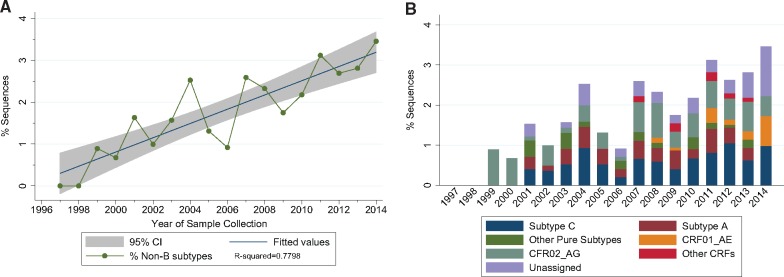
HIV-1 diversity is increasing in North American and European cohorts which may have public health implications. However, little is known about non-B subtype diversity in the southern United States, despite the region being the epicenter of the nation's epidemic. We characterized HIV-1 diversity and transmission clusters to identify the extent to which non-B strains are transmitted locally. We conducted cross-sectional analyses of HIV-1 partial sequences collected from 1997 to 2014 from adults accessing routine clinical care in North Carolina (NC). Subtypes were evaluated using COMET and phylogenetic analysis. Putative transmission clusters were identified using maximum-likelihood trees. Clusters involving non-B strains were confirmed and their dates of origin were estimated using Bayesian phylogenetics. Data were combined with demographic information collected at the time of sample collection and country of origin for a subset of patients. Among 24,972 sequences from 15,246 persons, the non-B subtype prevalence increased from 0% to 3.46% over the study period. Of 325 persons with non-B subtypes, diversity was high with over 15 pure subtypes and recombinants; subtype C (28.9%) and CRF02_AG (24.0%) were most common. While identification of transmission clusters was lower for persons with non-B versus B subtypes, several local transmission clusters (≥3 persons) involving non-B subtypes were identified and all were presumably due to heterosexual transmission. Prevalence of non-B subtype diversity remains low in NC but a statistically significant rise was identified over time which likely reflects multiple importation. However, the combined phylogenetic clustering analysis reveals evidence for local onward transmission. Detection of these non-B clusters suggests heterosexual transmission and may guide diagnostic and prevention interventions.
在北美和欧洲人群中,HIV-1的多样性正在增加,这可能对公共卫生产生影响。然而,尽管美国南部地区是该国艾滋病流行的中心,但对于该地区非B亚型的多样性却知之甚少。我们对HIV-1的多样性和传播集群进行了特征分析,以确定非B毒株在当地的传播程度。我们对1997年至2014年期间从北卡罗来纳州(NC)接受常规临床护理的成年人中收集的HIV-1部分序列进行了横断面分析。使用COMET和系统发育分析对亚型进行评估。使用最大似然树识别推定的传播集群。确认了涉及非B毒株的集群,并使用贝叶斯系统发育学估计了它们的起源日期。数据与样本采集时收集的人口统计学信息以及一部分患者的原籍国信息相结合。在来自15246人的24972个序列中,在研究期间,非B亚型的患病率从0%上升到3.46%。在325名非B亚型患者中,多样性很高,有超过15种纯亚型和重组体;C亚型(28.9%)和CRF02_AG亚型(24.0%)最为常见。虽然非B亚型患者的传播集群识别率低于B亚型患者,但仍识别出了几个涉及非B亚型的本地传播集群(≥3人),且所有集群可能都归因于异性传播。NC州非B亚型多样性的患病率仍然较低,但随着时间的推移,发现了具有统计学意义的上升,这可能反映了多次输入。然而,系统发育聚类分析表明存在本地传播的证据。这些非B集群的发现表明存在异性传播,可能为诊断和预防干预提供指导。