Manna Sudeshna, Panse Cornelia H, Sontakke Vyankat A, Sangamesh Sarangamath, Srivatsan Seergazhi G
Department of Chemistry, Indian Institute of Science Education and Research (IISER), Dr. Homi Bhabha Road, Pune, 411008, India.
Chembiochem. 2017 Aug 17;18(16):1604-1615. doi: 10.1002/cbic.201700283. Epub 2017 Jul 10.
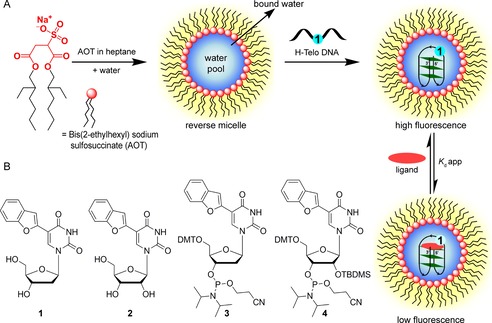
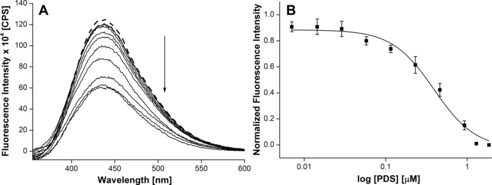
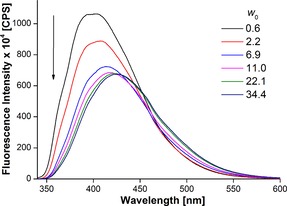
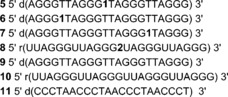
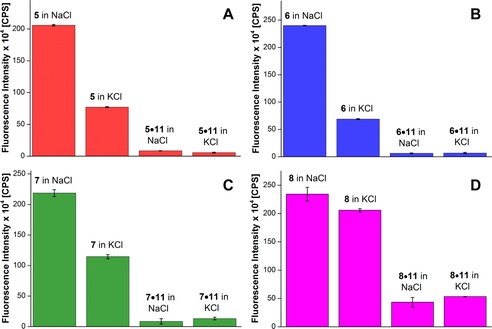
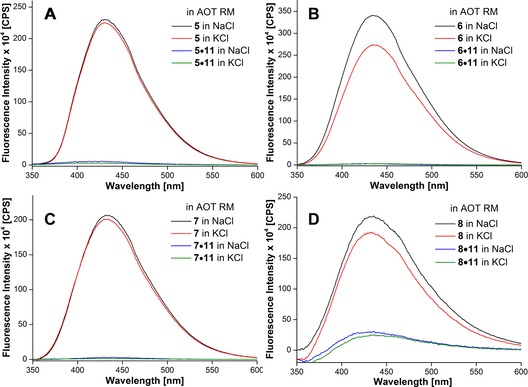
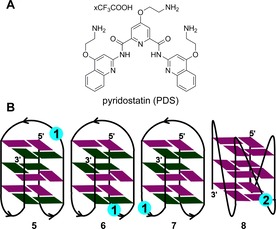
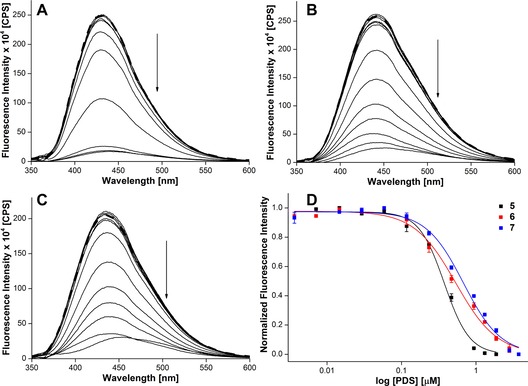
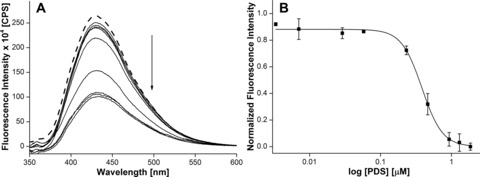
The development of biophysical systems that enable an understanding of the structure and ligand-binding properties of G-quadruplex (GQ)-forming nucleic acid sequences in cells or models that mimic the cellular environment would be highly beneficial in advancing GQ-directed therapeutic strategies. Herein, the establishment of a biophysical platform to investigate the structure and recognition properties of human telomeric (H-Telo) DNA and RNA repeats in a cell-like confined environment by using conformation-sensitive fluorescent nucleoside probes and a widely used cellular model, bis(2-ethylhexyl) sodium sulfosuccinate reverse micelles (RMs), is described. The 2'-deoxy and ribonucleoside probes, composed of a 5-benzofuran uracil base analogue, faithfully report the aqueous micellar core through changes in their fluorescence properties. The nucleoside probes incorporated into different loops of H-Telo DNA and RNA oligonucleotide repeats are minimally perturbing and photophysically signal the formation of respective GQ structures in both aqueous buffer and RMs. Furthermore, these sensors enable a direct comparison of the binding affinity of a ligand to H-Telo DNA and RNA GQ structures in the bulk and confined environment of RMs. These results demonstrate that this combination of a GQ nucleoside probe and easy-to-handle RMs could provide new opportunities to study and devise screening-compatible assays in a cell-like environment to discover GQ binders of clinical potential.
开发能够理解细胞中形成G-四链体(GQ)的核酸序列的结构和配体结合特性的生物物理系统,或者开发模拟细胞环境的模型,将对推进基于GQ的治疗策略非常有益。在此,描述了一种生物物理平台的建立,该平台通过使用构象敏感的荧光核苷探针和广泛使用的细胞模型——双(2-乙基己基)磺基琥珀酸钠反胶束(RMs),在类似细胞的受限环境中研究人端粒(H-Telo)DNA和RNA重复序列的结构和识别特性。由5-苯并呋喃尿嘧啶碱基类似物组成的2'-脱氧核苷探针和核糖核苷探针,通过其荧光特性的变化如实地报告水相胶束核心。掺入H-Telo DNA和RNA寡核苷酸重复序列不同环中的核苷探针的干扰最小,并通过光物理信号显示在水相缓冲液和RMs中各自GQ结构的形成。此外,这些传感器能够直接比较配体在RMs的本体和受限环境中与H-Telo DNA和RNA GQ结构的结合亲和力。这些结果表明,这种GQ核苷探针与易于操作的RMs的组合,可以为在类似细胞的环境中研究和设计筛选兼容的检测方法以发现具有临床潜力的GQ结合剂提供新的机会。