Sanghani-Kerai A, Coathup M, Samazideh S, Kalia P, Silvio L Di, Idowu B, Blunn G
The John Scales Centre for Biomedical Engineering, Institute of Orthopaedics and Musculoskeletal Science, Division of Surgery and Interventional Sciences, University College London, Stanmore, Middlesex HA7 4LP, UK
The John Scales Centre for Biomedical Engineering, Institute of Orthopaedics and Musculoskeletal Science, Division of Surgery and Interventional Sciences, University College London, Stanmore, Middlesex HA7 4LP, UK.
Bone Joint Res. 2017 Jun;6(6):358-365. doi: 10.1302/2046-3758.66.BJR-2016-0259.R1.
Cellular movement and relocalisation are important for many physiologic properties. Local mesenchymal stem cells (MSCs) from injured tissues and circulating MSCs aid in fracture healing. Cytokines and chemokines such as Stromal cell-derived factor 1(SDF-1) and its receptor chemokine receptor type 4 (CXCR4) play important roles in maintaining mobilisation, trafficking and homing of stem cells from bone marrow to the site of injury. We investigated the differences in migration of MSCs from the femurs of young, adult and ovariectomised (OVX) rats and the effect of CXCR4 over-expression on their migration.
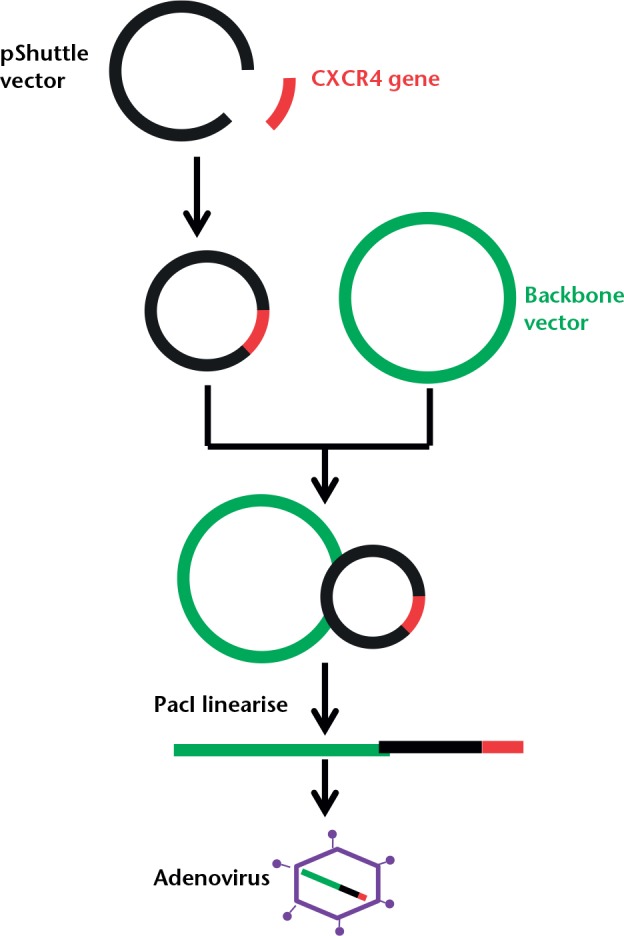
MSCs from young, adult and OVX rats were put in a Boyden chamber to establish their migration towards SDF-1. This was compared with MSCs transfected with CXCR4, as well as MSCs differentiated to osteoblasts.
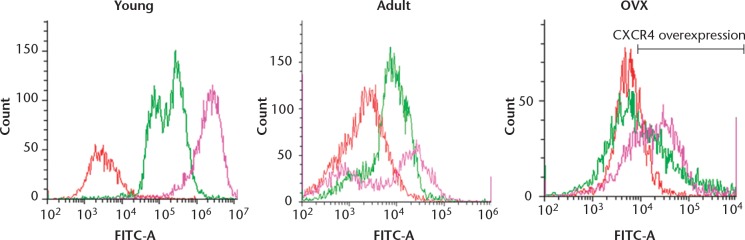
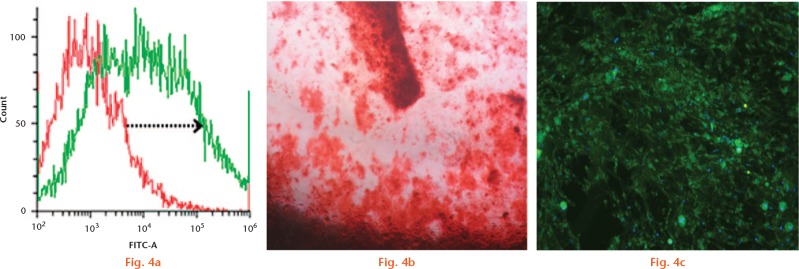
MSCs from OVX rats migrate significantly (p < 0.05) less towards SDF-1 (9%, sd 5%) compared with MSCs from adult (15%, sd 3%) and young rats (25%, sd 4%). Cells transfected with CXCR4 migrated significantly more towards SDF-1 compared with non-transfected cells, irrespective of whether these cells were from OVX (26.5%, sd 4%), young (47%, sd 17%) or adult (21%, sd 4%) rats. Transfected MSCs differentiated to osteoblasts express CXCR4 but do not migrate towards SDF-1.
MSC migration is impaired by age and osteoporosis in rats, and this may be associated with a significant reduction in bone formation in osteoporotic patients. The migration of stem cells can be ameliorated by upregulating CXCR4 levels which could possibly enhance fracture healing in osteoporotic patients. A. Sanghani-Kerai, M. Coathup, S. Samazideh, P. Kalia, L. Di Silvio, B. Idowu, G. Blunn. Osteoporosis and ageing affects the migration of stem cells and this is ameliorated by transfection with CXCR4. 2017;6:-365. DOI: 10.1302/2046-3758.66.BJR-2016-0259.R1.
细胞运动和重新定位对许多生理特性都很重要。来自受损组织的局部间充质干细胞(MSC)和循环中的MSC有助于骨折愈合。细胞因子和趋化因子,如基质细胞衍生因子1(SDF-1)及其受体趋化因子受体4型(CXCR4),在维持干细胞从骨髓到损伤部位的动员、运输和归巢中发挥重要作用。我们研究了年轻、成年和去卵巢(OVX)大鼠股骨来源的MSC迁移差异以及CXCR4过表达对其迁移的影响。
将年轻、成年和OVX大鼠的MSC置于博伊登小室中,以确定它们对SDF-1的迁移情况。将其与转染了CXCR4的MSC以及分化为成骨细胞的MSC进行比较。
与成年大鼠(15%,标准差3%)和年轻大鼠(25%,标准差4%)来源的MSC相比,OVX大鼠来源的MSC对SDF-1的迁移明显减少(p < 0.05)(9%,标准差5%)。与未转染的细胞相比,转染了CXCR4的细胞对SDF-1的迁移明显更多,无论这些细胞是来自OVX大鼠(26.5%,标准差4%)、年轻大鼠(47%,标准差17%)还是成年大鼠(21%,标准差4%)。分化为成骨细胞的转染MSC表达CXCR4,但不向SDF-1迁移。
大鼠的年龄和骨质疏松会损害MSC迁移,这可能与骨质疏松患者骨形成的显著减少有关。上调CXCR4水平可改善干细胞迁移,这可能会增强骨质疏松患者的骨折愈合。A. 桑哈尼 - 凯拉伊、M. 科瑟普、S. 萨马齐德、P. 卡利亚、L. 迪西尔维奥、B. 伊多武、G. 布伦。骨质疏松和衰老会影响干细胞迁移,而转染CXCR4可改善这种情况。2017;6:-365。DOI:10.1302/2046 - 3758.66.BJR - 2016 - 0259.R1。