Sort Rune, Brorson Stig, Gögenur Ismail, Møller Ann Merete
Department of Anaesthesiology, Herlev and Gentofte University Hospital, Copenhagen, Denmark.
Department of Orthopaedic Surgery, Herlev and Gentofte University Hospital, Copenhagen, Denmark.
BMJ Open. 2017 Jun 2;7(5):e016001. doi: 10.1136/bmjopen-2017-016001.
Ankle fracture surgery is a common procedure, but the influence of anaesthesia choice on postoperative pain and quality of recovery is poorly understood. Some authors suggest a benefit of peripheral nerve block (PNB) in elective procedures, but the different pain profile following acute fracture surgery and the rebound pain on cessation of the PNB both remain unexplored. We present an ongoing randomised study aiming to compare primary PNB anaesthesia with spinal anaesthesia for ankle fracture surgery regarding postoperative pain profiles and quality of recovery.
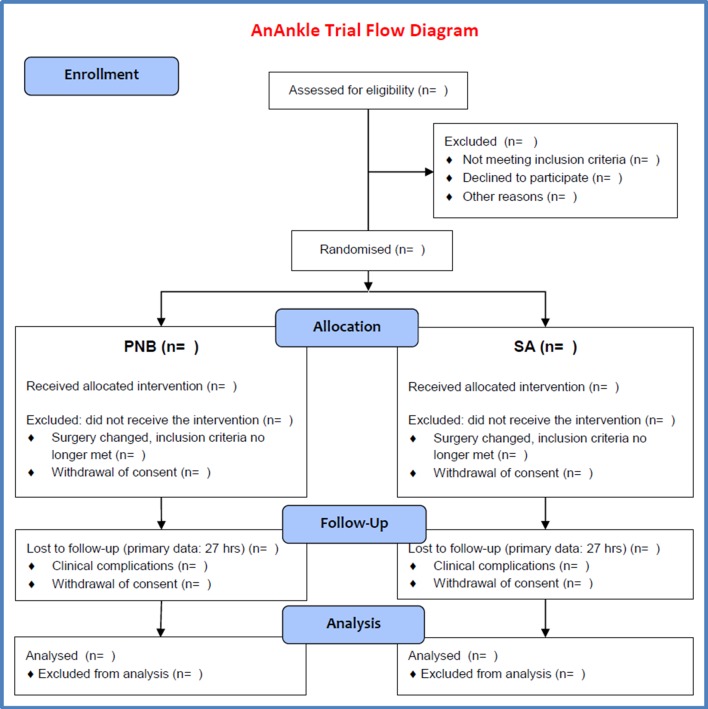
AnAnkle Trial is a randomised, dual-centre, open-label, blinded analysis trial of 150 adult patients undergoing primary internal fixation of an ankle fracture. Main exclusion criteria are habitual opioid use, impaired pain sensation, other painful injuries or cognitive impairment. The intervention is ultrasound-guided popliteal sciatic (20 mL) and saphenal nerve (8 mL) PNB with ropivacaine 7.5 mg/mL, and controls receive spinal anaesthesia (2 mL) with hyperbaric bupivacaine 5 mg/mL. Postoperatively all receive paracetamol, ibuprofen and patient-controlled intravenous morphine on demand. Morphine consumption and pain scores are registered in the first 27 hours and reported as an integrated pain score as the primary endpoint. Pain score intervals are 3 hours and we will use the area under curve to get a longitudinal measure of pain. Secondary outcomes include rebound pain on cessation of anaesthesia, opioid side effects (Opioid-Related Symptom Distress Scale), quality of recovery (Danish Quality of Recovery-15 score) and pain scores and medication days 1-7 (diary).
The study has been approved by the Regional Ethics Committees in the Capital Region of Denmark, the Danish Data Protection Agency and the Danish Health and Medical Authority. We will publish the results in international peer-reviewed medical journals.
AnAnkle Trial is registered in the European Clinical Trials Database (EudraCT 2015-001108-76).
踝关节骨折手术是一种常见的手术,但麻醉方式的选择对术后疼痛及恢复质量的影响尚不清楚。一些作者认为在择期手术中,外周神经阻滞(PNB)有一定优势,但急性骨折手术后不同的疼痛特征以及PNB停止后的反跳痛仍未得到研究。我们正在进行一项随机研究,旨在比较踝关节骨折手术中,初次PNB麻醉与脊髓麻醉在术后疼痛特征及恢复质量方面的差异。
踝关节试验是一项随机、双中心、开放标签、盲法分析试验,纳入150例接受踝关节骨折初次内固定的成年患者。主要排除标准为习惯性使用阿片类药物、痛觉受损、其他疼痛性损伤或认知障碍。干预措施为超声引导下,用0.75mg/mL罗哌卡因对腘窝坐骨神经(20mL)和隐神经(8mL)进行PNB,对照组接受0.5mg/mL重比重布比卡因脊髓麻醉(2mL)。术后所有患者按需接受对乙酰氨基酚、布洛芬及患者自控静脉注射吗啡。记录前27小时的吗啡用量及疼痛评分,并将其作为综合疼痛评分报告,作为主要终点指标。疼痛评分间隔为3小时,我们将使用曲线下面积来纵向衡量疼痛程度。次要结局包括麻醉停止后的反跳痛、阿片类药物副作用(阿片类药物相关症状困扰量表)、恢复质量(丹麦恢复质量-15评分)以及第1 - 7天的疼痛评分和用药情况(日记记录)。
该研究已获得丹麦首都地区地方伦理委员会、丹麦数据保护局以及丹麦卫生和医疗管理局的批准。我们将在国际同行评审医学期刊上发表研究结果。
踝关节试验已在欧洲临床试验数据库注册(EudraCT 2015 - 001108 - 76)。