Department of Medical Oncology and Cancer Genomics Netherlands, Erasmus MC Cancer Institute, Erasmus University Medical Center, Wytemaweg 80, 3015, CN, Rotterdam, The Netherlands.
Department of Pathology, Erasmus MC Cancer Institute, Erasmus University Medical Center, Rotterdam, The Netherlands.
Cell Oncol (Dordr). 2017 Oct;40(5):511-519. doi: 10.1007/s13402-017-0327-7. Epub 2017 Jun 2.
There is a lack of robust and clinically utilizable markers for the diagnosis and prognostication of malignant pleural mesothelioma (MPM). This research was aimed at optimizing and exploring novel approaches to improve the diagnosis and prognostication of MPM in pleural effusions and peripheral blood samples.
CellSearch-based and flow cytometry-based assays using melanoma cell adhesion molecule (MCAM) to identify circulating tumor cells (CTCs) in pleural effusions and peripheral blood samples of MPM patients were optimized, validated, explored clinically and, in case of pleural effusions, compared with cytological analyses. Additionally, tumor-associated circulating endothelial cells (CECs) were measured in peripheral blood samples. The assays were performed on a MPM cohort encompassing patients with histology-confirmed MPM (n=27) and in a control cohort of patients with alternative diagnoses (n=22). Exploratory analyses on the prognostic value of all assays were also performed.
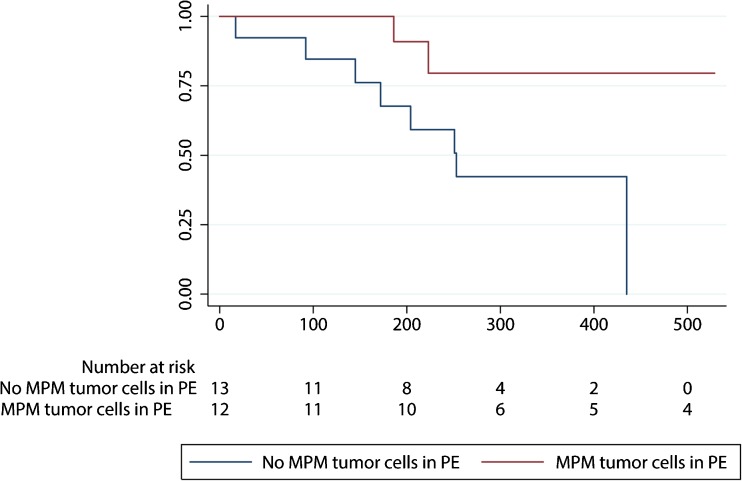
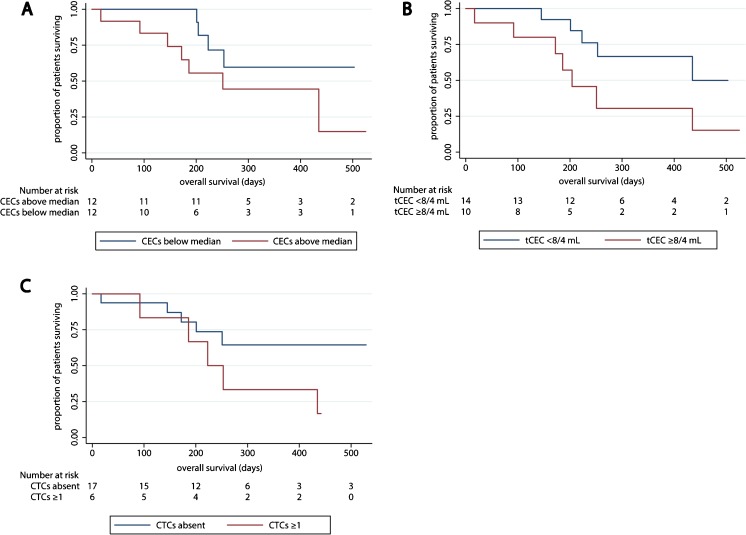
The malignancy of MCAM-positive cells in pleural effusions from MPM patients was confirmed. The detection of MPM CTCs in pleural effusions by CellSearch showed a poor specificity. The detection of MPM CTCs in pleural effusions by flow cytometry showed a superior sensitivity (48%) to standard cytological analysis (15%) (p = 0.03). In peripheral blood, CTCs were detected in 26% of the MPN patients, whereas in 42% of the MPM patients tumor-associated CECs were detected above the upper limit of normal (ULN). In exploratory analyses the absence of CTCs in pleural effusions, and tumor-associated CECs in peripheral blood samples above the ULN, appeared to be associated with a worse overall survival.
MCAM-based flow cytometric analysis of pleural effusions is more sensitive than routine cytological analysis. Flow cytometric analysis of pleural effusions and tumor-associated CECs in peripheral blood may serve as a promising approach for the prognostication of MPM patients and, therefore, warrants further study.
恶性胸膜间皮瘤(MPM)的诊断和预后缺乏稳健且临床可用的标志物。本研究旨在优化和探索新方法,以提高胸腔积液和外周血样本中 MPM 的诊断和预后。
优化、验证、临床探索基于细胞搜索和使用黑色素瘤细胞黏附分子(MCAM)的流式细胞术检测胸腔积液和 MPM 患者外周血样本中循环肿瘤细胞(CTC)的方法,并在胸腔积液中与细胞学分析进行比较。此外,还测量了外周血样本中的肿瘤相关循环内皮细胞(CEC)。该检测在包含组织学证实的 MPM 患者的 MPM 队列(n=27)和具有替代诊断的患者的对照队列(n=22)上进行。还对所有检测方法的预后价值进行了探索性分析。
证实了 MPM 患者胸腔积液中 MCAM 阳性细胞的恶性程度。细胞搜索检测胸腔积液中 MPM CTC 的特异性较差。流式细胞术检测胸腔积液中 MPM CTC 的敏感性(48%)优于标准细胞学分析(15%)(p=0.03)。在外周血中,26%的 MPN 患者检测到 CTCs,而在 42%的 MPM 患者中检测到肿瘤相关的 CECs 超过正常上限(ULN)。在探索性分析中,胸腔积液中未检测到 CTCs,以及外周血样本中肿瘤相关的 CECs 超过 ULN,似乎与总生存较差相关。
MCAM 基于流式细胞术分析胸腔积液比常规细胞学分析更敏感。胸腔积液和外周血中肿瘤相关的 CECs 的流式细胞术分析可能成为 MPM 患者预后的有前途的方法,因此值得进一步研究。