Hayashi Nakamasa, Takahashi Hideaki, Hasegawa Yuzo, Higuchi Fumi, Takahashi Masamichi, Makino Keishi, Takagaki Masatoshi, Akimoto Jiro, Okuda Takeshi, Okita Yoshiko, Mitsuya Koichi, Hirashima Yasuyuki, Narita Yoshitaka, Nakasu Yoko
Division of Neurosurgery, Shizuoka Cancer Center Hospital, Nagaizumi, Shizuoka, 411-8777, Japan.
Department of Neurosurgery, Niigata Cancer Center Hospital, Niigata, 951-8666, Japan.
BMC Cancer. 2017 Jun 2;17(1):397. doi: 10.1186/s12885-017-3358-6.
The prevalence of brain metastases (BM) from uterine cancer has recently increased because of the improvement of overall survival (OS) of patients with uterine cancer due to its early detection and improved local control as a result of new effective treatments. However, little information is available regarding their clinical characteristics and prognosis, because oncologists have encountered BM from uterine cancer on rare occasions.
Records from 81 patients with uterine BM were collected from 10 institutes in Japan. These were used in a multi-institutional study to identify prognostic factors and develop a graded prognostic assessment (GPA) for patients with BM from uterine cancer.
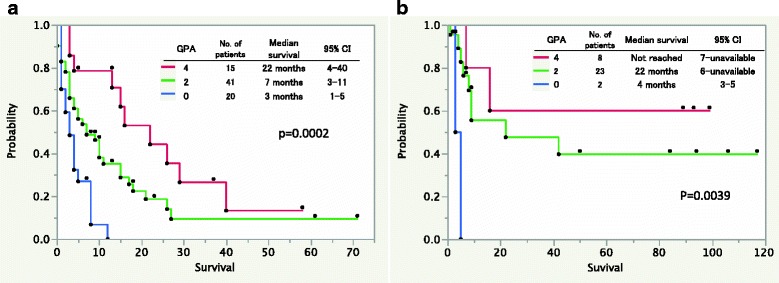
Median OS after the development of BM was 7 months (95% confidence interval, 4 to 10 months). Multivariate analysis revealed that there were survival differences according to the existence of extracranial metastases and number of BM. In the present uterine-GPA, a score of 0 was assigned to those patients with ≥5 BM and extracranial metastasis, a score of 2 was assigned to those patients with one to four BM or without extracranial metastasis, and a score of 4 was assigned to those patients with one to four BM and without extracranial metastasis. The median OS for patients with a uterine-GPA scores of 0, 2, and 4 was 3, 7, and 22 months, respectively. A survival analysis confirmed the presence of statistically significant differences between these groups (p < 0.05). The results were validated by data obtained from the National Report of Brain Tumor Registry of Japan.
Uterine GPA incorporates two simple clinical parameters of high prognostic significance and can be used to predict the expected survival times in patients with BM from uterine cancer. Its use may help in determining an appropriate treatment for individual patients with BM.
由于子宫癌早期检测手段的改进以及新的有效治疗方法提高了局部控制率,子宫癌患者的总生存期(OS)得以延长,导致脑转移(BM)的发生率最近有所上升。然而,由于肿瘤学家很少遇到子宫癌脑转移病例,关于其临床特征和预后的信息较少。
从日本10家机构收集了81例子宫癌脑转移患者的记录。这些记录用于一项多机构研究,以确定预后因素并为子宫癌脑转移患者制定分级预后评估(GPA)。
脑转移发生后的中位总生存期为7个月(95%置信区间,4至10个月)。多变量分析显示,根据颅外转移的存在情况和脑转移灶数量存在生存差异。在目前的子宫癌GPA中,脑转移灶≥5个且有颅外转移的患者评分为0分,有1至4个脑转移灶或无颅外转移的患者评分为2分,有1至4个脑转移灶且无颅外转移的患者评分为4分。子宫癌GPA评分为0、2和4分的患者的中位总生存期分别为3、7和22个月。生存分析证实这些组之间存在统计学显著差异(p<0.05)。结果通过从日本脑肿瘤登记处国家报告获得的数据得到验证。
子宫癌GPA纳入了两个具有高度预后意义的简单临床参数,可用于预测子宫癌脑转移患者的预期生存时间。其应用可能有助于为个别子宫癌脑转移患者确定合适的治疗方案。