Reynolds J V, Preston S R, O'Neill B, Baeksgaard L, Griffin S M, Mariette C, Cuffe S, Cunningham M, Crosby T, Parker I, Hofland K, Hanna G, Svendsen L B, Donohoe C L, Muldoon C, O'Toole D, Johnson C, Ravi N, Jones G, Corkhill A K, Illsley M, Mellor J, Lee K, Dib M, Marchesin V, Cunnane M, Scott K, Lawner P, Warren S, O'Reilly S, O'Dowd G, Leonard G, Hennessy B, Dermott R Mc
St. James's Hospital and Trinity College Dublin, Dublin, Ireland.
Royal Surrey County Hospital, Guildford, UK.
BMC Cancer. 2017 Jun 3;17(1):401. doi: 10.1186/s12885-017-3386-2.
Neoadjuvant therapy is increasingly the standard of care in the management of locally advanced adenocarcinoma of the oesophagus and junction (AEG). In randomised controlled trials (RCTs), the MAGIC regimen of pre- and postoperative chemotherapy, and the CROSS regimen of preoperative chemotherapy combined with radiation, were superior to surgery only in RCTs that included AEG but were not powered on this cohort. No completed RCT has directly compared neoadjuvant or perioperative chemotherapy and neoadjuvant chemoradiation. The Neo-AEGIS trial, uniquely powered on AEG, and including comprehensive modern staging, compares both these regimens.
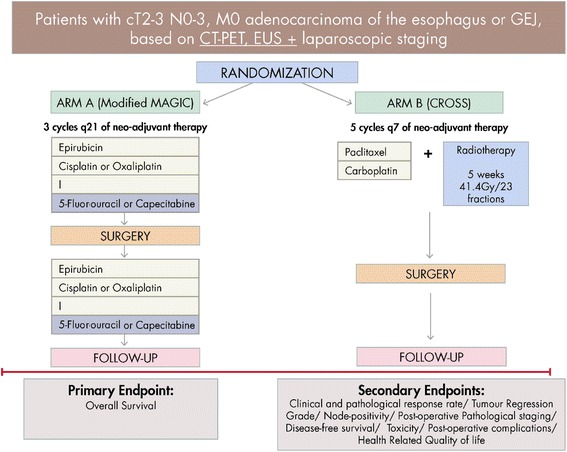
This open label, multicentre, phase III RCT randomises patients (cT2-3, N0-3, M0) in a 1:1 fashion to receive CROSS protocol (Carboplatin and Paclitaxel with concurrent radiotherapy, 41.4Gy/23Fr, over 5 weeks). The power calculation is a 10% difference in favour of CROSS, powered at 80%, two-sided alpha level of 0.05, requiring 540 patients to be evaluable, 594 to be recruited if a 10% dropout is included (297 in each group). The primary endpoint is overall survival, with a minimum 3-year follow up. Secondary endpoints include: disease free survival, recurrence rates, clinical and pathological response rates, toxicities of induction regimens, post-operative pathology and tumour regression grade, operative in-hospital complications, and health-related quality of life. The trial also affords opportunities for establishing a bio-resource of pre-treatment and resected tumour, and translational research.
This RCT directly compares two established treatment regimens, and addresses whether radiation therapy positively impacts on overall survival compared with a standard perioperative chemotherapy regimen Sponsor: Irish Clinical Research Group (ICORG).
NCT01726452 . Protocol 10-14. Date of registration 06/11/2012.
新辅助治疗日益成为局部晚期食管腺癌和食管胃交界腺癌(AEG)治疗的标准方案。在随机对照试验(RCT)中,术前和术后化疗的MAGIC方案以及术前化疗联合放疗的CROSS方案,仅在纳入AEG但未针对该队列进行效能分析的RCT中优于单纯手术。尚无完整的RCT直接比较新辅助或围手术期化疗与新辅助放化疗。Neo-AEGIS试验专门针对AEG进行了效能分析,并纳入了全面的现代分期,对这两种方案进行了比较。
这项开放标签、多中心、III期RCT以1:1的比例将患者(cT2-3,N0-3,M0)随机分组,接受CROSS方案(卡铂和紫杉醇同步放疗,41.4Gy/23次分割,共5周)。效能分析显示,CROSS方案有10%的优势,效能为80%,双侧α水平为0.05,需要540例患者可评估,若纳入10%的失访率则需招募594例(每组297例)。主要终点是总生存期,至少随访3年。次要终点包括:无病生存期、复发率、临床和病理缓解率、诱导方案的毒性、术后病理和肿瘤退缩分级、手术住院并发症以及健康相关生活质量。该试验还为建立治疗前和切除肿瘤的生物资源以及转化研究提供了机会。
这项RCT直接比较了两种既定的治疗方案,并探讨了与标准围手术期化疗方案相比,放疗是否对总生存期有积极影响。资助者:爱尔兰临床研究小组(ICORG)。
NCT01726452。方案10-14。注册日期2012年11月6日。