Modi Ankita, Fan Chun-Po Steve, Tang Jackson, Weaver Jessica Papadopoulos, Sajjan Shiva
Merck & Co., Inc., Kenilworth, NJ, USA.
Asclepius Analytics LLC, Brooklyn, NY, USA.
Bone Rep. 2016 Jun 7;5:208-213. doi: 10.1016/j.bonr.2016.06.001. eCollection 2016 Dec.
Gastrointestinal (GI) events are common in postmenopausal women treated for osteoporosis. The influence of GI events on treatment initiation and treatment compliance is the subject of ongoing research.
The objectives of this study were (i) to determine the association of GI events with receipt of treatment in patients newly diagnosed with osteoporosis, and (ii) among treated patients, to determine the association of GI events with treatment compliance.
This was a retrospective analysis of claims data carried out in Germany using the Mediplus database. Data were collected from January 1992 through December 2010. The dual-objective study design required two distinct cohorts. Cohort 1 comprised women aged ≥ 55 with a diagnosis of osteoporosis. GI events were recorded for the 12 month periods before and after the date of diagnosis. Time-varying Cox regression and discrete choice models were used, respectively, to assess the association of post-diagnosis GI events with the initiation of pharmacologic treatment (yes versus no) and the type of treatment initiated (bisphosphonates versus non-bisphosphonates). Cohort 2 comprised women aged ≥ 55 who initiated an oral bisphosphonate (alendronate, ibandronate, or risedronate). GI events were recorded for the 12 month periods before and after the date of bisphosphonate initiation, and a logistic regression model was employed to determine if pre-treatment or post-treatment GI events were associated with patient compliance, defined as a medication possession ratio (MPR) of ≥ 60%, with sensitivity analyses at MPR ≥ 80%.
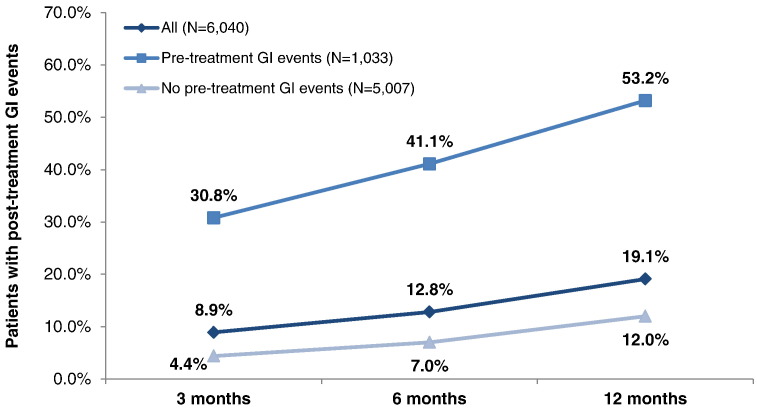
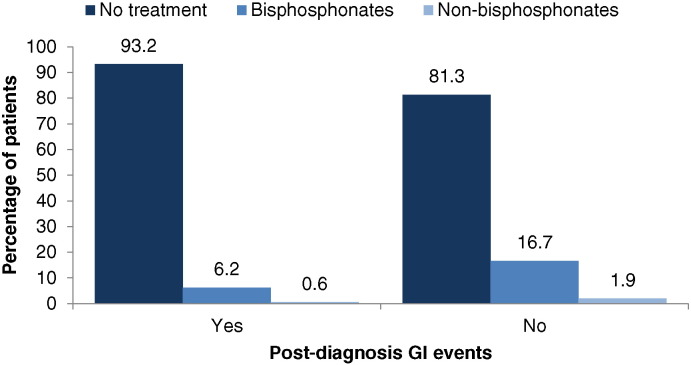
In cohort 1 (N = 18,813), 13.8% of patients had GI events in the pre-diagnosis period, and 14.8% had GI events in the post-diagnosis period. Among the patients with post-diagnosis GI events, 93.2% remained untreated during the post-index year, 6.2% were treated with bisphosphonates, and 0.6% received non-bisphosphonates. The respective percentages in patients without post-diagnosis GI events were 81.3%, 16.7%, and 1.9%. A post-diagnosis GI event decreased the likelihood of receiving any osteoporosis treatment (versus no treatment) by 83% (HR 0.17, 95% CI 0.14-0.20) and also decreased the likelihood of receiving a bisphosphonate (versus a non-bisphosphonate) by 39% (OR 0.61, 95% CI 0.54-0.68). In cohort 2 (N = 6040), 17.1% of patients had GI events in the year before treatment initiation, and 19.1% had GI events in the year after treatment initiation. At 12 months post-treatment initiation, GI events were more frequent in patients with pre-treatment GI events (53.2%) than in those without pre-treatment GI events (12.0%). Post-treatment GI events decreased the likelihood of attaining compliance defined as an MPR ≥ 60% (OR 0.84, 95% CI 0.73-0.97) but not an MPR ≥ 80% (OR 0.91, 95% CI 0.79-1.06).
In German women newly diagnosed with osteoporosis, GI events decreased the likelihood of receiving treatment and were associated with the choice of treatment. In women initiating oral bisphosphonates, post-treatment GI events were associated with reduced patient compliance.
胃肠道(GI)事件在接受骨质疏松症治疗的绝经后女性中很常见。GI事件对治疗开始和治疗依从性的影响是正在进行的研究课题。
本研究的目的是(i)确定新诊断为骨质疏松症的患者中GI事件与接受治疗之间的关联,以及(ii)在接受治疗的患者中,确定GI事件与治疗依从性之间的关联。
这是一项使用Mediplus数据库对德国索赔数据进行的回顾性分析。数据收集时间为1992年1月至2010年12月。双目标研究设计需要两个不同的队列。队列1包括年龄≥55岁且诊断为骨质疏松症的女性。在诊断日期前后12个月期间记录GI事件。分别使用时变Cox回归和离散选择模型,评估诊断后GI事件与药物治疗开始(是与否)以及开始治疗的类型(双膦酸盐与非双膦酸盐)之间的关联。队列2包括年龄≥55岁且开始口服双膦酸盐(阿仑膦酸钠、伊班膦酸钠或利塞膦酸钠)的女性。在双膦酸盐开始日期前后12个月期间记录GI事件,并采用逻辑回归模型确定治疗前或治疗后GI事件是否与患者依从性相关,患者依从性定义为药物持有率(MPR)≥60%,并在MPR≥80%时进行敏感性分析。
在队列1(N = 18,813)中,13.8%的患者在诊断前期有GI事件,14.8%的患者在诊断后期有GI事件。在诊断后有GI事件的患者中,93.2%在索引年后仍未接受治疗,6.2%接受双膦酸盐治疗,0.6%接受非双膦酸盐治疗。在诊断后无GI事件的患者中,相应比例分别为81.3%、16.7%和1.9%。诊断后发生GI事件会使接受任何骨质疏松症治疗(与未治疗相比)的可能性降低83%(HR 0.17,95%CI 0.14 - 0.20),也会使接受双膦酸盐治疗(与非双膦酸盐治疗相比)的可能性降低39%(OR 0.61,95%CI 0.54 - 0.68)。在队列2(N = 6040)中,17.