Department of Biology and Hjort Centre for Marine Ecosystem Dynamics, University of Bergen, Bergen, Norway.
Red Sea Research Center, King Abdullah University of Science and Technology, Thuwal 23955-6900, Saudi Arabia.
Sci Adv. 2017 May 31;3(5):e1602468. doi: 10.1126/sciadv.1602468. eCollection 2017 May.
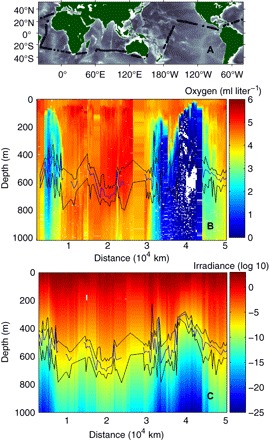
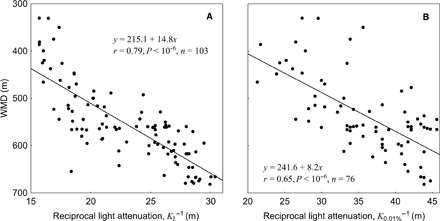
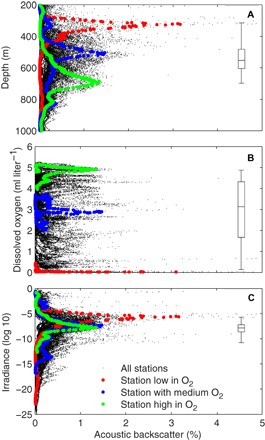
The deep scattering layer (DSL) is a ubiquitous acoustic signature found across all oceans and arguably the dominant feature structuring the pelagic open ocean ecosystem. It is formed by mesopelagic fishes and pelagic invertebrates. The DSL animals are an important food source for marine megafauna and contribute to the biological carbon pump through the active flux of organic carbon transported in their daily vertical migrations. They occupy depths from 200 to 1000 m at daytime and migrate to a varying degree into surface waters at nighttime. Their daytime depth, which determines the migration amplitude, varies across the global ocean in concert with water mass properties, in particular the oxygen regime, but the causal underpinning of these correlations has been unclear. We present evidence that the broad variability in the oceanic DSL daytime depth observed during the Malaspina 2010 Circumnavigation Expedition is governed by variation in light penetration. We find that the DSL depth distribution conforms to a common optical depth layer across the global ocean and that a correlation between dissolved oxygen and light penetration provides a parsimonious explanation for the association of shallow DSL distributions with hypoxic waters. In enhancing understanding of this phenomenon, our results should improve the ability to predict and model the dynamics of one of the largest animal biomass components on earth, with key roles in the oceanic biological carbon pump and food web.
深海散射层 (DSL) 是一种普遍存在于所有海洋中的声学特征,可以说是构成开阔海洋生态系统的主要特征。它由中层鱼类和远洋无脊椎动物组成。DSL 动物是海洋巨型动物的重要食物来源,并通过其在日常垂直迁移中运输的有机碳的主动通量为生物碳泵做出贡献。它们栖息在白天从 200 米到 1000 米的深度,并在夜间以不同程度迁移到水面。它们的白天深度决定了迁移幅度,与全球海洋中的水体特性,特别是氧气状况一致,但这些相关性的因果关系一直不清楚。我们提供的证据表明,在 2010 年马拉斯皮纳环球航行探险期间观察到的海洋 DSL 白天深度的广泛变化是由光穿透的变化决定的。我们发现,全球海洋 DSL 深度分布符合一个共同的光学深度层,溶解氧和光穿透之间的相关性为 DSL 分布与缺氧水域的关联提供了一个简洁的解释。我们的研究结果提高了对这一现象的理解,应该能够提高预测和模拟地球上最大的动物生物量组成部分之一的动态的能力,这些动物在海洋生物碳泵和食物网中发挥着关键作用。