Department of Chemistry, Columbia University, New York, NY 10027, USA.
Tata Institute of Fundamental Research, Center for Interdisciplinary Sciences, 21 Brundavan Colony, Narsingi, Hyderabad, India.
Sci Adv. 2017 May 31;3(5):e1700014. doi: 10.1126/sciadv.1700014. eCollection 2017 May.
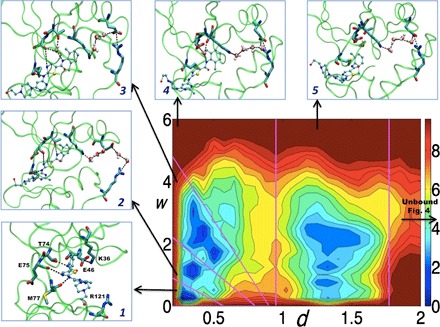
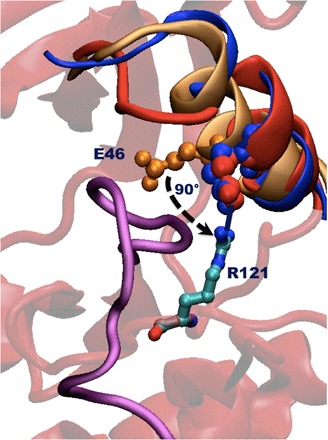
Obtaining atomistic resolution of drug unbinding from a protein is a much sought-after experimental and computational challenge. We report the unbinding dynamics of the anticancer drug dasatinib from c-Src kinase in full atomistic resolution using enhanced sampling molecular dynamics simulations. We obtain multiple unbinding trajectories and determine a residence time in agreement with experiments. We observe coupled protein-water movement through multiple metastable intermediates. The water molecules form a hydrogen bond bridge, elongating a specific, evolutionarily preserved salt bridge and enabling conformation changes essential to ligand unbinding. This water insertion in the salt bridge acts as a molecular switch that controls unbinding. Our findings provide a mechanistic rationale for why it might be difficult to engineer drugs targeting certain specific c-Src kinase conformations to have longer residence times.
从蛋白质中获得药物非结合的原子分辨率是一个备受关注的实验和计算挑战。我们使用增强采样分子动力学模拟报告了抗癌药物达沙替尼从 c-Src 激酶中的非结合动力学。我们获得了多个非结合轨迹,并确定了与实验一致的停留时间。我们观察到通过多个亚稳态中间产物的蛋白质-水耦合运动。水分子形成氢键桥,延长特定的、进化上保守的盐桥,并使配体非结合所必需的构象变化成为可能。盐桥中的这种水分子插入充当了控制非结合的分子开关。我们的发现为为什么设计针对某些特定 c-Src 激酶构象的药物以延长停留时间可能具有挑战性提供了一种机械上的解释。