Department of Chemistry, Chicago Center for Theoretical Chemistry, Institute for Biophysical Dynamics and James Frank Institute, University of Chicago, Chicago, IL 60637.
Graduate Program in Biophysical Sciences, University of Chicago, Chicago, IL 60637.
Proc Natl Acad Sci U S A. 2024 Jul 16;121(29):e2408156121. doi: 10.1073/pnas.2408156121. Epub 2024 Jul 9.
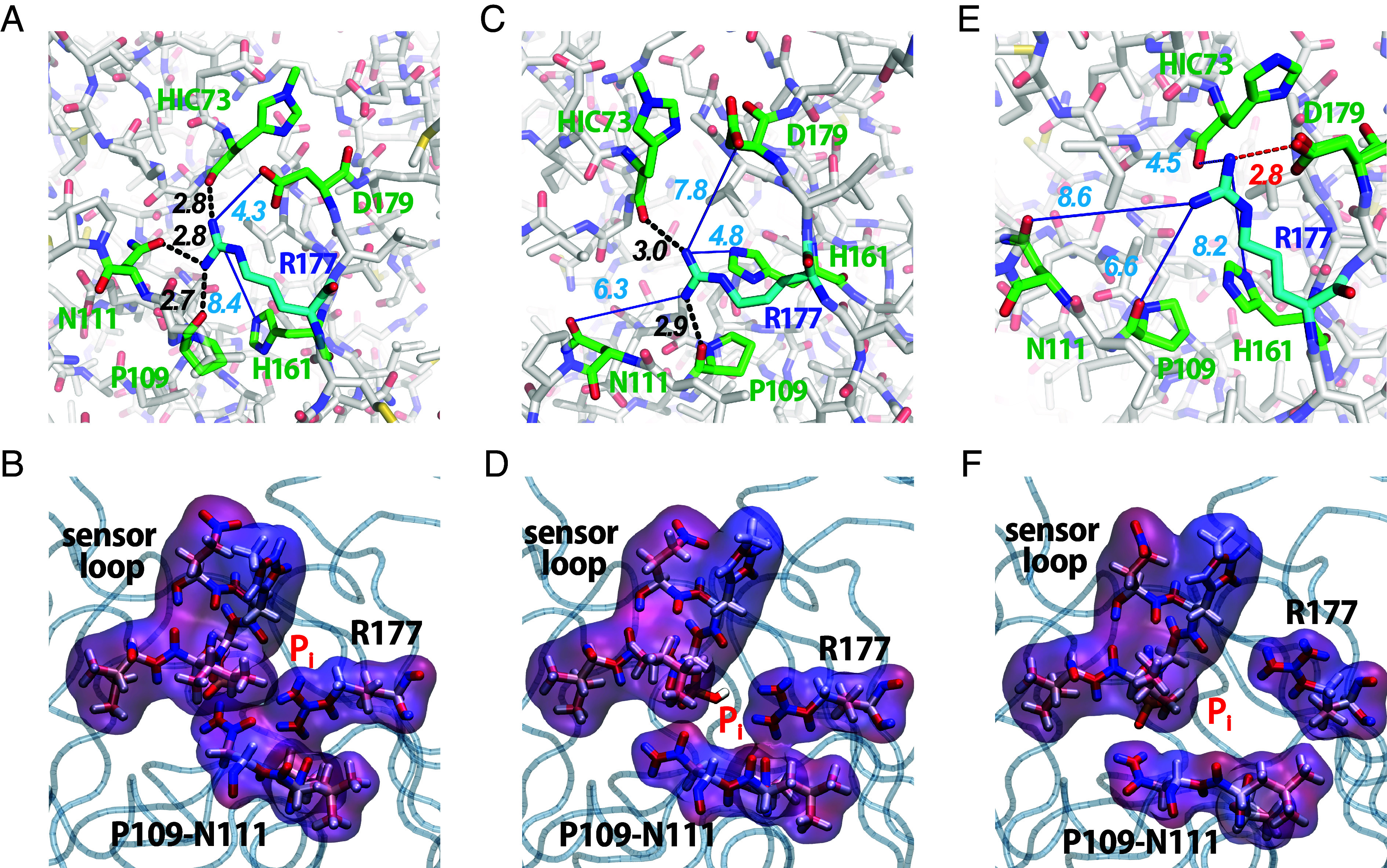
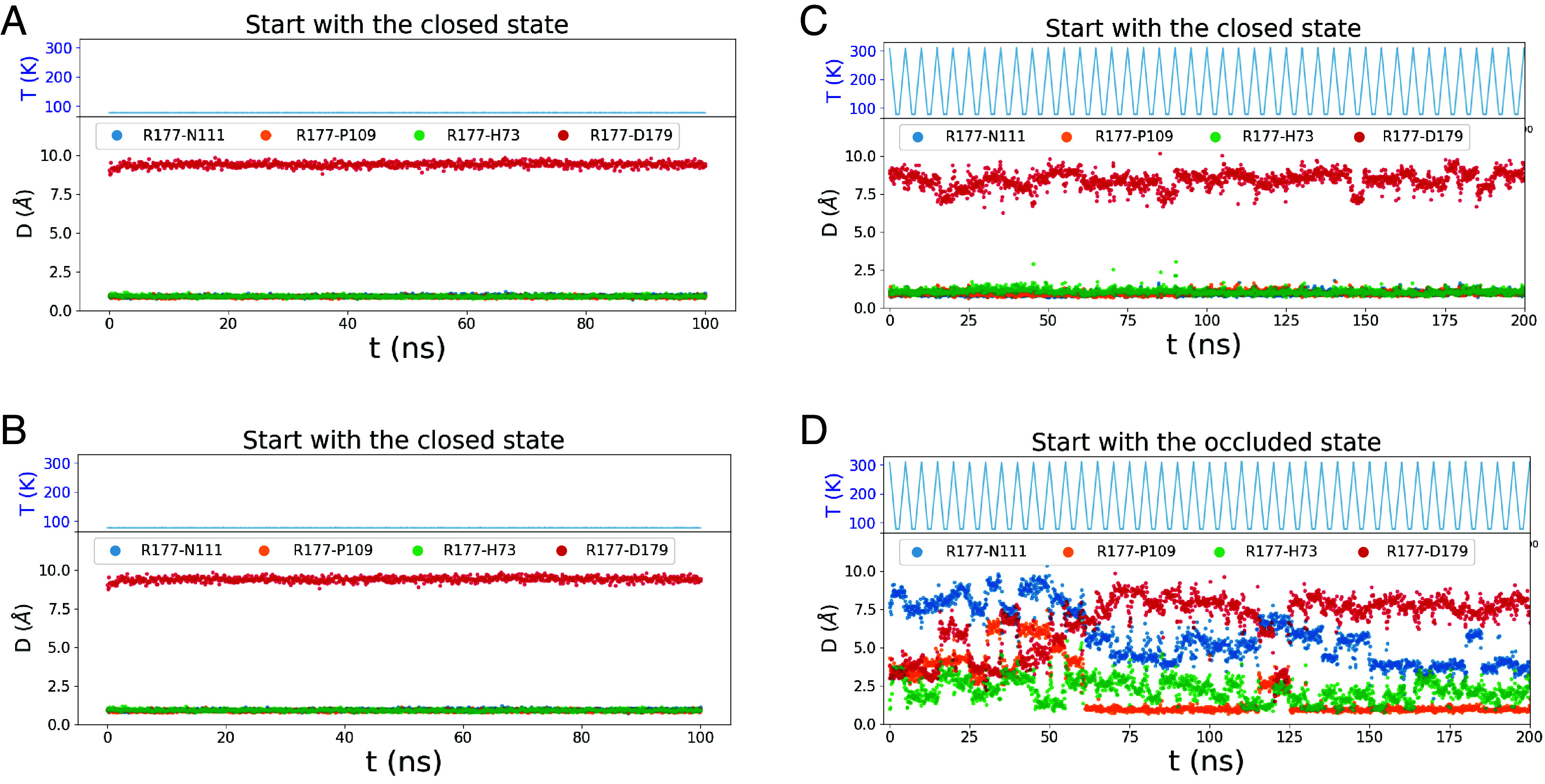
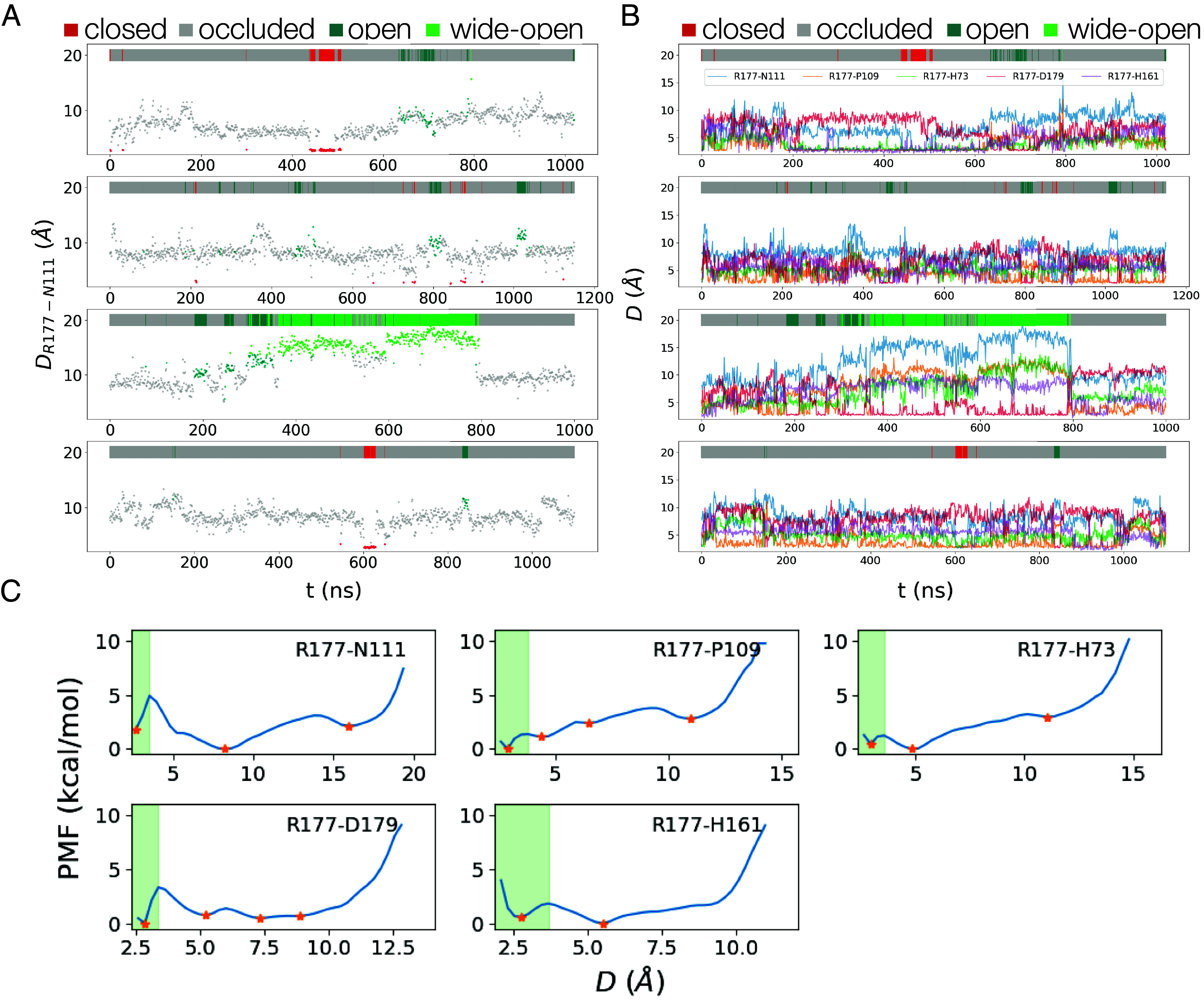
After ATP-actin monomers assemble filaments, the ATP's [Formula: see text]-phosphate is hydrolyzedwithin seconds and dissociates over minutes. We used all-atom molecular dynamics simulations to sample the release of phosphate from filaments and study residues that gate release. Dissociation of phosphate from Mg is rate limiting and associated with an energy barrier of 20 kcal/mol, consistent with experimental rates of phosphate release. Phosphate then diffuses within an internal cavity toward a gate formed by R177, as suggested in prior computational studies and cryo-EM structures. The gate is closed when R177 hydrogen bonds with N111 and is open when R177 forms a salt bridge with D179. Most of the time, interactions of R177 with other residues occlude the phosphate release pathway. Machine learning analysis reveals that the occluding interactions fluctuate rapidly, underscoring the secondary role of backdoor gate opening in P release, in contrast with the previous hypothesis that gate opening is the primary event.
在 ATP-肌动蛋白单体组装成纤维后,ATP 的 [Formula: see text]-磷酸酯在几秒钟内被水解,并在数分钟内解离。我们使用全原子分子动力学模拟来采样从纤维中释放磷酸盐,并研究控制释放的残基。磷酸盐从 Mg 的解离是限速步骤,与 20 kcal/mol 的能量障碍相关,与实验释放磷酸盐的速率一致。然后,磷酸盐在内部空腔内扩散,朝向先前的计算研究和冷冻电镜结构中提出的由 R177 形成的门。当 R177 与 N111 形成氢键时,门关闭,当 R177 与 D179 形成盐桥时,门打开。大多数情况下,R177 与其他残基的相互作用会阻塞磷酸盐释放途径。机器学习分析表明,封闭相互作用迅速波动,突出了后门打开在 P 释放中的次要作用,与先前的假设相反,即门打开是主要事件。