Department of Physics and Research Center OPTIMAS, Technische Universität Kaiserslautern, Erwin-Schrödinger-Strasse, 67663 Kaiserslautern, Germany.
Graduate School Materials Science in Mainz, Staudinger Weg 9, 55128 Mainz, Germany.
Nat Commun. 2017 Jun 5;8:15601. doi: 10.1038/ncomms15601.
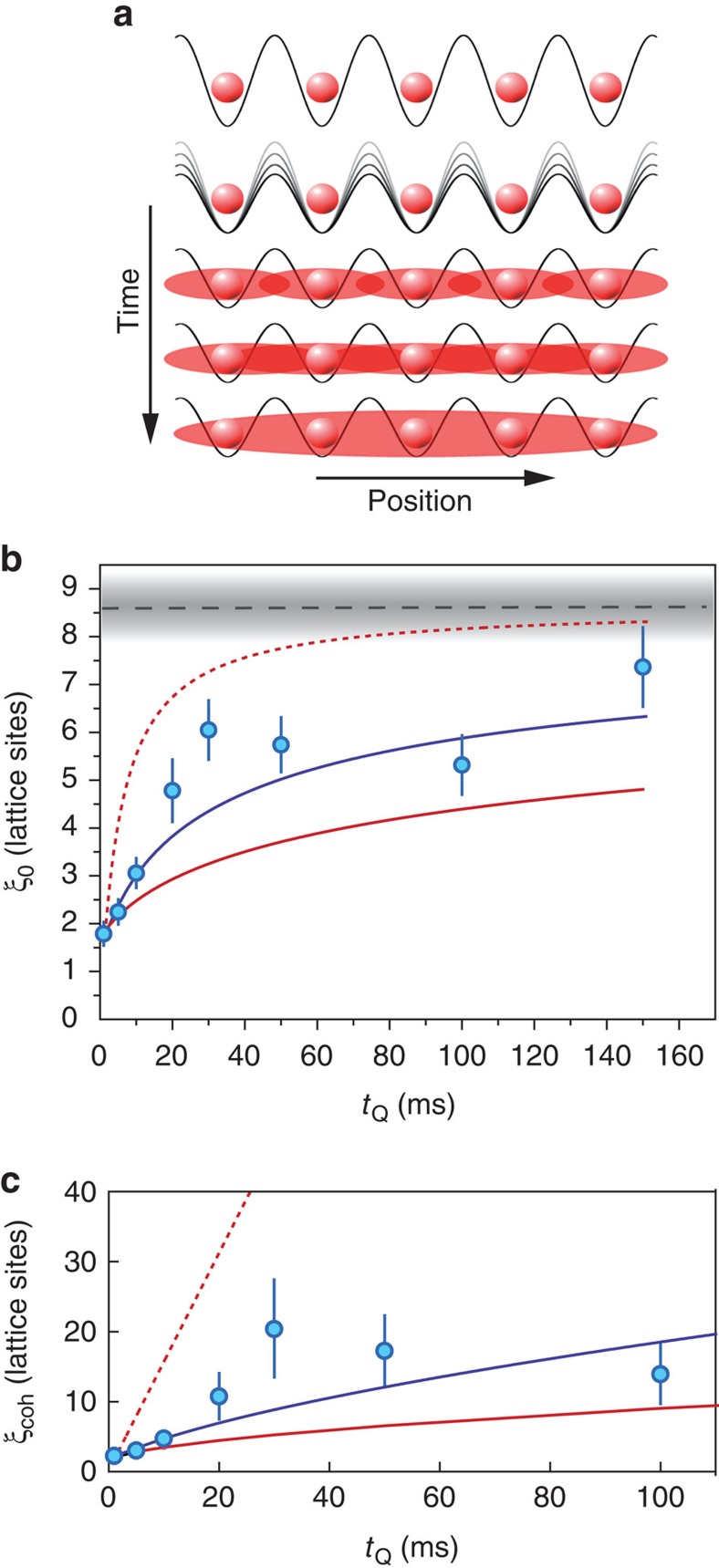
One of the important goals of present research is to control and manipulate coherence in a broad variety of systems, such as semiconductor spintronics, biological photosynthetic systems, superconducting qubits and complex atomic networks. Over the past decades, interferometry of atoms and molecules has proven to be a powerful tool to explore coherence. Here we demonstrate a near-field interferometer based on the Talbot effect, which allows us to measure finite-range phase coherence of ultracold atoms in an optical lattice. We apply this interferometer to study the build-up of phase coherence after a quantum quench of a Bose-Einstein condensate residing in a one-dimensional optical lattice. Our technique of measuring finite-range phase coherence is generic, easy to adopt and can be applied in practically all lattice experiments without further modifications.
目前研究的一个重要目标是控制和操纵广泛的系统中的相干性,如半导体自旋电子学、生物光合作用系统、超导量子位和复杂的原子网络。在过去的几十年中,原子和分子的干涉测量已被证明是探索相干性的一种强大工具。在这里,我们展示了一种基于泰伯效应的近场干涉仪,它使我们能够测量光学晶格中超冷原子的有限范围相位相干性。我们将这种干涉仪应用于研究驻留在一维光学晶格中的玻色-爱因斯坦凝聚体经历量子淬火后相位相干的建立。我们测量有限范围相位相干性的技术是通用的,易于采用,并且可以在实际上所有的晶格实验中应用,而无需进一步修改。