Institut für Laserphysik, Universität Hamburg, Hamburg, Germany.
The Hamburg Centre for Ultrafast Imaging, Hamburg, Germany.
Nature. 2021 Nov;599(7886):571-575. doi: 10.1038/s41586-021-04011-2. Epub 2021 Nov 24.
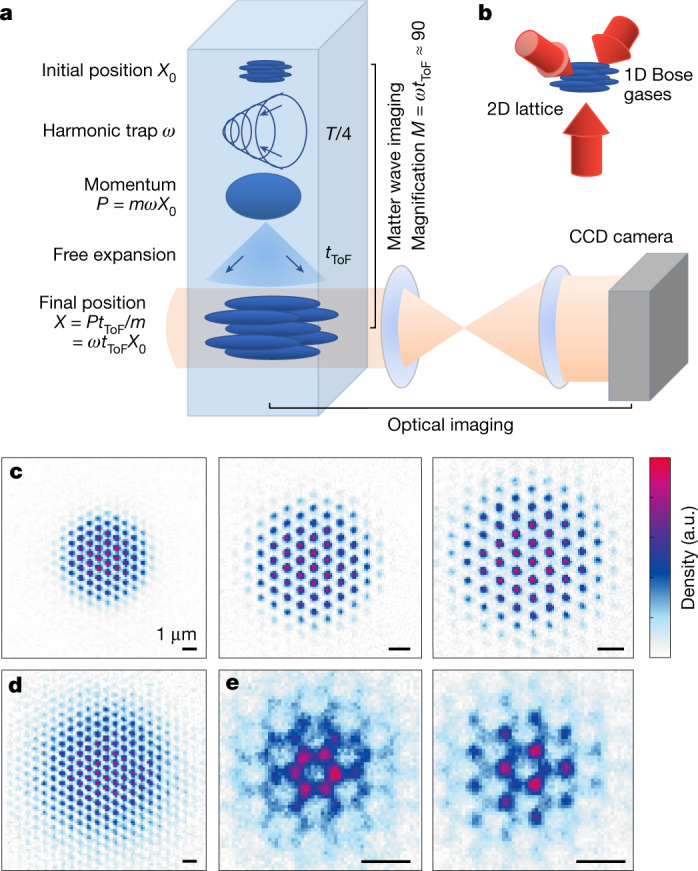
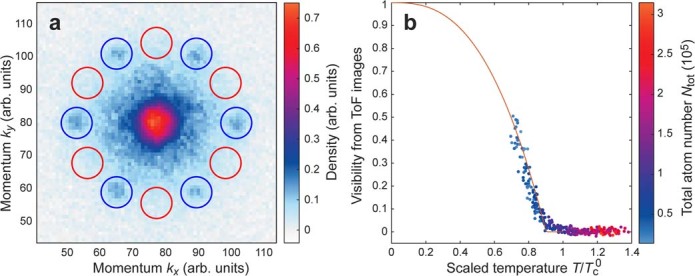
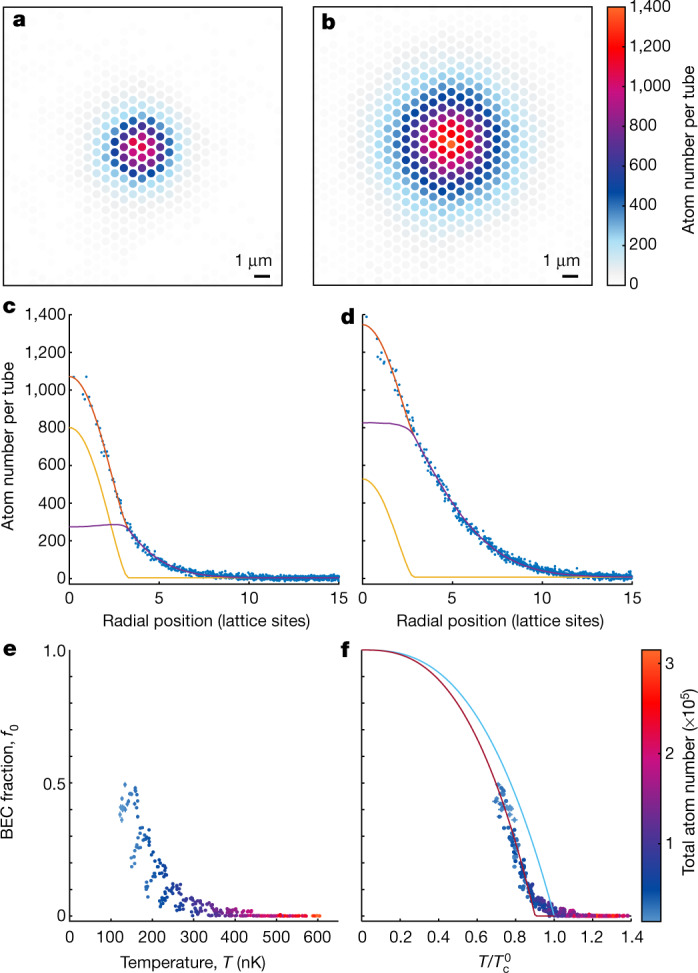
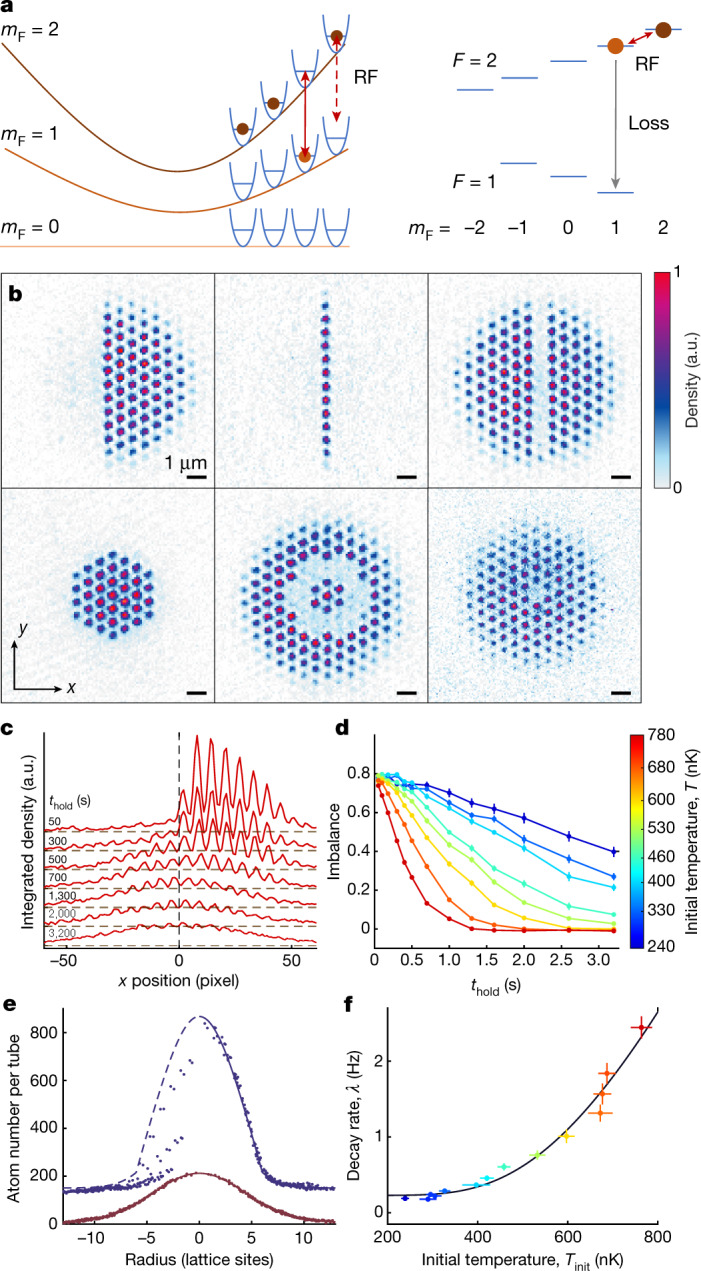
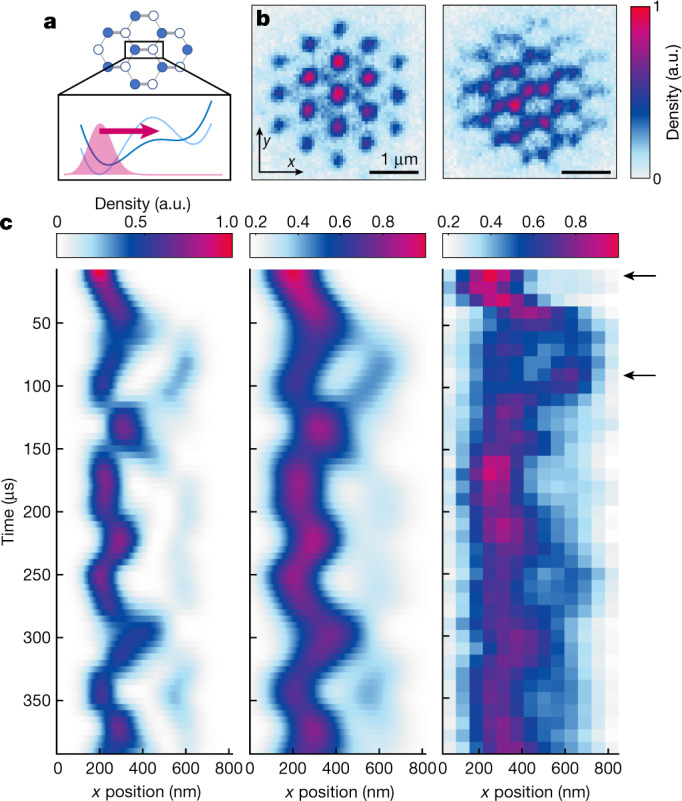
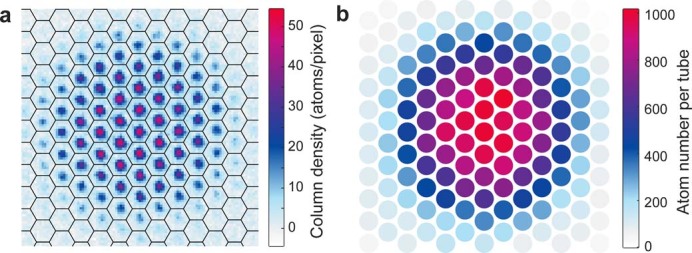
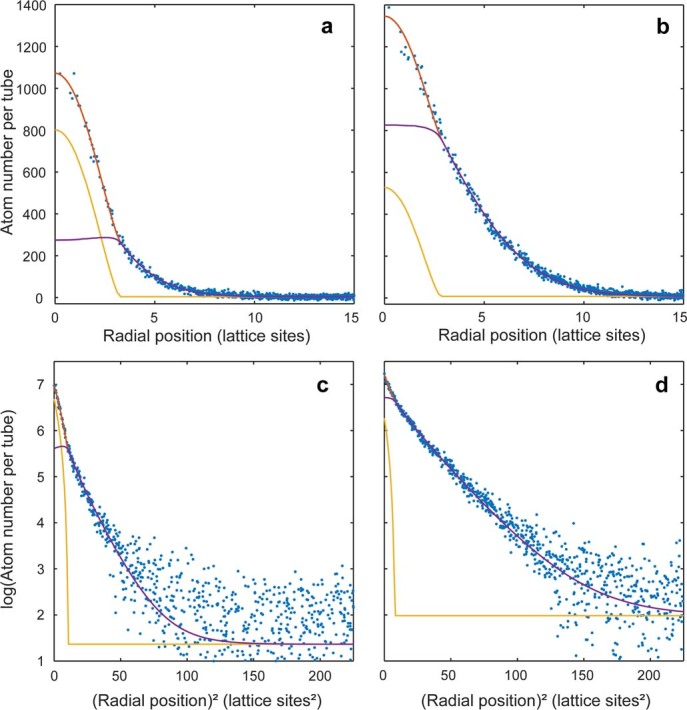
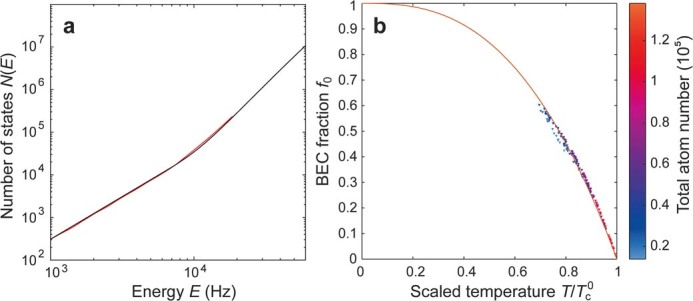
Imaging is central to gaining microscopic insight into physical systems, and new microscopy methods have always led to the discovery of new phenomena and a deeper understanding of them. Ultracold atoms in optical lattices provide a quantum simulation platform, featuring a variety of advanced detection tools including direct optical imaging while pinning the atoms in the lattice. However, this approach suffers from the diffraction limit, high optical density and small depth of focus, limiting it to two-dimensional (2D) systems. Here we introduce an imaging approach where matter wave optics magnifies the density distribution before optical imaging, allowing 2D sub-lattice-spacing resolution in three-dimensional (3D) systems. By combining the site-resolved imaging with magnetic resonance techniques for local addressing of individual lattice sites, we demonstrate full accessibility to 2D local information and manipulation in 3D systems. We employ the high-resolution images for precision thermodynamics of Bose-Einstein condensates in optical lattices as well as studies of thermalization dynamics driven by thermal hopping. The sub-lattice resolution is demonstrated via quench dynamics within the lattice sites. The method opens the path for spatially resolved studies of new quantum many-body regimes, including exotic lattice geometries or sub-wavelength lattices, and paves the way for single-atom-resolved imaging of atomic species, where efficient laser cooling or deep optical traps are not available, but which substantially enrich the toolbox of quantum simulation of many-body systems.
成像技术是深入研究物理系统微观结构的核心手段,而新的显微镜方法总是能够发现新现象并加深对其的理解。光学晶格中的超冷原子为量子模拟提供了一个平台,具有多种先进的检测工具,包括直接光学成像,同时将原子固定在晶格中。然而,这种方法受到衍射极限、高光学密度和小景深的限制,只能用于二维(2D)系统。在这里,我们介绍了一种成像方法,该方法通过物质波光学在光学成像之前对密度分布进行放大,从而在三维(3D)系统中实现 2D 亚晶格间距的分辨率。通过将位分辨成像与用于局部位寻址的磁共振技术相结合,我们实现了在 3D 系统中对 2D 局域信息和操控的完全访问。我们利用高分辨率图像对光学晶格中的玻色-爱因斯坦凝聚体进行了精确的热力学研究,并对热跃迁驱动的热化动力学进行了研究。通过晶格位的淬火动力学来演示亚晶格分辨率。该方法为新的量子多体态的空间分辨研究开辟了道路,包括奇异的晶格几何形状或亚波长晶格,并为原子种类的单原子分辨成像铺平了道路,在这种情况下,有效的激光冷却或深光学陷阱不可用,但这极大地丰富了多体系统量子模拟的工具包。