Won Daeyoun David, Lee Jae Im, Lee In Kyu, Oh Seong-Taek, Jung Eun Sun, Lee Sung Hak
Department of Surgery, Seoul St. Mary's Hospital, College of Medicine, The Catholic University of Korea, Seoul, Republic of Korea.
Department of Surgery, Uijeongbu St. Mary's Hospital, College of Medicine, The Catholic University of Korea, Seoul, Republic of Korea.
BMC Cancer. 2017 Jun 5;17(1):403. doi: 10.1186/s12885-017-3381-7.
BRAF and KRAS mutations are well-established biomarkers in anti-EGFR therapy. However, the prognostic significance of these mutations is still being examined. We determined the prognostic value of BRAF and KRAS mutations in Korean colorectal cancer (CRC) patients.
From July 2010 to September 2013, 1096 patients who underwent surgery for CRC at Seoul St. Mary's Hospital were included in the analysis. Resected specimens were examined for BRAF, KRAS, and microsatellite instability (MSI) status. All data were reviewed retrospectively.
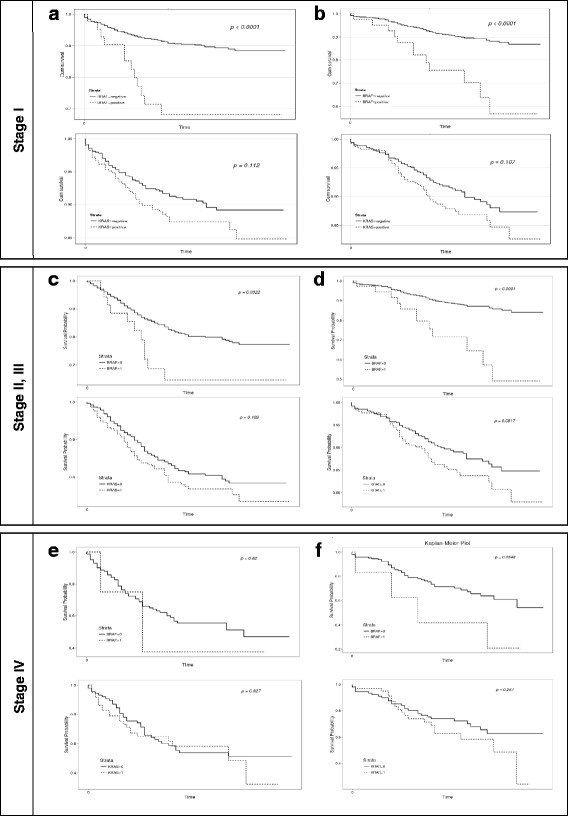
Among 1096 patients, 401 (36.7%) had KRAS mutations and 44 (4.0%) had BRAF mutations. Of 83 patients, 77 (92.8%) had microsatellite stable (MSS) or MSI low (MSI-L) status while 6 (7.2%) patients had MSI high (MSI-H) status. Patients with BRAF mutation demonstrated a worse disease-free survival (DFS, HR 1.990, CI 1.080-3.660, P = 0.02) and overall survival (OS, HR 3.470, CI 1.900-6.330, P < 0.0001). Regarding KRAS status, no significant difference was noted in DFS (P = 0.0548) or OS (P = 0.107). Comparing the MSS/MSI-L and MSI-H groups there were no significant differences in either DFS (P = 0.294) or OS (P = 0.557).
BRAF mutation, rather than KRAS, was a significant prognostic factor in Korean CRC patients at both early and advanced stages. The subgroup analysis for MSI did not show significant differences in clinical outcome. BRAF should be included in future larger prospective biomarker studies on CRC.
BRAF和KRAS突变是抗表皮生长因子受体(EGFR)治疗中公认的生物标志物。然而,这些突变的预后意义仍在研究中。我们确定了BRAF和KRAS突变在韩国结直肠癌(CRC)患者中的预后价值。
2010年7月至2013年9月,在首尔圣玛丽医院接受CRC手术的1096例患者纳入分析。对切除标本进行BRAF、KRAS和微卫星不稳定性(MSI)状态检测。所有数据均进行回顾性审查。
1096例患者中,401例(36.7%)有KRAS突变,44例(4.0%)有BRAF突变。83例患者中,77例(92.8%)为微卫星稳定(MSS)或微卫星低度不稳定(MSI-L)状态,6例(7.2%)为微卫星高度不稳定(MSI-H)状态。BRAF突变患者的无病生存期(DFS,风险比[HR]1.990,可信区间[CI]1.080 - 3.660,P = 0.02)和总生存期(OS,HR 3.470,CI 1.900 - 6.330,P < 0.0001)较差。关于KRAS状态,DFS(P = 0.0548)或OS(P = 0.107)无显著差异。比较MSS/MSI-L组和MSI-H组,DFS(P = 0.294)或OS(P = 0.557)均无显著差异。
在韩国CRC患者的早期和晚期,BRAF突变而非KRAS突变是一个重要的预后因素。MSI亚组分析未显示临床结局有显著差异。BRAF应纳入未来更大规模的CRC前瞻性生物标志物研究中。