Ye Hongjian, Zhou Qian, Fan Li, Guo Qunying, Mao Haiping, Huang Fengxian, Yu Xueqing, Yang Xiao
Department of Nephrology, The First Affiliated Hospital, Sun Yat-sen University, 58th, Zhongshan Road II, Guangzhou, 510080, China.
Key Laboratory of Nephrology, Ministry of Health, Guangzhou, 510080, China.
BMC Nephrol. 2017 Jun 5;18(1):186. doi: 10.1186/s12882-017-0588-4.
Results concerning the association between peritoneal dialysis-related peritonitis and mortality in peritoneal dialysis patients are inconclusive, with one potential reason being that the time-dependent effect of peritonitis has rarely been considered in previous studies. This study aimed to evaluate whether peritonitis has a negative impact on mortality in a large cohort of peritoneal dialysis patients. We also assessed the changing impact of peritonitis on patient mortality with respect to duration of follow-up.
This retrospective cohort study included incident patients who started peritoneal dialysis from 1 January 2006 to 31 December 2011. Episodes of peritonitis were recorded at the time of onset, and peritonitis was parameterized as a time-dependent variable for analysis. We used the Cox regression model to assess whether peritonitis has a negative impact on mortality.
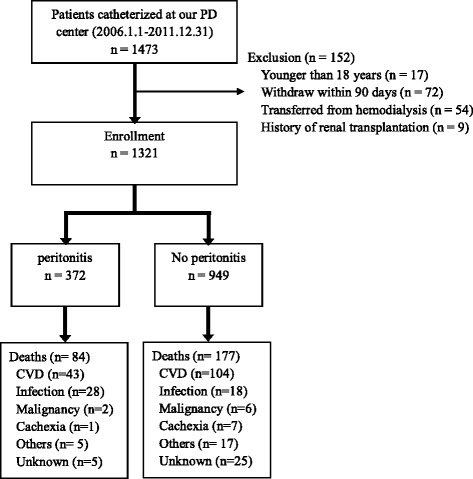
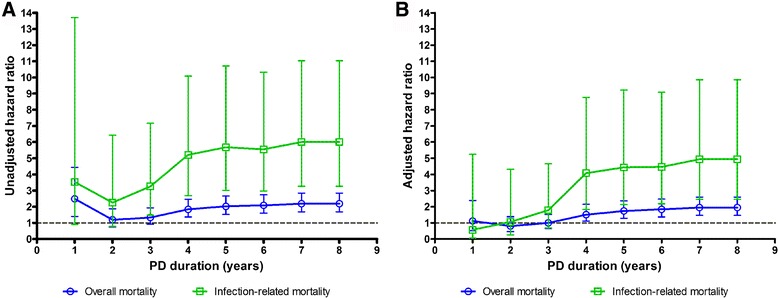
A total of 1321 patients were included. The mean age was 48.1 ± 15.3 years, 41.3% were female, and 23.5% with diabetes mellitus. The median (interquartile) follow-up time was 34 (21-48) months. After adjusting for confounders, peritonitis was independently associated with 95% increased risk of all-cause mortality (hazard ratio, 1.95; 95% confidence interval: 1.46-2.60), 90% increased risk of cardiovascular mortality (hazard ratio, 1.90; 95% confidence interval: 1.28-2.81) and near 4-fold increased risk of infection-related mortality (hazard ratio, 4.94; 95% confidence interval: 2.47-9.86). Further analyses showed that peritonitis was not significantly associated with mortality within 2 years of peritoneal dialysis initiation, but strongly influenced mortality in patients dialysed longer than 2 years.
Peritonitis was independently associated with higher risk of all-cause, cardiovascular and infection-related mortality in peritoneal dialysis patients, and its impact on mortality was more significant in patients with longer peritoneal dialysis duration.
关于腹膜透析相关腹膜炎与腹膜透析患者死亡率之间关联的研究结果尚无定论,一个潜在原因是以往研究很少考虑腹膜炎的时间依赖性效应。本研究旨在评估腹膜炎对一大群腹膜透析患者的死亡率是否有负面影响。我们还评估了腹膜炎对患者死亡率的影响随随访时间的变化情况。
这项回顾性队列研究纳入了2006年1月1日至2011年12月31日开始腹膜透析的新发病例患者。腹膜炎发作时进行记录,并将腹膜炎作为时间依赖性变量进行参数化分析。我们使用Cox回归模型评估腹膜炎对死亡率是否有负面影响。
共纳入1321例患者。平均年龄为48.1±15.3岁,41.3%为女性,23.5%患有糖尿病。中位(四分位间距)随访时间为34(21 - 48)个月。在调整混杂因素后,腹膜炎与全因死亡率风险增加95%独立相关(风险比,1.95;95%置信区间:1.46 - 2.60),与心血管死亡率风险增加90%独立相关(风险比,1.90;95%置信区间:1.28 - 2.81),与感染相关死亡率风险增加近4倍独立相关(风险比,4.94;95%置信区间:2.47 - 9.86)。进一步分析表明,腹膜炎在腹膜透析开始后2年内与死亡率无显著关联,但对透析时间超过2年的患者死亡率有强烈影响。
腹膜炎与腹膜透析患者全因、心血管和感染相关死亡率的较高风险独立相关,且其对死亡率的影响在腹膜透析时间较长的患者中更为显著。