Saadé Antoine, Baron Pascal, Noujeim Ziad, Azar Dany
Department of Orthodontics, Lebanese University, School of Dentistry, Beirut, Lebanon.
Laboratoire AMIS UMR 5288 CNRS, Paul Sabatier University, and Department of Orthodontics, Faculty of Dental Surgery, Toulouse, France.
J Int Soc Prev Community Dent. 2017 May-Jun;7(3):90-97. doi: 10.4103/jispcd.JISPCD_139_17. Epub 2017 May 22.
Assessing dental and bone ages is frequently required in a wide range of fields such as odontology, forensic science, as well as orthopedics. The aim of this study was to evaluate applicability of two methods of bone age assessment and two methods of dental age (DA) assessment for Lebanese children.
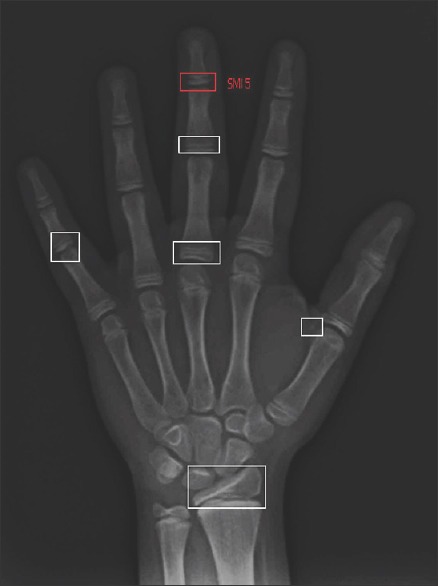
Skeletal age (SA) of 260 orthodontic patients (124 males, 136 females divided into four groups each) was consecutively assessed using Greulich and Pyle and Fishman's SMI methods. DA was evaluated using both Demirjian's and Willem's methods. Mean age was 11.89 ± 1.38 years for males and 11.75 ± 1.58 years for females. Data were collected and statistically analyzed using the SPSS software (IBM SPSS Statistics, version 21, USA). The differences between estimated DA, estimated SA, and chronological age (CA) were compared by gender and age group.
Greulich and Pyle method showed nonsignificant difference with CA in male sample, while in both assessment methods, the difference between skeletal and CAs is significant in female sample. Results of Willem's method in the whole sample suggested a statistically nonsignificant difference, when compared to CA. Demirjian's method delivered higher mean value than Willem's assessment in both genders.
Greulich and Pyle method is accurate for SA assessment in males and only in one group of females, while it significantly overestimates age in all other female groups. Willem's method is more suitable to assess DA in both genders. A strong correlation exists between both dental and skeletal assessment methods and CA.
在牙科学、法医学以及矫形外科学等众多领域,常常需要评估牙齿年龄和骨骼年龄。本研究的目的是评估两种骨骼年龄评估方法和两种牙齿年龄(DA)评估方法对黎巴嫩儿童的适用性。
连续使用格氏和派氏法以及菲什曼的SMI法评估260例正畸患者(124名男性,136名女性,各分为四组)的骨骼年龄(SA)。使用德米尔坚法和威廉姆斯法评估DA。男性的平均年龄为11.89±1.38岁,女性为11.75±1.58岁。使用SPSS软件(美国IBM SPSS Statistics 21版)收集数据并进行统计分析。按性别和年龄组比较估计的DA、估计的SA和实足年龄(CA)之间的差异。
格氏和派氏法在男性样本中与CA的差异无统计学意义,而在两种评估方法中,女性样本中骨骼年龄与CA之间的差异有统计学意义。在整个样本中,威廉姆斯法的结果与CA相比差异无统计学意义。德米尔坚法在两性中的平均值均高于威廉姆斯法的评估值。
格氏和派氏法在男性以及仅一组女性中对SA评估准确,而在所有其他女性组中显著高估年龄。威廉姆斯法更适合评估两性的DA。牙齿和骨骼评估方法与CA之间均存在强相关性。