Ozkaya Akagunduz Ozlem, Guven Yilmaz Suzan, Yalman Deniz, Yuce Berna, Demirkilinc Biler Elif, Afrashi Filiz, Esassolak Mustafa
Ege University Faculty of Medicine, Department of Radiation Oncology, Izmir, Turkey.
Ege University Faculty of Medicine, Department of Ophthalmology, Izmir, Turkey.
Technol Cancer Res Treat. 2017 Dec;16(6):969-977. doi: 10.1177/1533034617711613. Epub 2017 Jun 6.
To evaluate the radiation dose-volume effects of optic nerves and chiasm by visual psychophysical, electrophysiologic tests, and optical coherence tomography in patients with locally advanced nasopharyngeal carcinoma.
A series of visual tests including visual acuity, visual field, contrast sensitivity, visual evoked potential, and optical coherence tomography were administered to 20 patients with locally advanced (T3-T4) nasopharyngeal carcinoma who were treated with definitive chemoradiotherapy. Volume that received 55 Gy (V), mean dose (), highest dose to 5% of the volume (D), and maximum dose (D) for optic nerves and chiasm were evaluated for each patient. Cutoff values were identified as V: 50%, D: 50 Gy, D: 55 Gy, and D: 60 Gy. The effects of radiation dose-volume on ophthalmologic tests were evaluated.
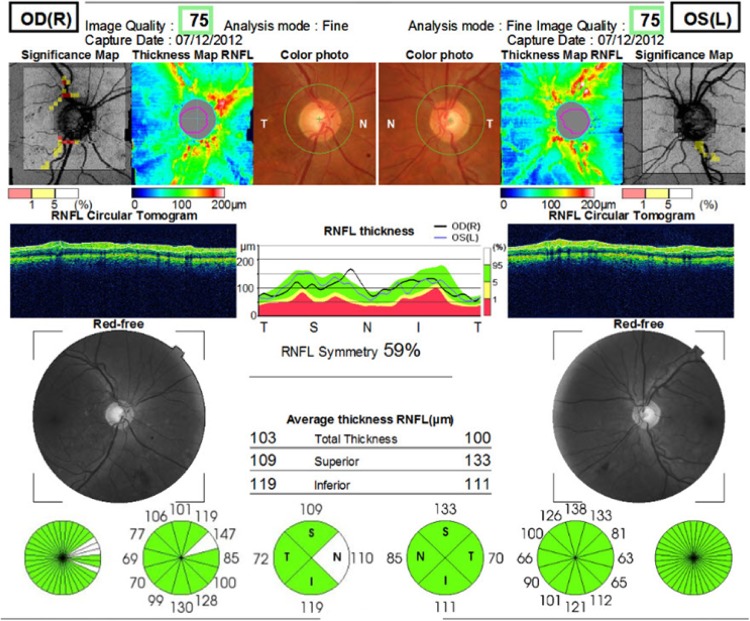
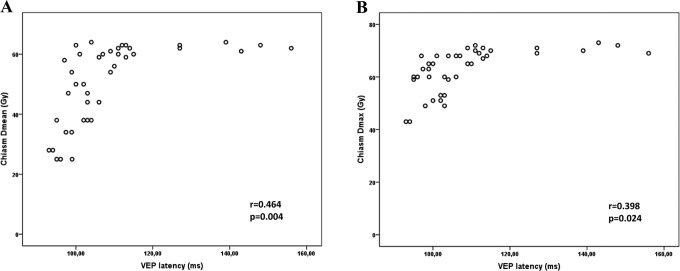
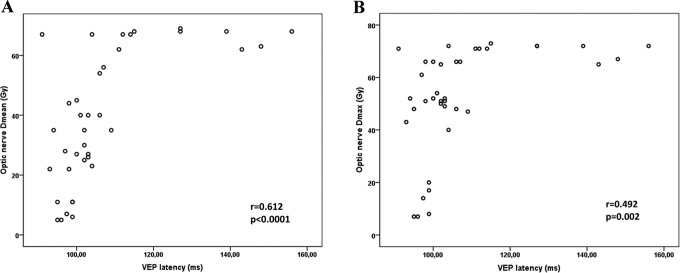
Ophthalmological evaluation revealed optic neuropathy with simultaneous retinopathy in 6 eyes of 4 patients and radiation retinopathy alone in both eyes of 1 patient. Regarding radiation dose-volume effects of the optic nerve, significant detrimental effect of all parameters was observed on visual acuity. Visual field and contrast sensitivity were affected significantly with V ≥ 50% and D ≥ 50 Gy. Visual evoked potential latency was affected significantly with D ≥ 50 Gy, D ≥ 55 Gy, and D ≥ 60 Gy. For the chiasm, significant detrimental effect of all parameters was observed on visual acuity as well. Retinal nerve fiber layer thickness and visual evoked potential amplitude were not affected by any of the dose-volume parameters neither optic nerves nor chiasm.
The volume receiving the threshold dose, mean dose, and 5% of the volume receiving the maximum dose are important parameters besides maximum dose to optic nerves and chiasm. A comprehensive ophthalmological evaluation including visual field, contrast sensitivity, visual evoked potential latency, and amplitude should be performed for these patients. Visual evoked potential latency is an objective predictor of vision loss before the onset of clinical signs.
通过视觉心理物理学、电生理测试以及光学相干断层扫描,评估局部晚期鼻咽癌患者视神经和视交叉的放射剂量 - 体积效应。
对20例接受确定性放化疗的局部晚期(T3 - T4)鼻咽癌患者进行了一系列视觉测试,包括视力、视野、对比敏感度、视觉诱发电位以及光学相干断层扫描。评估了每位患者视神经和视交叉接受55 Gy的体积(V)、平均剂量()、体积的5%所接受的最高剂量(D)以及最大剂量(D)。将截断值确定为V:50%,D:50 Gy,D:55 Gy,D:60 Gy。评估了放射剂量 - 体积对眼科测试的影响。
眼科评估显示,4例患者的6只眼中存在视神经病变并伴有视网膜病变,1例患者的双眼单独出现放射性视网膜病变。关于视神经的放射剂量 - 体积效应,所有参数对视力均有显著的有害影响。当V≥50%且D≥50 Gy时,视野和对比敏感度受到显著影响。当D≥50 Gy、D≥55 Gy以及D≥60 Gy时,视觉诱发电位潜伏期受到显著影响。对视交叉而言,所有参数对视力也有显著的有害影响。视网膜神经纤维层厚度和视觉诱发电位振幅均未受视神经和视交叉的任何剂量 - 体积参数影响。
除了视神经和视交叉的最大剂量外,接受阈值剂量的体积、平均剂量以及接受最大剂量的5%的体积是重要参数。应对这些患者进行包括视野、对比敏感度、视觉诱发电位潜伏期和振幅在内的全面眼科评估。视觉诱发电位潜伏期是临床症状出现前视力丧失的客观预测指标。