Morel Pierre, Ulbrich Philipp, Gail Alexander
German Primate Center, Sensorimotor Group, Göttingen, Germany.
University of Goettingen, Georg-Elias-Mueller Institute of Psychology, Göttingen, Germany.
PLoS Biol. 2017 Jun 6;15(6):e2001323. doi: 10.1371/journal.pbio.2001323. eCollection 2017 Jun.
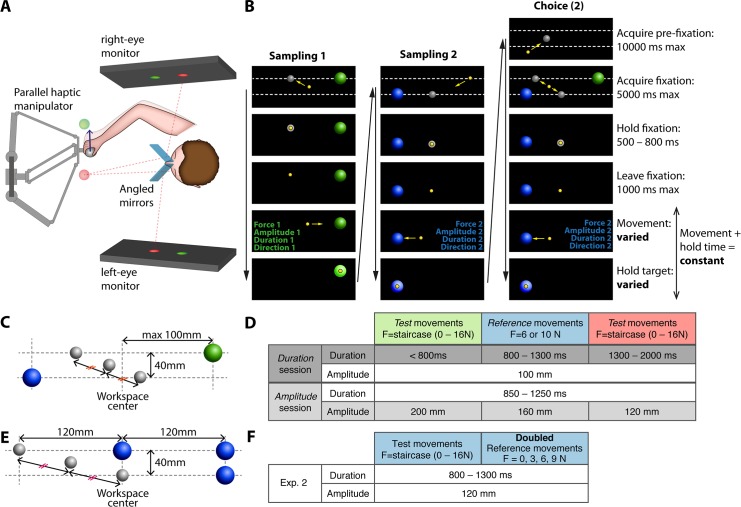
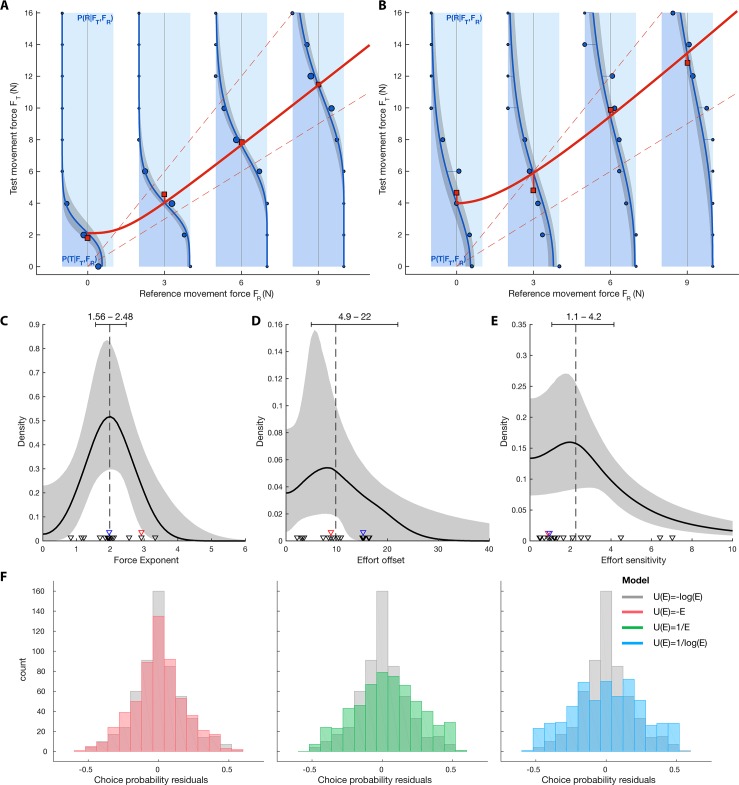
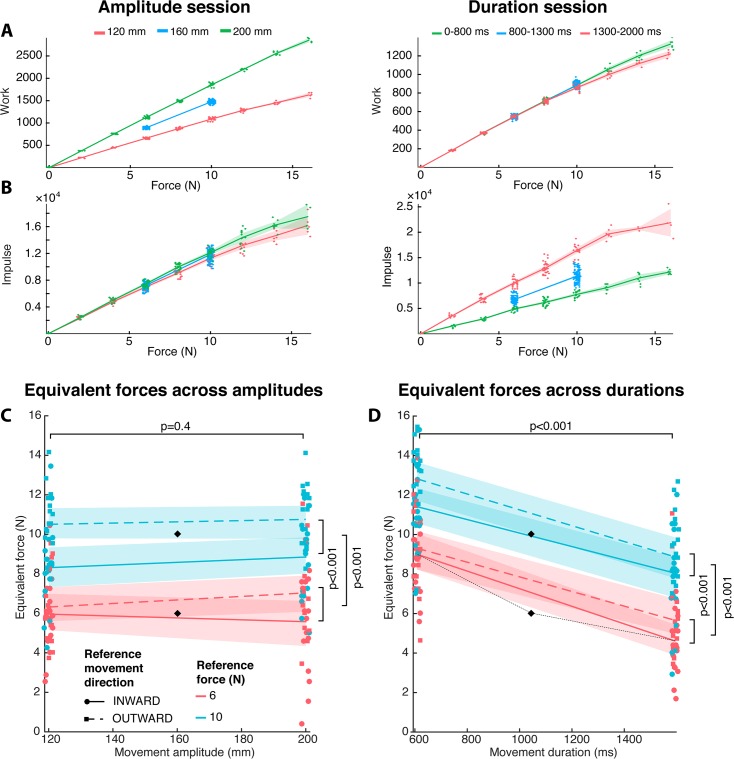
When deciding between alternative options, a rational agent chooses on the basis of the desirability of each outcome, including associated costs. As different options typically result in different actions, the effort associated with each action is an essential cost parameter. How do humans discount physical effort when deciding between movements? We used an action-selection task to characterize how subjective effort depends on the parameters of arm transport movements and controlled for potential confounding factors such as delay discounting and performance. First, by repeatedly asking subjects to choose between 2 arm movements of different amplitudes or durations, performed against different levels of force, we identified parameter combinations that subjects experienced as identical in effort (isoeffort curves). Movements with a long duration were judged more effortful than short-duration movements against the same force, while movement amplitudes did not influence effort. Biomechanics of the movements also affected effort, as movements towards the body midline were preferred to movements away from it. Second, by introducing movement repetitions, we further determined that the cost function for choosing between effortful movements had a quadratic relationship with force, while choices were made on the basis of the logarithm of these costs. Our results show that effort-based action selection during reaching cannot easily be explained by metabolic costs. Instead, force-loaded reaches, a widely occurring natural behavior, imposed an effort cost for decision making similar to cost functions in motor control. Our results thereby support the idea that motor control and economic choice are governed by partly overlapping optimization principles.
在决定备选方案时,理性主体会根据每个结果的可取性进行选择,包括相关成本。由于不同的选择通常会导致不同的行动,与每个行动相关的努力是一个重要的成本参数。在决定行动时,人类如何权衡体力消耗呢?我们使用了一个行动选择任务来描述主观努力如何依赖于手臂运输运动的参数,并控制了潜在的混杂因素,如延迟折扣和表现。首先,通过反复要求受试者在不同幅度或持续时间的两种手臂运动之间进行选择,这些运动是在不同的力水平下进行的,我们确定了受试者感觉努力程度相同的参数组合(等努力曲线)。在相同的力下,持续时间长的运动比持续时间短的运动被认为更费力,而运动幅度并不影响努力程度。运动的生物力学也会影响努力程度,因为朝向身体中线的运动比远离中线的运动更受青睐。其次,通过引入运动重复,我们进一步确定,在费力运动之间进行选择的成本函数与力呈二次关系,而选择是基于这些成本的对数做出的。我们的结果表明,在伸手过程中基于努力的行动选择不能轻易地用代谢成本来解释。相反,负重伸手,一种广泛存在的自然行为,在决策时施加了一种类似于运动控制中的成本函数的努力成本。因此,我们的结果支持了这样一种观点,即运动控制和经济选择受部分重叠的优化原则支配。