Zhang Hui, Zeng Xianshang, Zhang Nan, Zeng Dan, Xu Ping, Zhang Lili, Chen Deng, Yu Weiguang, Zhang Xinchao
1 Emergency Department, The First Affiliated Hospital of Sun Yat-sen University, Huangpu District, Guangzhou, Guangdong, China.
2 Department of Orthopedics, The First Affiliated Hospital of Sun Yat-sen University, Huangpu District, Guangzhou, Guangdong, China.
J Int Med Res. 2017 Aug;45(4):1297-1309. doi: 10.1177/0300060517710584. Epub 2017 Jun 6.
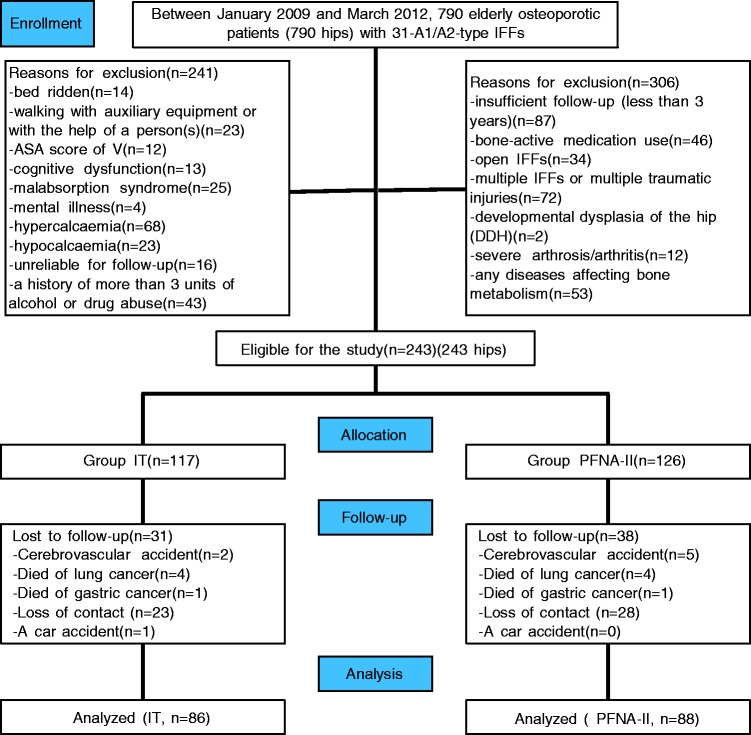
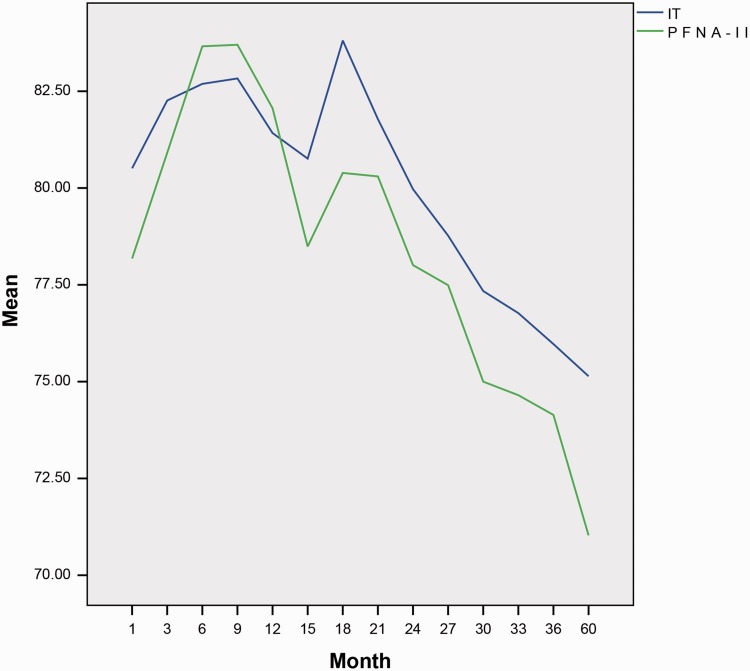
Objectives To compare the long-term functional and radiographic outcomes of the proximal femoral nail antirotation-Asia (PFNA-II) and INTERTAN nail (IT) in the management of intertrochanteric femoral fractures (IFFs) (AO/OTA Type 31A1.1-A2.3) in elderly patients with primary osteoporosis. Methods A retrospective comparative study was performed in our institution. From January 2009 to March 2012, 243 patients with osteoporosis (243 hips) with IFFs (AO/OTA Type 3.1A1.1-A2.3) underwent repair with either a PFNA-II or IT. Follow-up assessments were performed 1, 3, 6, 9, and 12 months postoperatively and every year thereafter. All implant position changes were noted. Patient-related functional outcomes were evaluated based on the Harris hip score. Results In total, 174 patients with osteoporosis (IT, n = 86; PFNA-II, n = 88) were evaluated during a mean follow-up period of 40 months (range, 38-60 months). An increased risk of femoral shaft fracture after implant removal was observed at month 9 of follow-up in 0.0% and 4.4% of the IT and PFNA-II groups, respectively. This difference remained over time with rates of 1.1% and 6.8%, respectively, at the last follow-up. Conclusion The IT nail appears to be a reliable implant in the management of IFFs (AO/OTA Type 3.1A1.1-A2.3) in elderly patients with primary osteoporosis.
目的 比较股骨近端防旋髓内钉亚洲版(PFNA-II)与INTERTAN髓内钉(IT)治疗老年原发性骨质疏松性股骨转子间骨折(IFFs,AO/OTA 31A1.1-A2.3型)的长期功能和影像学结果。方法 在我们机构进行了一项回顾性比较研究。2009年1月至2012年3月,243例患有骨质疏松症(243髋)的IFFs(AO/OTA 3.1A1.1-A2.3型)患者接受了PFNA-II或IT治疗。术后1、3、6、9和12个月以及此后每年进行随访评估。记录所有植入物位置变化。基于Harris髋关节评分评估患者相关功能结果。结果 总共174例骨质疏松症患者(IT组,n = 86;PFNA-II组,n = 88)在平均40个月(范围38 - 60个月)的随访期内接受了评估。随访第9个月时,IT组和PFNA-II组分别有0.0%和4.4%的患者在取出植入物后发生股骨干骨折风险增加。随着时间推移,这种差异仍然存在,末次随访时发生率分别为1.1%和6.8%。结论 IT髓内钉似乎是治疗老年原发性骨质疏松性IFFs(AO/OTA 3.1A1.1-A2.3型)的可靠植入物。