Buscot Marie-Jeanne, Wotherspoon Simon S, Magnussen Costan G, Juonala Markus, Sabin Matthew A, Burgner David P, Lehtimäki Terho, Viikari Jorma S A, Hutri-Kähönen Nina, Raitakari Olli T, Thomson Russell J
Menzies Institute for Medical Research, University of Tasmania, Hobart, Australia.
Institute of Marine and Antarctic Studies, University of Tasmania, Hobart, Australia.
BMC Med Res Methodol. 2017 Jun 6;17(1):86. doi: 10.1186/s12874-017-0358-9.
Bayesian hierarchical piecewise regression (BHPR) modeling has not been previously formulated to detect and characterise the mechanism of trajectory divergence between groups of participants that have longitudinal responses with distinct developmental phases. These models are useful when participants in a prospective cohort study are grouped according to a distal dichotomous health outcome. Indeed, a refined understanding of how deleterious risk factor profiles develop across the life-course may help inform early-life interventions. Previous techniques to determine between-group differences in risk factors at each age may result in biased estimate of the age at divergence.
We demonstrate the use of Bayesian hierarchical piecewise regression (BHPR) to generate a point estimate and credible interval for the age at which trajectories diverge between groups for continuous outcome measures that exhibit non-linear within-person response profiles over time. We illustrate our approach by modeling the divergence in childhood-to-adulthood body mass index (BMI) trajectories between two groups of adults with/without type 2 diabetes mellitus (T2DM) in the Cardiovascular Risk in Young Finns Study (YFS).
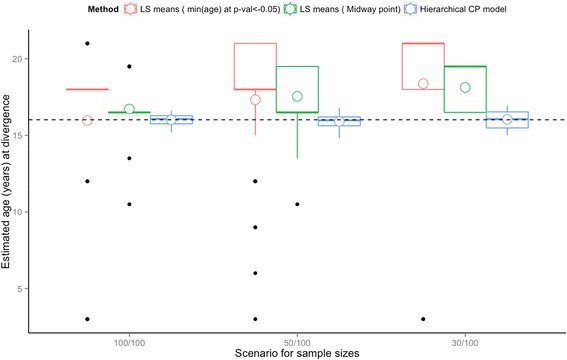
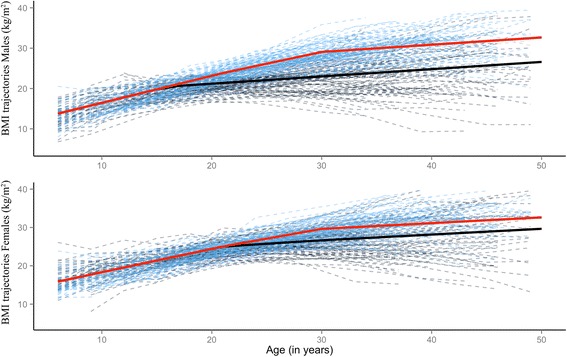
Using the proposed BHPR approach, we estimated the BMI profiles of participants with T2DM diverged from healthy participants at age 16 years for males (95% credible interval (CI):13.5-18 years) and 21 years for females (95% CI: 19.5-23 years). These data suggest that a critical window for weight management intervention in preventing T2DM might exist before the age when BMI growth rate is naturally expected to decrease. Simulation showed that when using pairwise comparison of least-square means from categorical mixed models, smaller sample sizes tended to conclude a later age of divergence. In contrast, the point estimate of the divergence time is not biased by sample size when using the proposed BHPR method.
BHPR is a powerful analytic tool to model long-term non-linear longitudinal outcomes, enabling the identification of the age at which risk factor trajectories diverge between groups of participants. The method is suitable for the analysis of unbalanced longitudinal data, with only a limited number of repeated measures per participants and where the time-related outcome is typically marked by transitional changes or by distinct phases of change over time.
贝叶斯分层分段回归(BHPR)模型此前尚未用于检测和描述具有不同发育阶段纵向反应的参与者群体之间轨迹差异的机制。当在一项前瞻性队列研究中,参与者根据远端二分健康结局进行分组时,这些模型很有用。事实上,对有害风险因素谱在整个生命过程中如何发展的更精确理解可能有助于为早期干预提供信息。以前用于确定各年龄组间风险因素差异的技术可能会导致对差异出现年龄的估计有偏差。
我们展示了使用贝叶斯分层分段回归(BHPR)为连续结局指标生成差异出现年龄的点估计和可信区间,这些指标随时间呈现非线性的个体内反应曲线。我们通过对芬兰青年人心血管风险研究(YFS)中两组有/无2型糖尿病(T2DM)的成年人从儿童期到成年期体重指数(BMI)轨迹差异进行建模来说明我们的方法。
使用所提出的BHPR方法,我们估计男性T2DM参与者的BMI曲线在16岁时与健康参与者出现差异(95%可信区间(CI):13.5 - 18岁),女性在21岁时出现差异(95%CI:19.5 - 23岁)。这些数据表明,在自然预期BMI增长率下降的年龄之前,可能存在预防T2DM体重管理干预的关键窗口期。模拟显示,当使用分类混合模型的最小二乘均值进行成对比较时,较小样本量往往得出差异出现较晚的年龄。相比之下,使用所提出的BHPR方法时,差异时间的点估计不受样本量影响。
BHPR是一种强大的分析工具,可用于对长期非线性纵向结局进行建模,能够识别参与者群体之间风险因素轨迹出现差异的年龄。该方法适用于分析不平衡的纵向数据,每个参与者只有有限数量的重复测量,且时间相关结局通常以过渡性变化或随时间的不同变化阶段为特征。