To Kelvin Kw, Lu Lu, Yip Cyril Cy, Poon Rosana Ws, Fung Ami My, Cheng Andrew, Lui Daniel Hk, Ho Deborah Ty, Hung Ivan Fn, Chan Kwok-Hung, Yuen Kwok-Yung
State Key Laboratory for Emerging Infectious Diseases, Li Ka Shing Faculty of Medicine, The University of Hong Kong, Hong Kong, China.
Carol Yu Centre for Infection, Li Ka Shing Faculty of Medicine, The University of Hong Kong, Hong Kong, China.
Emerg Microbes Infect. 2017 Jun 7;6(6):e49. doi: 10.1038/emi.2017.35.
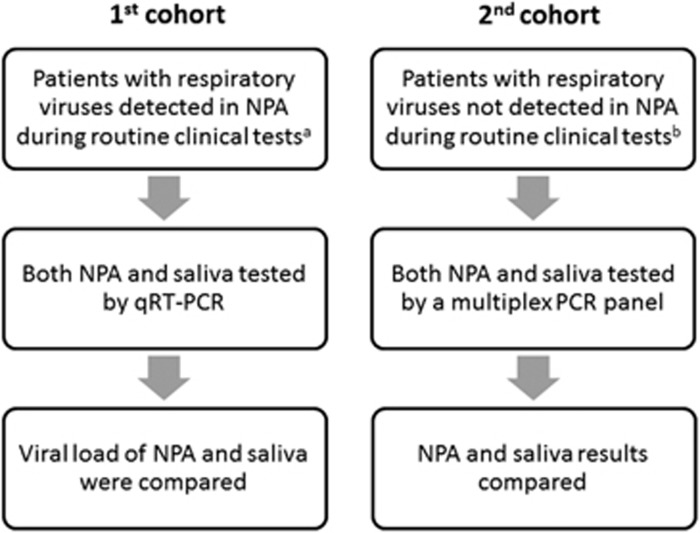
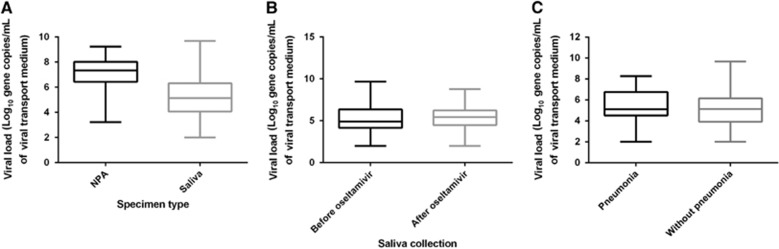
Emerging infectious diseases in humans are often caused by respiratory viruses such as pandemic or avian influenza viruses and novel coronaviruses. Microbiological testing for respiratory viruses is important for patient management, infection control and epidemiological studies. Nasopharyngeal specimens are frequently tested, but their sensitivity is suboptimal. This study evaluated the incremental benefit of testing respiratory viruses in expectorated saliva using molecular assays. A total of 258 hospitalized adult patients with suspected respiratory infections were included. Their expectorated saliva was collected without the use of any special devices. In the first cohort of 159 patients whose nasopharyngeal aspirates (NPAs) tested positive for respiratory viruses during routine testing, the viral load was measured using quantitative reverse transcription PCR. Seventeen percent of the patients (27/159) had higher viral loads in the saliva than in the NPA. The second cohort consisted of 99 patients whose NPAs tested negative for respiratory viruses using a direct immunofluorescence assay. Their NPA and saliva specimens were additionally tested using multiplex PCR. In these patients, the concordance rate by multiplex PCR between NPA and saliva was 83.8%. Multiplex PCR detected viruses in saliva samples from 16 patients, of which nine (56.3%) had at least one virus that was not detected in the NPA. Decisions on antiviral or isolation precautions would be affected by salivary testing in six patients. Although NPAs have high viral loads and remain the specimen of choice for most patients with respiratory virus infections, supplementary molecular testing of saliva can improve the clinical management of these patients.
人类新发传染病通常由呼吸道病毒引起,如大流行性流感病毒、禽流感病毒和新型冠状病毒。呼吸道病毒的微生物检测对于患者管理、感染控制和流行病学研究至关重要。鼻咽标本经常进行检测,但其敏感性并不理想。本研究评估了使用分子检测方法检测咳出唾液中呼吸道病毒的额外益处。共纳入258例住院的疑似呼吸道感染成年患者。在不使用任何特殊设备的情况下收集他们的咳出唾液。在第一个队列中,159例患者的鼻咽抽吸物(NPA)在常规检测中呼吸道病毒呈阳性,使用定量逆转录PCR测量病毒载量。17%的患者(27/159)唾液中的病毒载量高于NPA。第二个队列由99例患者组成,其NPA使用直接免疫荧光法检测呼吸道病毒呈阴性。他们的NPA和唾液标本另外使用多重PCR进行检测。在这些患者中,NPA和唾液之间多重PCR的一致性率为83.8%。多重PCR在16例患者的唾液样本中检测到病毒,其中9例(56.3%)至少有一种病毒在NPA中未检测到。唾液检测会影响6例患者的抗病毒或隔离预防措施决策。尽管NPA的病毒载量高,仍然是大多数呼吸道病毒感染患者的首选标本,但唾液的补充分子检测可以改善这些患者的临床管理。