Teraishi Masayoshi, Tojo Yuka, Yamada Naohiro, Okumoto Yutaka
Graduate School of Agriculture, Kyoto University, Oiwake, Kitashirakawa, Sakyo, Kyoto 606-8502, Japan.
Nagano Vegetable and Ornamental Crops Experiment Station, 1066-1 Soga, Shiojiri, Nagano 399-6461, Japan.
Breed Sci. 2017 Mar;67(2):123-128. doi: 10.1270/jsbbs.16086. Epub 2017 Mar 4.
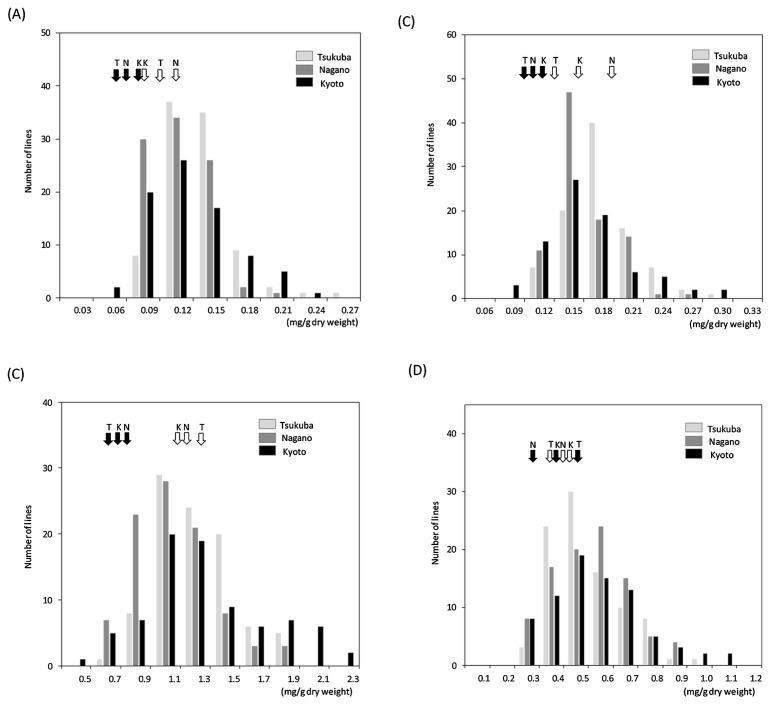
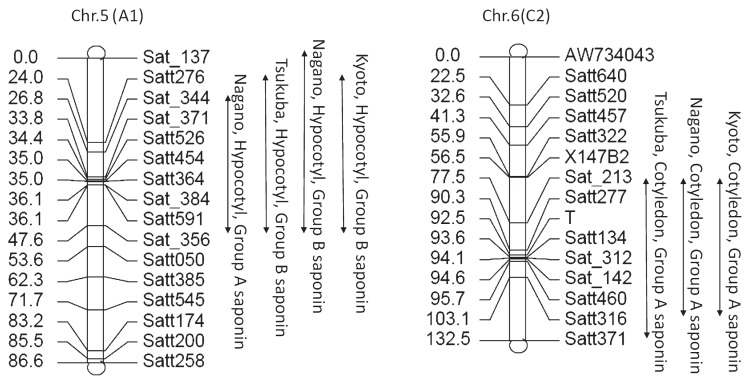
Saponins are secondary metabolites that are widely distributed in plants. There are two major saponin precursors in soybean: soyasapogenol A, contributing to the undesirable taste, and soyasapogenol B, some of which have health benefits. It is important to control the ratio and content of the two major saponin groups to enhance the appeal of soybean as a health food. The structural diversity of saponin in the sugar chain composition makes it hard to quantify the saponin content. We measured the saponin content in soybean by removing the sugar chain from the saponin using acidic hydrolysis and detected novel quantitative trait loci (QTLs) for saponin content. Major QTLs in the hypocotyl were identified on chromosome 5 near the SSR marker, Satt 384, while those in the cotyledon were on chromosome 6 near Sat_312, which is linked to the and loci. Our results suggest that saponin contents in the hypocotyl and cotyledon are controlled by different genes and that it is difficult to increase the beneficial group B saponin and to decrease the undesirable group A saponin at the same time.
皂苷是广泛分布于植物中的次生代谢产物。大豆中有两种主要的皂苷前体:导致不良味道的大豆皂醇A,以及部分具有健康益处的大豆皂醇B。控制这两种主要皂苷类别的比例和含量对于提高大豆作为健康食品的吸引力很重要。皂苷糖链组成的结构多样性使得难以对皂苷含量进行定量。我们通过酸性水解从皂苷中去除糖链来测量大豆中的皂苷含量,并检测到了皂苷含量的新数量性状位点(QTL)。在下胚轴中,主要QTL位于第5号染色体上SSR标记Satt 384附近,而子叶中的主要QTL位于第6号染色体上与Sat_312附近,Sat_312与 和 位点连锁。我们的结果表明,下胚轴和子叶中的皂苷含量由不同基因控制,同时增加有益的B组皂苷并减少不良的A组皂苷是困难的。