Liu Yuan, Cao Aiping, Li Yawen, Li Xun, Cong Hua, He Shenyi, Zhou Huaiyu
Department of Parasitology, School of Medicine, Shandong University, Jinan, Shandong Province, People's Republic of China.
Present address Department of Clinical Laboratory, The People's Hospital of Rizhao, Rizhao, Shandong Province, People's Republic of China.
BMC Infect Dis. 2017 Jun 7;17(1):403. doi: 10.1186/s12879-017-2507-5.
Toxoplasma gondii (T. gondii) is an obligate intracellular protozoan parasite that infects all warm-blooded animals including humans and causes toxoplasmosis. An effective vaccine could be an ideal choice for preventing and controlling toxoplasmosis. T. gondii Superoxide dismutase (TgSOD) might participate in affecting the intracellular growth of both bradyzoite and tachyzoite forms. In the present study, the TgSOD gene was used to construct a DNA vaccine (pEGFP-SOD).
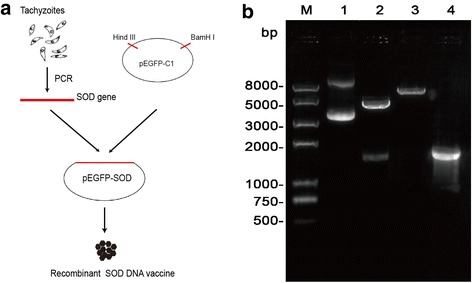
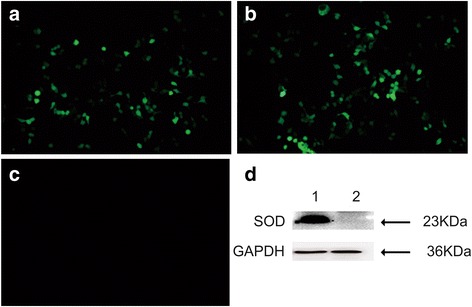
TgSOD gene was amplified and inserted into eukaryotic vector pEGFP-C1 and formed the DNA vaccine pEGFP-SOD. Then the BALB/c mice were immunized intramuscularly with the DNA vaccine and those injected with pEGFP-C1, PBS or nothing were treated as controls. Four weeks after the last immunization, all mouse groups followed by challenging intraperitoneally with tachyzoites of T. gondii ME49 strain.
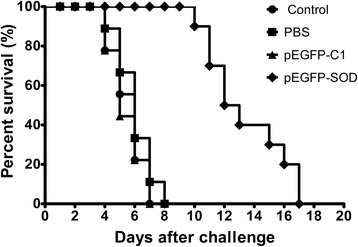
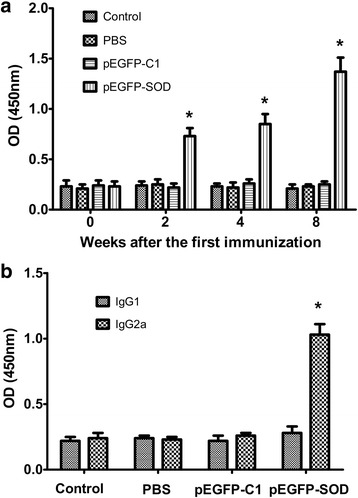
Results showed higher levels of total IgG, IgG2α in the sera and interferon gamma (IFN-γ) in the splenocytes from pEGFP-SOD inoculated mice than those unvaccinated, or inoculated with either empty plasmid vector or PBS. The proportions of CD4 T cells and CD8 T cells in the spleen from pEGFP-SOD inoculated mice were significantly (p < 0.05) increased compared to control groups. In addition, the survival time of mice immunized with pEGFP-SOD was significantly prolonged as compared to the controls (p < 0.05) although all the mice died.
The present study revealed that the DNA vaccine triggered strong humoral and cellular immune responses, and aroused partial protective immunity against acute T. gondii infection in BALB/c mice. The collective data suggests the SOD may be a potential vaccine candidate for further development.
刚地弓形虫是一种专性细胞内寄生原虫,可感染包括人类在内的所有温血动物,并引起弓形虫病。有效的疫苗可能是预防和控制弓形虫病的理想选择。刚地弓形虫超氧化物歧化酶(TgSOD)可能参与影响缓殖子和速殖子形式的细胞内生长。在本研究中,使用TgSOD基因构建了一种DNA疫苗(pEGFP-SOD)。
扩增TgSOD基因并将其插入真核载体pEGFP-C1中,形成DNA疫苗pEGFP-SOD。然后将BALB/c小鼠肌肉注射DNA疫苗,将注射pEGFP-C1、PBS或未注射任何物质的小鼠作为对照。最后一次免疫后四周,所有小鼠组腹腔注射刚地弓形虫ME49株速殖子进行攻毒。
结果显示,接种pEGFP-SOD的小鼠血清中总IgG、IgG2α水平以及脾细胞中干扰素γ(IFN-γ)水平高于未接种疫苗、接种空质粒载体或PBS的小鼠。与对照组相比,接种pEGFP-SOD的小鼠脾脏中CD4 T细胞和CD8 T细胞的比例显著增加(p<0.05)。此外,尽管所有小鼠均死亡,但与对照组相比,接种pEGFP-SOD的小鼠存活时间显著延长(p<0.05)。
本研究表明,该DNA疫苗引发了强烈的体液和细胞免疫反应,并在BALB/c小鼠中引起了对急性刚地弓形虫感染的部分保护性免疫。汇总数据表明,SOD可能是进一步开发的潜在疫苗候选物。