Jeon Chang-Seok, Shim Man-Shik, Park Seung-Jung, Jeong Dong Seop, Park Kyoung-Min, On Young Keun, Kim June Soo, Park Pyo Won
Department of Thoracic and Cardiovascular Surgery, Samsung Medical Center, Sungkyunkwan University School of Medicine.
Division of Cardiology, Department of Medicine, Samsung Medical Center, Sungkyunkwan University School of Medicine.
Korean J Thorac Cardiovasc Surg. 2017 Jun;50(3):163-170. doi: 10.5090/kjtcs.2017.50.3.163. Epub 2017 Jun 5.
The absence of atrial contraction (AC) after the maze procedure has been reported to cause subsequent annular dilatation and to increase the risk of embolic stroke. We hypothesized that the lack of AC could increase the risk of permanent pacemaker (PPM) implantation in patients undergoing the maze procedure.
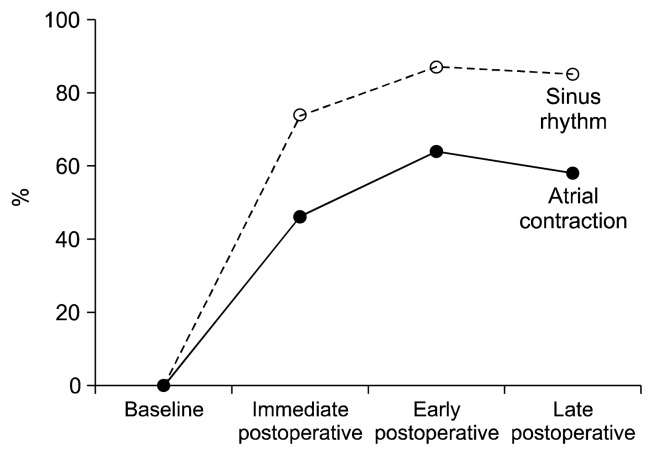
In 376 consecutive patients who had undergone a cryo-maze procedure and combined valve operation, recovery of AC was assessed at baseline and at immediate (≤2 weeks), early (≤1 year, 4.6±3.8 months), and late (>1 year, 3.5±1.1 years) postoperative stages.
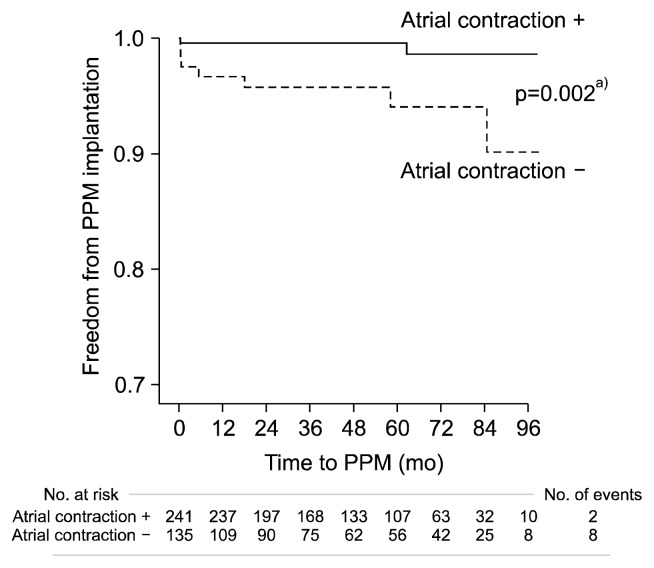
With a median follow-up of 53 months, 10 patients underwent PPM implantation. Seven PPM implants were for sinus node dysfunction (pauses of 9.6±2.4 seconds), one was for marked sinus bradycardia, and two were for advanced/complete atrioventricular block. The median (interquartile range) time to PPM implantation was 13.8 (0.5-68.2) months. Our time-varying covariate Cox models showed that the absence of AC was a risk factor for PPM implantation (hazard ratio, 11.92; 95% confidence interval, 2.52 to 56.45; p=0.002).
The absence of AC may be associated with a subsequent risk of PPM implantation.
据报道,迷宫手术后心房收缩(AC)缺失会导致随后的瓣环扩张,并增加栓塞性中风的风险。我们推测,AC缺失可能会增加接受迷宫手术患者植入永久性起搏器(PPM)的风险。
在376例连续接受冷冻迷宫手术及联合瓣膜手术的患者中,于基线时以及术后即刻(≤2周)、早期(≤1年,4.6±3.8个月)和晚期(>1年,3.5±1.1年)评估AC的恢复情况。
中位随访53个月时,有10例患者植入了PPM。7例植入PPM是因为窦房结功能障碍(停搏9.6±2.4秒),1例是因为显著窦性心动过缓,2例是因为高度/完全性房室传导阻滞。植入PPM的中位(四分位间距)时间为13.8(0.5 - 68.2)个月。我们的时变协变量Cox模型显示,AC缺失是PPM植入的一个危险因素(风险比,11.92;95%置信区间,2.52至56.45;p = 0.002)。
AC缺失可能与随后植入PPM的风险相关。