Department of Psychology and Neuroscience, University of North Carolina, Chapel Hill, NC 27599.
Department of Psychology and Neuroscience, University of Colorado Boulder, Boulder, CO 80309.
eNeuro. 2017 Jun 7;4(3). doi: 10.1523/ENEURO.0058-17.2017. eCollection 2017 May-Jun.
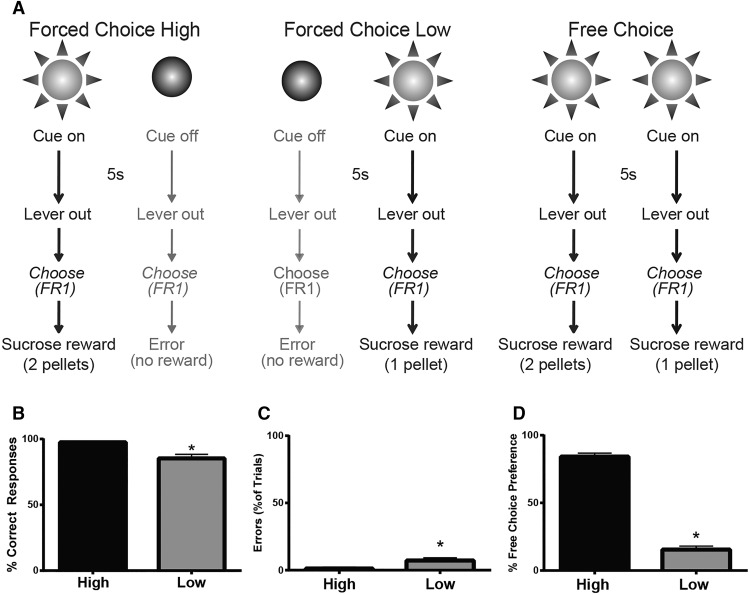
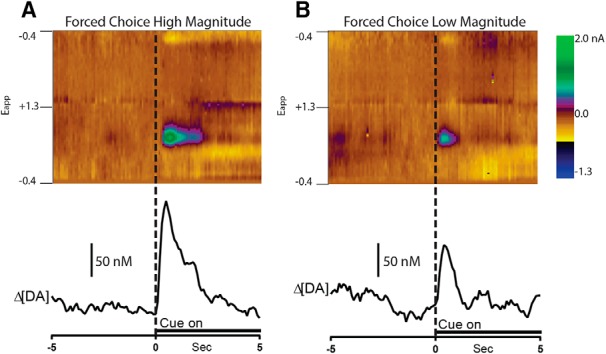
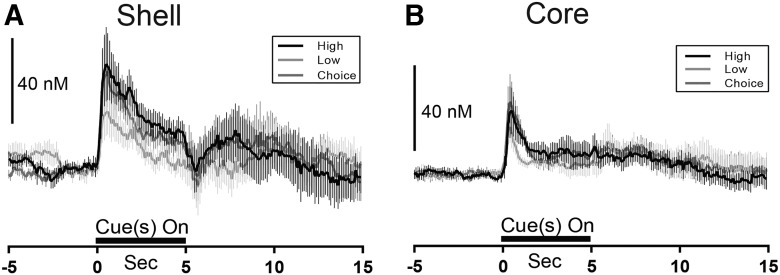
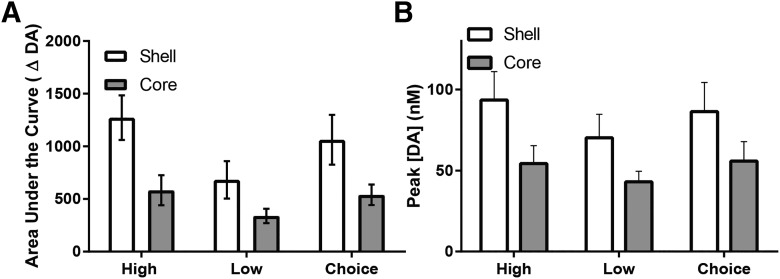
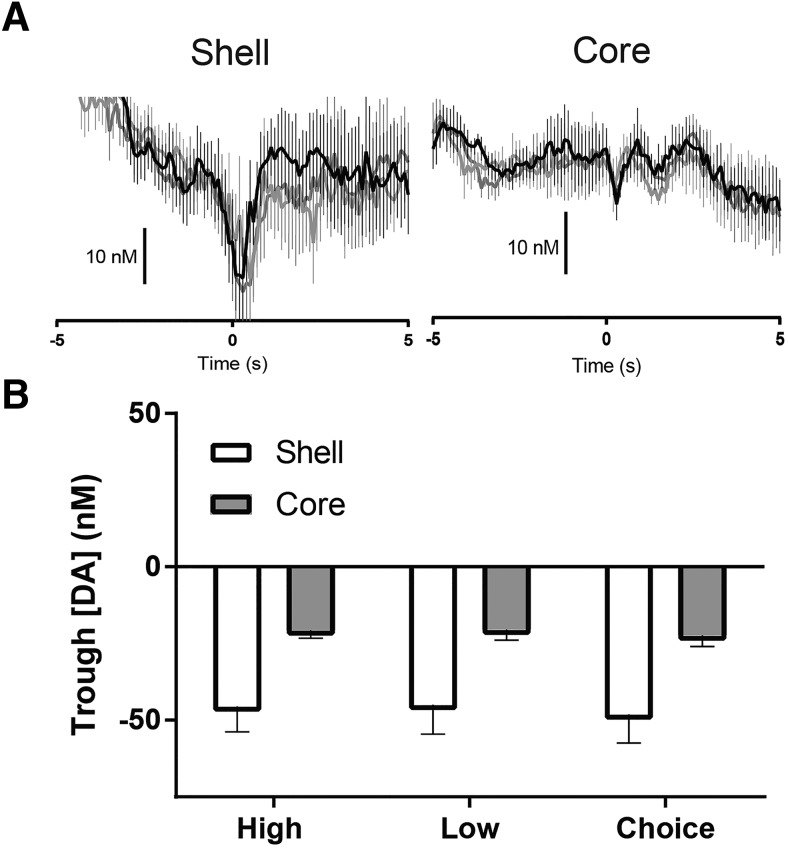
Effective decision-making requires organisms to predict reward values and bias behavior toward the best available option. The mesolimbic dopamine system, including the nucleus accumbens (NAc) shell and core, is involved in this process. Although studies support a role of the shell and core in specific aspects of decision-making (e.g., risk, effort, delay), no studies have directly compared dopamine release dynamics in these subregions to cues exclusively signaling the availability of different reward magnitudes. Here, fast-scan cyclic voltammetry was used to compare rapid dopamine release dynamics in the NAc subregions during a magnitude-based decision-making task. Rats learned that distinct cues signaled the availability of either a small or large reward (one or two sugar pellets), and then were given an opportunity to choose their preferred option. We found that peak dopamine release tracked the more preferred (higher-magnitude) option in both core and shell subregions. Critically, however, overall (i.e., global) dopamine release was significantly higher and longer lasting in the shell and tracked the preferred magnitude during the entire cue period. Further, in the shell (not core), dopamine signaling significantly declined immediately at the lever press for reward but increased during the period of reward consumption. Collectively, the results indicate that although dopamine release in both the core and shell are activated by cues signaling the opportunity to respond for rewards of different magnitudes, dopamine release in the shell plays a differential and unique role in tracking information related to the outcome value of reward.
有效的决策需要生物体预测奖励值,并使行为偏向最佳选择。中脑边缘多巴胺系统,包括伏隔核(NAc)壳和核,参与了这个过程。尽管研究支持壳和核在决策的特定方面(例如风险、努力、延迟)的作用,但没有研究直接比较这些亚区中多巴胺释放的动力学,以专门提示不同奖励幅度的可用性。在这里,使用快速扫描循环伏安法比较了在基于大小的决策任务中 NAc 亚区中快速多巴胺释放的动力学。大鼠学习到不同的线索表示可用的小或大奖励(一个或两个糖丸),然后有机会选择他们喜欢的选项。我们发现,在核心和壳亚区中,峰值多巴胺释放都追踪到了更受欢迎(更高幅度)的选项。然而,至关重要的是,总的(即全局)多巴胺释放在壳中明显更高且持续时间更长,并且在整个线索期间追踪偏好幅度。此外,在壳(而非核)中,多巴胺信号在奖励的杠杆按压时立即显著下降,但在奖励消费期间增加。总之,结果表明,尽管壳和核中多巴胺的释放都被提示有机会对不同幅度的奖励做出反应而激活,但壳中的多巴胺释放在跟踪与奖励结果价值相关的信息方面发挥了差异化和独特的作用。