Świderski Zdzisław, Miquel Jordi, Azzouz-Maache Samira, Pétavy Anne-Françoise
Witold Stefański Institute of Parasitology, Polish Academy of Sciences, 51/55 Twarda Street, 00-818, Warszawa, Poland.
Secció de Parasitologia, Departament de Biologia, Sanitat i Medi Ambient, Facultat de Farmàcia i Ciències de l'Alimentació, Universitat de Barcelona, Av. Joan XXIII, sn, 08028, Barcelona, Spain.
Parasitol Res. 2017 Jul;116(7):1963-1971. doi: 10.1007/s00436-017-5479-x. Epub 2017 Jun 7.
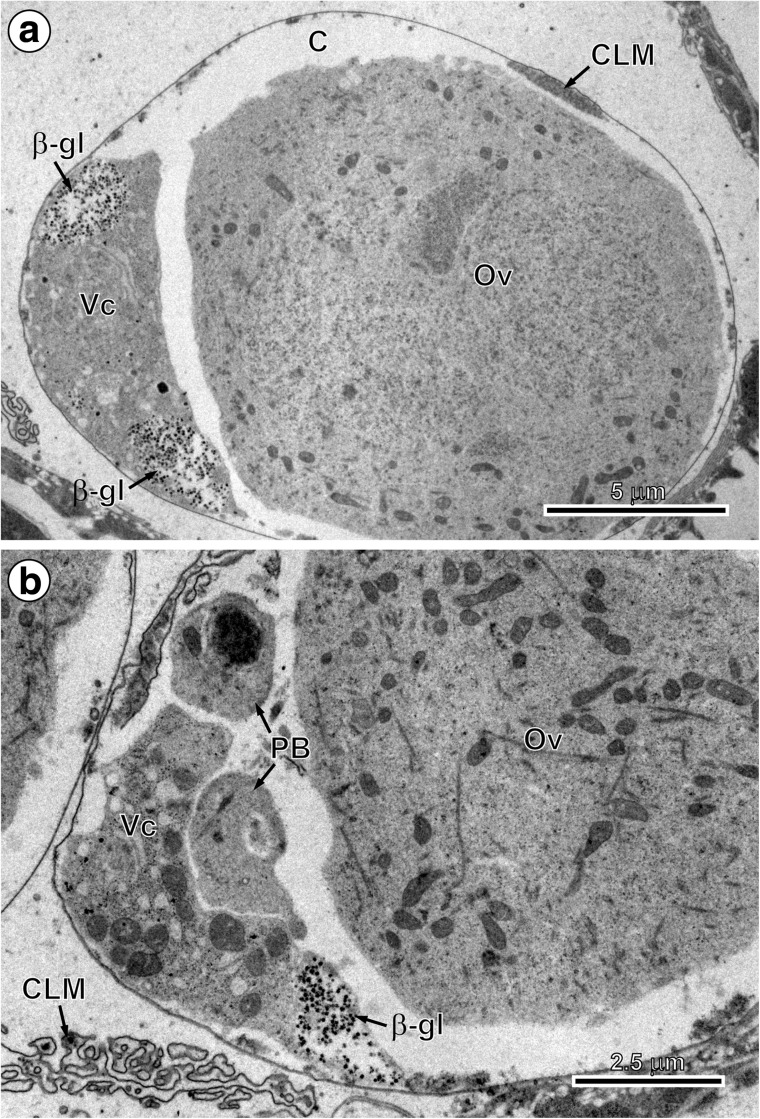
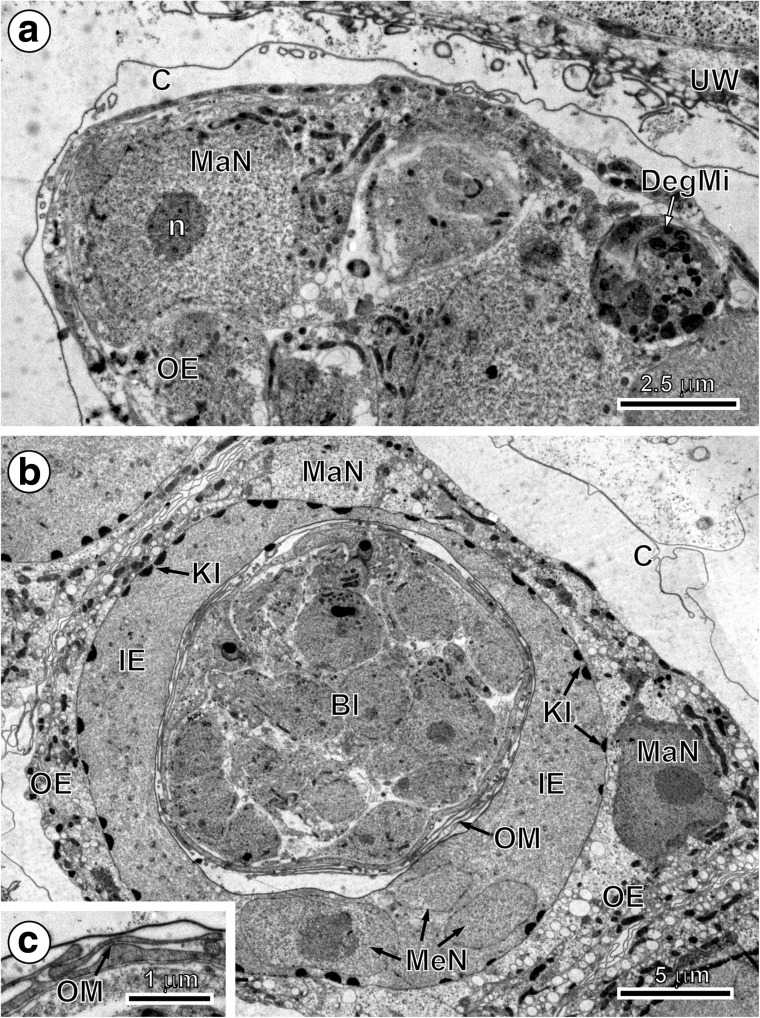
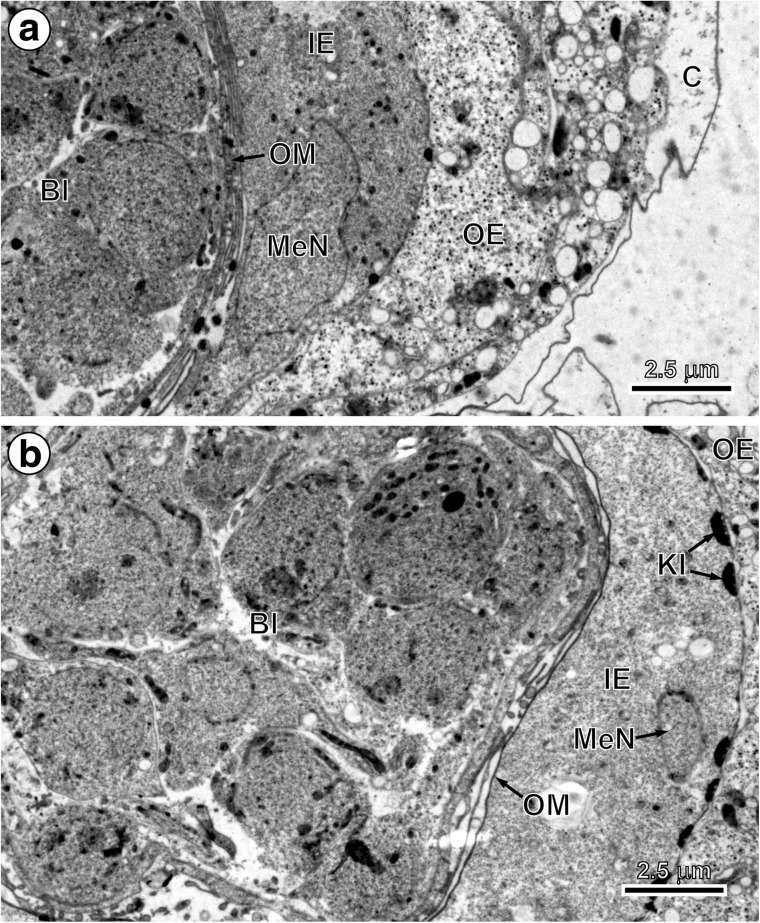
The origin, differentiation and functional ultrastructure of oncospheral or egg envelopes in Echinococcus multilocularis Leuckart, 1863 were studied by transmission electron microscopy (TEM) and cytochemistry. The purpose of our study is to describe the formation of the four primary embryonic envelopes, namely vitelline capsule, outer envelope, inner envelope and oncospheral membrane, and their transformation into the oncospheral or egg envelopes surrounding the mature hexacanth. This transformation takes place in the preoncospheral phase of embryonic development. The vitelline capsule and oncospheral membrane are thin membranes, while the outer and inner envelopes are thick cytoplasmic layers formed by two specific types of blastomeres: the outer envelope by cytoplasmic fusion of two macromeres and the inner envelope by cytoplasmic fusion of three mesomeres. Both outer and inner envelopes are therefore cellular in origin and syncytial in nature. During the advanced phase of embryonic development, the outer and inner envelopes undergo great modifications. The outer envelope remains as a metabolically active layer involved in the storage of glycogen and lipids for the final stages of egg development and survival. The inner envelope is the most important protective layer because of its thick layer of embryophoric blocks that assures oncospheral protection and survival. This embryophore is the principal layer of mature eggs, affording physical and physiological protection for the differentiated embryo or oncosphere, since the outer envelope is stripped from the egg before it is liberated. The embryophore is very thick and impermeable, consisting of polygonal blocks of an inert keratin-like protein held together by a cementing substance. The embryophore therefore assures extreme resistance of eggs, enabling them to withstand a wide range of environmental temperatures and physicochemical conditions.
利用透射电子显微镜(TEM)和细胞化学方法,对多房棘球绦虫(1863年,Leuckart)原头蚴或虫卵包膜的起源、分化及功能超微结构进行了研究。我们研究的目的是描述四种主要胚胎包膜的形成,即卵黄囊、外膜、内膜和原头蚴膜,以及它们如何转变为围绕成熟六钩蚴的原头蚴或虫卵包膜。这种转变发生在胚胎发育的原头蚴前期。卵黄囊和原头蚴膜是薄膜,而外膜和内膜是由两种特定类型的卵裂球形成的厚细胞质层:外膜由两个大卵裂球的细胞质融合形成,内膜由三个中卵裂球的细胞质融合形成。因此,外膜和内膜均起源于细胞,本质上为多核体。在胚胎发育的后期阶段,外膜和内膜发生了重大变化。外膜作为一层代谢活跃的层保留下来,参与为虫卵发育和存活的最后阶段储存糖原和脂质。内膜是最重要的保护层,因为它有一层厚厚的胚膜块,可确保原头蚴得到保护并存活。这种胚膜是成熟虫卵的主要层,为分化的胚胎或原头蚴提供物理和生理保护,因为外膜在虫卵释放前就从虫卵上剥离了。胚膜非常厚且不透水,由多边形的惰性角蛋白样蛋白质块通过一种胶结物质连接在一起组成。因此,胚膜确保了虫卵具有极强的抵抗力,使其能够承受广泛的环境温度和理化条件。