Link Nathan Wong, Hamilton Leah K
Rutgers University, Camden, USA.
Temple University, Philadelphia, USA.
Health Justice. 2017 Dec;5(1):8. doi: 10.1186/s40352-017-0053-2. Epub 2017 Jun 7.
Much work has investigated the association between substance use, crime, and recidivism, yet little scholarship has examined these associations longitudinally among samples of recently released prisoners. We examine the lagged reciprocal effects of hard substance use and crime, among other covariates, in the context of the prisoner reentry process.
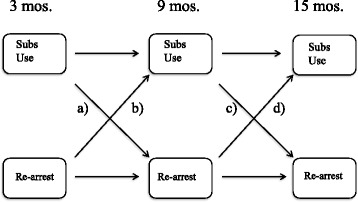
We rely on data from the Serious and Violent Offender Reentry Initiative (SVORI) evaluation and employ cross-lagged panel models to examine short-term changes in substance use and crime over time among a large sample of high-risk, former prisoners (N = 1697).
Substance use marginally predicted increased odds of rearrest at one wave, and rearrest significantly (p < .05) predicted increased odds of substance use at another. As such, the results provide limited evidence for a degree of lagged mutual causation; associations vary over the reentry process and are complicated by other realities of life after prison. A key finding is that both behaviors are more consistently influenced by other factors, such as service needs and instrumental and emotional supports.
Although there are relationships between drug use and criminal behavior, these behaviors alone are insufficient explanations for one another in an adult reentry population. Alternatively, the compounding social and personal needs of the reentry population, and the extent to which they received support or services to address these needs, appear to have the strongest influence on both behaviors in the reentry context.
许多研究探讨了物质使用、犯罪和累犯之间的关联,但很少有学术研究在近期获释囚犯样本中对这些关联进行纵向考察。我们在囚犯重新融入社会的过程中,研究了硬性物质使用与犯罪以及其他协变量之间的滞后相互影响。
我们依赖于严重暴力罪犯重新融入社会计划(SVORI)评估的数据,并采用交叉滞后面板模型,来研究一大群高风险前囚犯(N = 1697)在一段时间内物质使用和犯罪的短期变化。
物质使用在一定程度上预测了某一波次再次被捕几率的增加,而再次被捕则显著(p <.05)预测了另一波次物质使用几率的增加。因此,研究结果为一定程度的滞后相互因果关系提供了有限的证据;这些关联在重新融入社会的过程中有所不同,并且因出狱后的其他生活现实而变得复杂。一个关键发现是,这两种行为更一致地受到其他因素的影响,如服务需求以及工具性和情感性支持。
虽然药物使用和犯罪行为之间存在关联,但在成年重新融入社会的人群中,仅这些行为不足以相互解释。相反,重新融入社会人群复杂的社会和个人需求,以及他们在多大程度上获得了满足这些需求的支持或服务,似乎在重新融入社会的背景下对这两种行为都有最强的影响。