Tatem Kathleen S, Romo Matthew L, McVeigh Katharine H, Chan Pui Ying, Lurie-Moroni Elizabeth, Thorpe Lorna E, Perlman Sharon E
New York City Department of Health and Mental Hygiene, Long Island City, New York.
City University of New York School of Public Health, New York, New York.
Prev Chronic Dis. 2017 Jun 8;14:E44. doi: 10.5888/pcd14.160516.
Electronic health record (EHR) systems provide an opportunity to use a novel data source for population health surveillance. Validation studies that compare prevalence estimates from EHRs and surveys most often use difference testing, which can, because of large sample sizes, lead to detection of significant differences that are not meaningful. We explored a novel application of the two one-sided t test (TOST) to assess the equivalence of prevalence estimates in 2 population-based surveys to inform margin selection for validating EHR-based surveillance prevalence estimates derived from large samples.
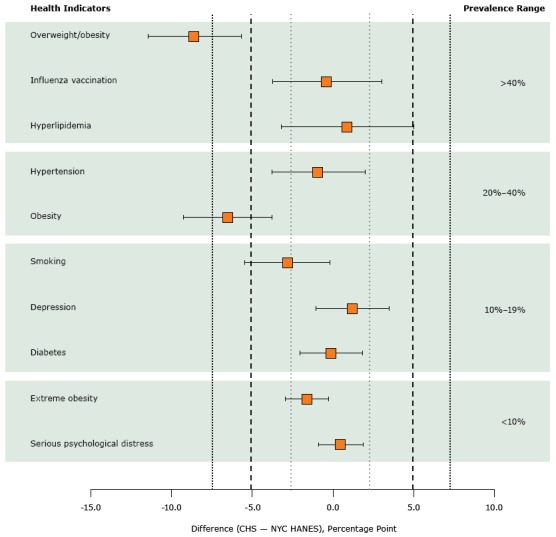
We compared prevalence estimates of health indicators in the 2013 Community Health Survey (CHS) and the 2013-2014 New York City Health and Nutrition Examination Survey (NYC HANES) by using TOST, a 2-tailed t test, and other goodness-of-fit measures.
A ±5 percentage-point equivalence margin for a TOST performed well for most health indicators. For health indicators with a prevalence estimate of less than 10% (extreme obesity [CHS, 3.5%; NYC HANES, 5.1%] and serious psychological distress [CHS, 5.2%; NYC HANES, 4.8%]), a ±2.5 percentage-point margin was more consistent with other goodness-of-fit measures than the larger percentage-point margins.
A TOST with a ±5 percentage-point margin was useful in establishing equivalence, but a ±2.5 percentage-point margin may be appropriate for health indicators with a prevalence estimate of less than 10%. Equivalence testing can guide future efforts to validate EHR data.
电子健康记录(EHR)系统为利用新型数据源进行人群健康监测提供了契机。比较EHR系统与调查得出的患病率估计值的验证研究大多采用差异检验,由于样本量较大,这种方法可能会检测到无实际意义的显著差异。我们探索了双侧t检验(TOST)的一种新应用,以评估两项基于人群的调查中患病率估计值的等效性,为验证从大样本得出的基于EHR的监测患病率估计值选择合适的差值范围提供依据。
我们使用TOST、双侧t检验及其他拟合优度指标,比较了2013年社区健康调查(CHS)和2013 - 2014年纽约市健康与营养检查调查(NYC HANES)中健康指标的患病率估计值。
对于大多数健康指标,TOST的±5个百分点的等效差值范围表现良好。对于患病率估计值低于10%的健康指标(极度肥胖[CHS为3.5%;NYC HANES为5.1%]和严重心理困扰[CHS为5.2%;NYC HANES为4.8%]),±2.5个百分点的差值范围比更大的差值范围与其他拟合优度指标更一致。
差值范围为±5个百分点的TOST在确定等效性方面很有用,但对于患病率估计值低于10%的健康指标,±2.5个百分点的差值范围可能更合适。等效性检验可为未来验证EHR数据的工作提供指导。