Goldfinger Judith Z, Preiss Liliana R, Devereux Richard B, Roman Mary J, Hendershot Tabitha P, Kroner Barbara L, Eagle Kim A
Zena and Michael A. Wiener Cardiovascular Institute, Icahn School of Medicine at Mount Sinai, New York, New York.
Biostatistics and Epidemiology Division, Research Triangle Institute International, Rockville, Maryland.
J Am Coll Cardiol. 2017 Jun 13;69(23):2821-2830. doi: 10.1016/j.jacc.2017.04.026.
Previous small studies suggested reduced quality of life (QOL) for people with Marfan syndrome (MFS) compared with those without MFS. The national registry of GenTAC (Genetically Triggered Thoracic Aortic Aneurysms and Cardiovascular Conditions) is a longitudinal observational cohort study of patients with conditions that predispose to thoracic aortic aneurysms and dissections, including MFS. At the time of registry enrollment, GenTAC study participants are asked to complete questionnaires about demographics, medical history, health habits, and QOL.
This study assessed QOL in GenTAC participants with MFS and identify associated factors using self-reported data.
QOL was assessed using the 4 subscales of the Physical Component Summary (PCS) of the Medical Outcomes Study 36-Item Short-Form Health Survey (SF-36): physical functioning; role limitations due to physical health; bodily pain; and general health. We studied the association of QOL with self-reported demographics, health behaviors, physical impairments, surgeries, comorbid medical conditions, medications, and MFS severity.
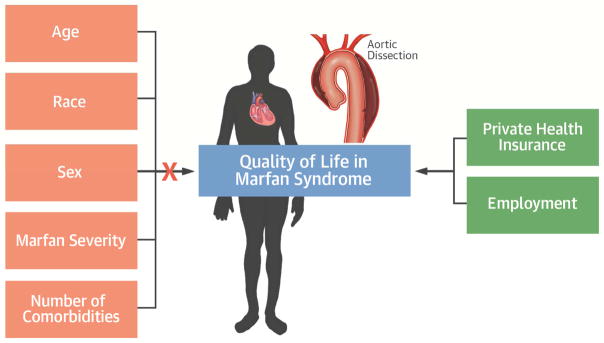
In the GenTAC registry, 389 adults with MFS completed the SF-36. Mean age was 41 years, 51% were men, 92% were white, and 65% were college graduates. The mean PCS composite score was 42.3. In bivariate analysis, predictors of better QOL included college education, marital status, higher household income, private health insurance, full-time employment, moderate alcohol use, fewer prior surgeries, fewer comorbid conditions, absence of depression, and less severe MFS manifestations. In a multivariable analysis, insurance status and employment remained significant predictors of QOL.
In a large cohort of patients with MFS in the GenTAC registry, health-related QOL was below the population norm. Better QOL was independently associated with socioeconomic factors, not factors related to general health or MFS severity.
先前的小型研究表明,与没有马凡综合征(MFS)的人相比,患有马凡综合征的人的生活质量(QOL)有所下降。GenTAC(遗传性触发胸主动脉瘤和心血管疾病)国家登记处是一项针对易患胸主动脉瘤和夹层的疾病患者(包括MFS)的纵向观察队列研究。在登记入组时,GenTAC研究参与者被要求填写有关人口统计学、病史、健康习惯和生活质量的问卷。
本研究使用自我报告数据评估GenTAC中患有MFS的参与者的生活质量,并确定相关因素。
使用医学结果研究36项简短健康调查(SF-36)的身体成分总结(PCS)的4个分量表评估生活质量:身体功能;因身体健康导致的角色限制;身体疼痛;以及总体健康状况。我们研究了生活质量与自我报告的人口统计学、健康行为、身体损伤、手术、合并症、药物治疗和MFS严重程度之间的关联。
在GenTAC登记处,389名患有MFS的成年人完成了SF-36。平均年龄为41岁,51%为男性,92%为白人,65%为大学毕业生。PCS综合平均得分为42.3。在双变量分析中,生活质量较好的预测因素包括大学教育、婚姻状况、家庭收入较高、私人医疗保险、全职工作、适度饮酒量、既往手术较少、合并症较少、无抑郁以及MFS表现较轻。在多变量分析中,保险状况和就业仍然是生活质量的重要预测因素。
在GenTAC登记处的一大群患有MFS的患者中,与健康相关的生活质量低于人群平均水平。更好的生活质量与社会经济因素独立相关,而不是与一般健康或MFS严重程度相关的因素。