a Department of Neurosurgery , Stanford University School of Medicine , Stanford , CA USA.
Autophagy. 2017;13(11):1998-1999. doi: 10.1080/15548627.2017.1327511. Epub 2017 Oct 5.
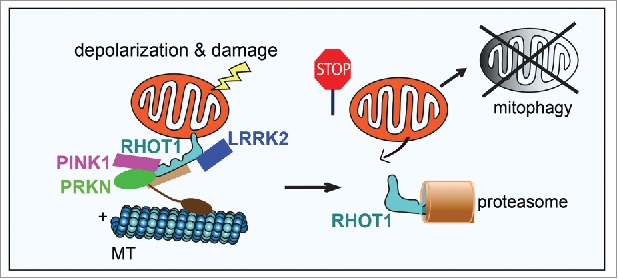
The knowledge gap separating the molecular and cellular underpinnings of Parkinson disease (PD) and its pathology hinders treatment innovation. Adding to this difficulty is the lack of a reliable biomarker for PD. Our previous studies identify a link of 2 PD proteins, PINK1/PRKN Parkin to a mitochondrial motor adaptor RHOT1/Miro-1, which mediates mitochondrial motility and mitophagy. Here we review our recent paper showing that a third PD protein, LRRK2, also targets RHOT1 and regulates mitophagy, and pathogenic LRRK2 disrupts this function. Notably, we discover impairments in RHOT1 and mitophagy in sporadic PD patients with no known genetic backgrounds, pointing to RHOT1-mediated mitophagy as a convergent pathway in PD. This novelty opens new doors in PD research toward RHOT1-based therapy and biomarker development.
帕金森病(PD)的分子和细胞基础与其病理学之间的知识差距阻碍了治疗创新。更有难度的是,PD 缺乏可靠的生物标志物。我们之前的研究发现 2 种 PD 蛋白 PINK1/PRKN 与 Parkin 到线粒体运动衔接子 RHOT1/Miro-1 的联系,该衔接子介导线粒体运动和线粒体自噬。在这里,我们回顾了我们最近的一篇论文,该论文表明第三种 PD 蛋白 LRRK2 也靶向 RHOT1 并调节线粒体自噬,致病性 LRRK2 破坏了这一功能。值得注意的是,我们在没有已知遗传背景的散发性 PD 患者中发现了 RHOT1 和线粒体自噬的损伤,这表明 RHOT1 介导的线粒体自噬是 PD 的一个汇聚途径。这一新颖性为基于 RHOT1 的治疗和生物标志物开发的 PD 研究开辟了新的途径。