Department of Sport and Exercise Science, University of Salzburg, Schlossallee 49, 5400 Hallein/Rif, Austria.
Salzburg Research Forschungsgesellschaft m.b.H., Jakob-Haringer-Straße 5, 5020 Salzburg, Austria.
Sensors (Basel). 2020 Nov 25;20(23):6737. doi: 10.3390/s20236737.
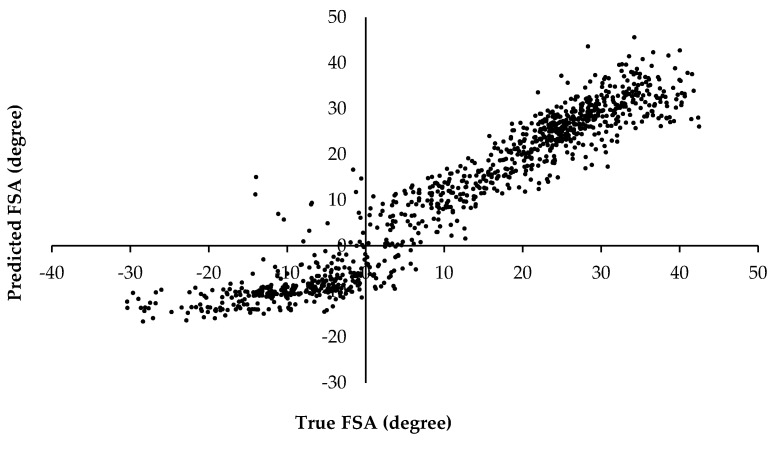
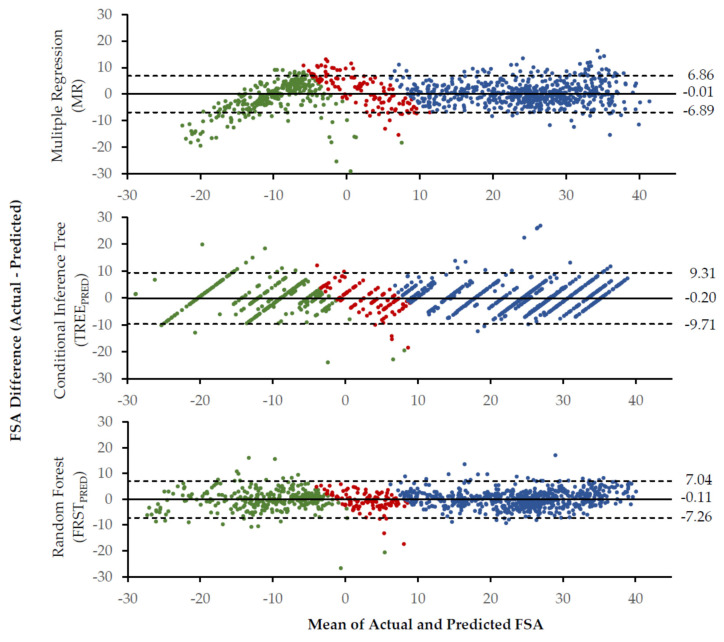
The foot strike pattern performed during running is an important variable for runners, performance practitioners, and industry specialists. Versatile, wearable sensors may provide foot strike information while encouraging the collection of diverse information during ecological running. The purpose of the current study was to predict foot strike angle and classify foot strike pattern from Loadsol wearable pressure insoles using three machine learning techniques (multiple linear regression-MR, conditional inference tree-TREE, and random forest-FRST). Model performance was assessed using three-dimensional kinematics as a ground-truth measure. The prediction-model accuracy was similar for the regression, inference tree, and random forest models (RMSE: MR = 5.16°, TREE = 4.85°, FRST = 3.65°; MAPE: MR = 0.32°, TREE = 0.45°, FRST = 0.33°), though the regression and random forest models boasted lower maximum precision (13.75° and 14.3°, respectively) than the inference tree (19.02°). The classification performance was above 90% for all models (MR = 90.4%, TREE = 93.9%, and FRST = 94.1%). There was an increased tendency to misclassify mid foot strike patterns in all models, which may be improved with the inclusion of more mid foot steps during model training. Ultimately, wearable pressure insoles in combination with simple machine learning techniques can be used to predict and classify a runner's foot strike with sufficient accuracy.
在跑步过程中,足部的着地方式是跑者、运动表现从业者和行业专家关注的重要变量。多功能、可穿戴的传感器可以提供足部着地信息,同时鼓励在生态跑步过程中收集多样化的信息。本研究的目的是使用三种机器学习技术(多元线性回归-MR、条件推断树-TREE 和随机森林-FRST),从 Loadsol 可穿戴压力鞋垫中预测足部着地角度和分类足部着地模式。通过三维运动学作为地面真实测量来评估模型性能。回归、推理树和随机森林模型的预测模型准确性相似(均方根误差:MR = 5.16°,TREE = 4.85°,FRST = 3.65°;平均绝对百分比误差:MR = 0.32°,TREE = 0.45°,FRST = 0.33°),尽管回归和随机森林模型的最大精度较低(分别为 13.75°和 14.3°),而推理树的最大精度为 19.02°。所有模型的分类性能均高于 90%(MR = 90.4%,TREE = 93.9%,FRST = 94.1%)。所有模型都存在将中足着地模式错误分类的趋势,通过在模型训练中纳入更多的中足着地,可以改善这种情况。最终,可穿戴压力鞋垫与简单的机器学习技术相结合,可以足够准确地预测和分类跑者的足部着地方式。