Turner-McGrievy Gabrielle M, Wilcox Sara, Boutté Alycia, Hutto Brent E, Singletary Camelia, Muth Eric R, Hoover Adam W
Department of Health Promotion, Education, and Behavior, Arnold School of Public Health, University of South Carolina, Columbia, South Carolina, USA.
Department of Exercise Science, Prevention Research Center, Arnold School of Public Health, University of South Carolina, Columbia, South Carolina, USA.
Obesity (Silver Spring). 2017 Aug;25(8):1336-1342. doi: 10.1002/oby.21889. Epub 2017 Jun 10.
To examine the use of two different mobile dietary self-monitoring methods for weight loss.
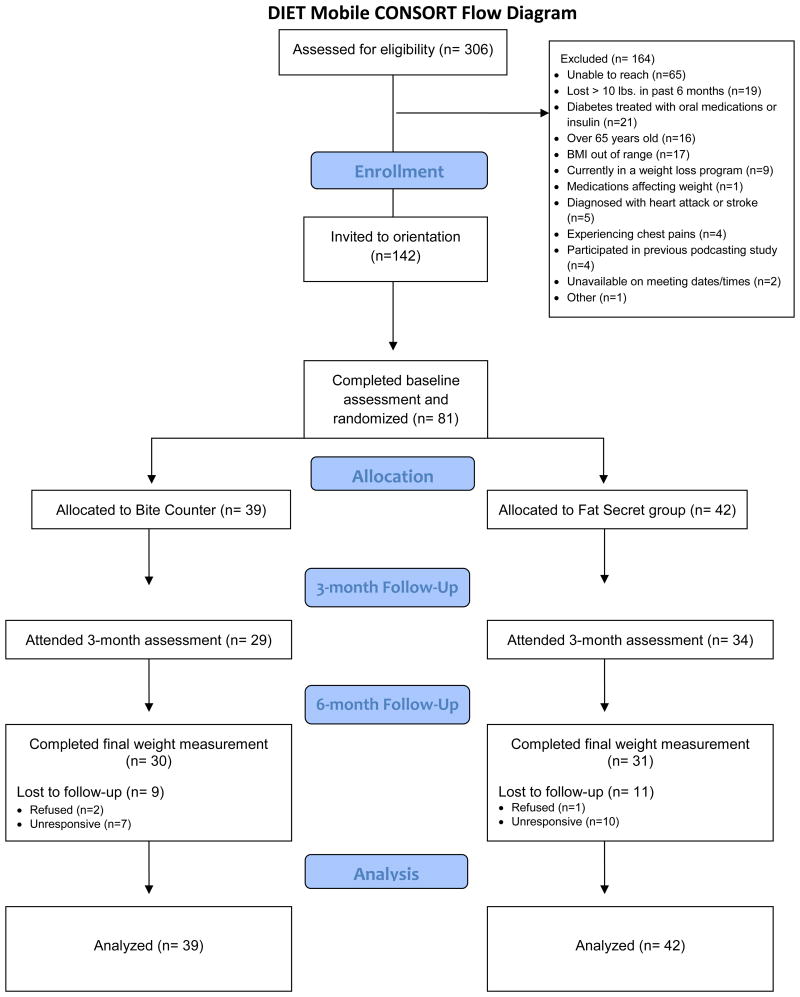
Adults with overweight (n = 81; mean BMI 34.7 ± 5.6 kg/m ) were randomized to self-monitor their diet with a mobile app (App, n = 42) or wearable Bite Counter device (Bite, n = 39). Both groups received the same behavioral weight loss information via twice-weekly podcasts. Weight, physical activity (International Physical Activity Questionnaire), and energy intake (two dietary recalls) were assessed at 0, 3, and 6 months.
At 6 months, 75% of participants completed the trial. The App group lost significantly more weight (-6.8 ± 0.8 kg) than the Bite group (-3.0 ± 0.8 kg; group × time interaction: P < 0.001). Changes in energy intake (kcal/d) (-621 ± 157 App, -456 ± 167 Bite; P = 0.47) or number of days diet was tracked (90.7 ± 9.1 App, 68.4 ± 9.8 Bite; P = 0.09) did not differ between groups, but the Bite group had significant increases in physical activity metabolic equivalents (+2015.4 ± 684.6 min/wk; P = 0.02) compared to little change in the App group (-136.5 ± 630.6; P = 0.02). Total weight loss was significantly correlated with number of podcasts downloaded (r = -0.33, P < 0.01) and number of days diet was tracked (r = -0.33, P < 0.01).
While frequency of diet tracking was similar between the App and Bite groups, there was greater weight loss observed in the App group.
研究两种不同的移动饮食自我监测方法对减肥的作用。
超重成年人(n = 81;平均体重指数34.7±5.6kg/m²)被随机分为两组,一组使用移动应用程序进行饮食自我监测(应用程序组,n = 42),另一组使用可穿戴式咬食计数器设备进行监测(咬食计数器组,n = 39)。两组均通过每周两次的播客获得相同的行为减肥信息。在0、3和6个月时评估体重、身体活动(国际身体活动问卷)和能量摄入(两次饮食回顾)。
6个月时,75%的参与者完成了试验。应用程序组减重显著多于咬食计数器组(-6.8±0.8kg比-3.0±0.8kg;组×时间交互作用:P<0.001)。两组间能量摄入变化(千卡/天)(应用程序组-621±157,咬食计数器组-456±167;P = 0.47)或饮食跟踪天数(应用程序组90.7±9.1,咬食计数器组68.4±9.8;P = 0.09)无差异,但咬食计数器组身体活动代谢当量显著增加(+2015.4±684.6分钟/周;P = 0.02),而应用程序组变化不大(-136.5±630.6;P = 0.02)。总体减重与下载的播客数量(r = -0.33,P<0.01)和饮食跟踪天数(r = -0.33,P<0.01)显著相关。
虽然应用程序组和咬食计数器组的饮食跟踪频率相似,但应用程序组的减重更多。