Toftaker Ingrid, Holmøy Ingrid, Nødtvedt Ane, Østerås Olav, Stokstad Maria
Department of Production Animal Clinical Sciences, Norwegian University of Life Sciences, PO Box 8146 Dep, 0033 Oslo, Norway.
Department of Production Animal Clinical Sciences, Norwegian University of Life Sciences, PO Box 8146 Dep, 0033 Oslo, Norway.
J Dairy Sci. 2017 Aug;100(8):6483-6493. doi: 10.3168/jds.2017-12605. Epub 2017 Jun 7.
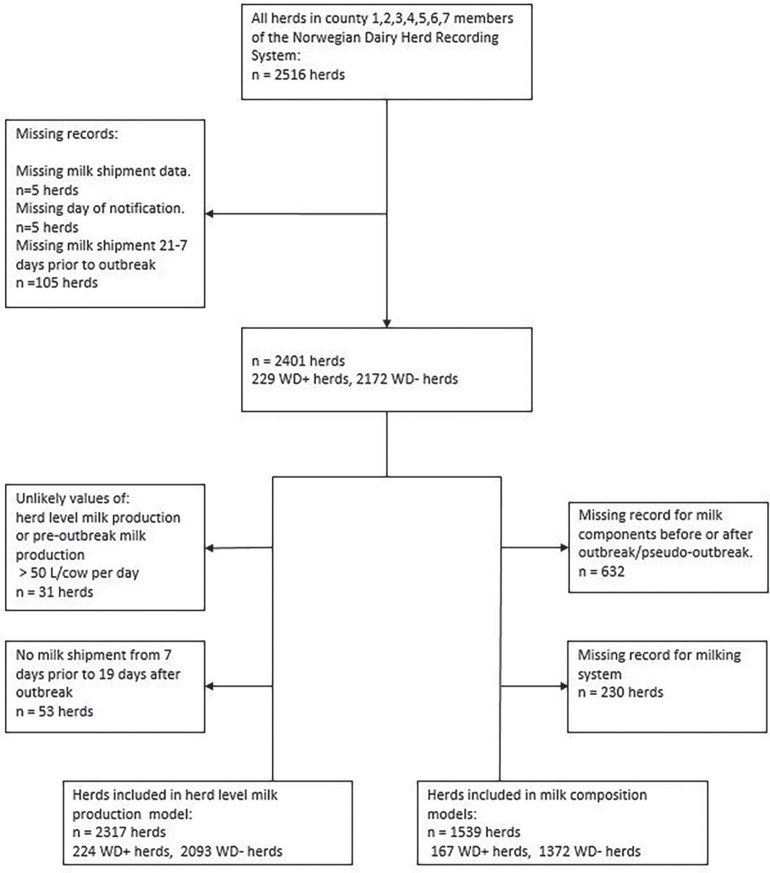
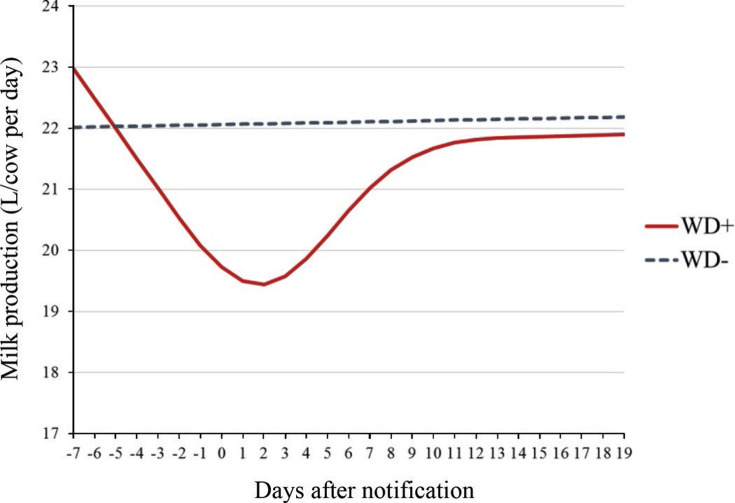
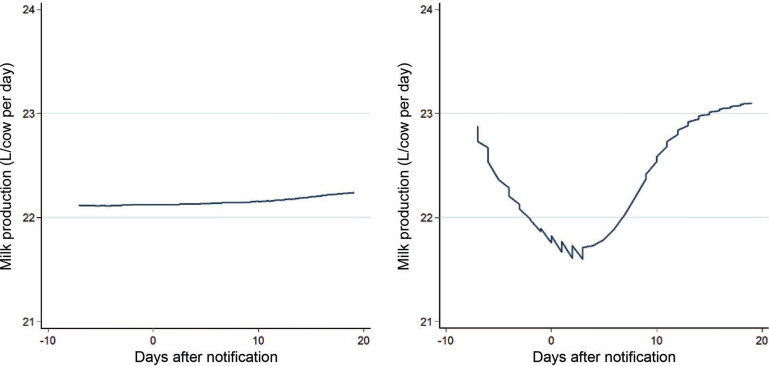
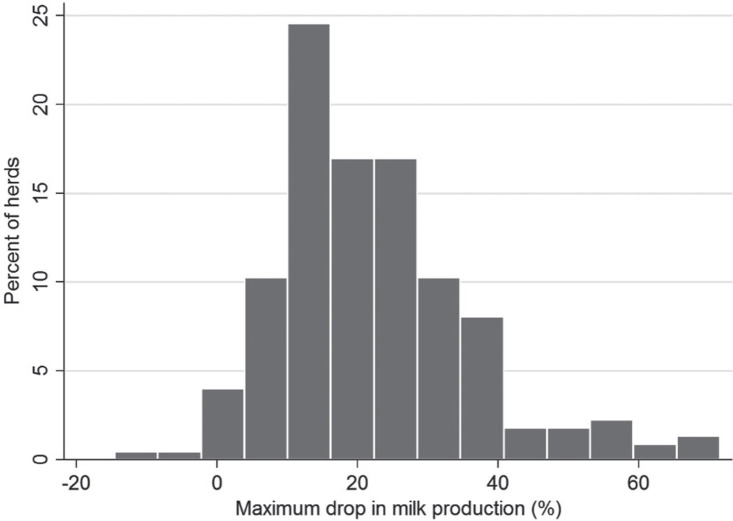
Winter dysentery (WD) is a contagious disease caused by bovine coronavirus. It is characterized by acute onset of diarrhea, fever, depression, and reduced milk yield in adult cattle. Although production loss is a well-known consequence of WD, large-scale studies estimating the effect on milk production are lacking. The objective of this study was to estimate the effect of farmer-reported WD on herd-level milk production and milk composition. A cohort study was performed based on reports of herd outbreaks of winter dysentery during a regional epidemic in Norway during the winter of 2011-2012. Reports were made by farmers, and diagnosis was based on a herd outbreak of acute diarrhea in adults. Milk shipment data were retrieved from the dairy company, and information on herd size and milking system were retrieved from the Norwegian Dairy Herd Recording System. We compared milk production in herds with reported outbreaks of WD (n = 224) with all herds in the same area without a reported outbreak (n = 2,093) during the same period. The outcome variable in the analysis was milk volume per cow per day, and the main predictor was whether the herd had a reported outbreak of WD or not. We assessed the effect of WD on milk production by fitting a linear mixed model, adjusting for milk production in the herd before the outbreak. Similarly, we assessed the effect of WD on milk composition using linear regression, adjusting for the levels of milk components before the outbreak. This study estimated a total loss of 51 L/cow during the study period, from 7 d before to 19 d after a reported outbreak. The lowest estimated production was 2 d after the outbreak was reported, when the average milk yield was 19.4 L/cow per day, compared with 23.0 L/cow per day 7 days before notification (i.e., a difference of 3.6 L/cow, or 15%). The effect gradually declined with time. The estimated effect on milk composition was modest, but an increase of 11% in free fatty acids and a small increase in fat/protein ratio indicated that WD might put cows into negative energy balance. Descriptive analysis indicated that herd milk yield was still reduced 4 mo after an outbreak. This cohort study showed that WD causes considerable decreases in milk production, and it alters milk composition. These findings highlight the important negative consequences of WD, and should motivate actions to prevent between-herd spread of bovine coronavirus.
冬季痢疾(WD)是一种由牛冠状病毒引起的传染病。其特征为成年牛急性腹泻、发热、精神沉郁和产奶量下降。虽然生产损失是冬季痢疾的一个众所周知的后果,但缺乏估计其对牛奶生产影响的大规模研究。本研究的目的是估计农民报告的冬季痢疾对牛群水平的牛奶产量和牛奶成分的影响。基于2011 - 2012年冬季挪威一次地区性疫情期间牛群冬季痢疾暴发的报告进行了一项队列研究。报告由农民提供,诊断基于成年牛群的急性腹泻暴发。牛奶运输数据从乳制品公司获取,牛群规模和挤奶系统信息从挪威奶牛群记录系统获取。我们将报告有冬季痢疾暴发的牛群(n = 224)在同一时期的牛奶产量与同一地区未报告有暴发的所有牛群(n = 2,093)进行了比较。分析中的结果变量是每头奶牛每天的产奶量,主要预测因素是牛群是否报告有冬季痢疾暴发。我们通过拟合线性混合模型评估冬季痢疾对牛奶产量的影响,并对暴发前牛群的牛奶产量进行了调整。同样,我们使用线性回归评估冬季痢疾对牛奶成分的影响,并对暴发前牛奶成分水平进行了调整。本研究估计在研究期间,从报告暴发前7天到暴发后19天内,每头奶牛总共损失51升牛奶。估计产量最低是在报告暴发后2天,此时平均产奶量为每头奶牛每天19.4升,而通知前7天为每头奶牛每天23.0升(即每头奶牛相差3.6升,或15%)。这种影响随时间逐渐下降。对牛奶成分的估计影响较小,但游离脂肪酸增加11%以及脂肪/蛋白质比率略有增加表明冬季痢疾可能使奶牛进入负能量平衡状态。描述性分析表明,暴发后4个月牛群牛奶产量仍会下降。这项队列研究表明,冬季痢疾会导致牛奶产量大幅下降,并改变牛奶成分。这些发现突出了冬季痢疾的重要负面后果,应促使采取行动预防牛冠状病毒在牛群间传播。