Zhang Kang, Zhao Zhe, Lan Liting, Wei Xiaoli, Wang Liyun, Liu Xiaoyan, Yan Haitao, Zheng Jianquan
State Key Laboratory of Toxicology and Medical Countermeasures, Beijing Key Laboratory of Neuropsychopharmacology, Department of Biochemical Pharmacology, Beijing Institute of Pharmacology and ToxicologyBeijing, China.
Department of Neurobiology, Beijing Institute of Basic Medical SciencesBeijing, China.
Front Pharmacol. 2017 May 26;8:302. doi: 10.3389/fphar.2017.00302. eCollection 2017.
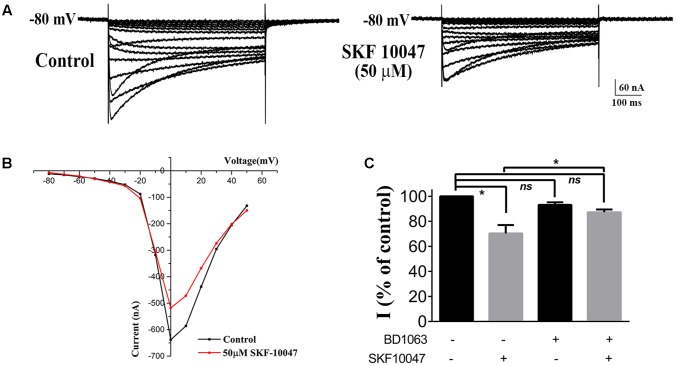
The sigma-1 receptor is a 223 amino acids molecular chaperone with a single transmembrane domain. It is resident to eukaryotic mitochondrial-associated endoplasmic reticulum and plasma membranes. By chaperone-mediated interactions with ion channels, G-protein coupled receptors and cell-signaling molecules, the sigma-1 receptor performs broad physiological and pharmacological functions. Despite sigma-1 receptors have been confirmed to regulate various types of ion channels, the relationship between the sigma-1 receptor and N-type Ca channel is still unclear. Considering both sigma-1 receptors and N-type Ca channels are involved in intracellular calcium homeostasis and neurotransmission, we undertake studies to explore the possible interaction between these two proteins. In the experiment, we confirmed the expression of the sigma-1 receptors and the N-type calcium channels in the cholinergic interneurons (ChIs) in rat striatum by using single-cell reverse transcription-polymerase chain reaction (scRT-PCR) and immunofluorescence staining. N-type Ca currents recorded from ChIs in the brain slice of rat striatum was depressed when sigma-1 receptor agonists (SKF-10047 and Pre-084) were administrated. The inhibition was completely abolished by sigma-1 receptor antagonist (BD-1063). Co-expression of the sigma-1 receptors and the N-type calcium channels in Xenopus oocytes presented a decrease of N-type Ca current amplitude with an increase of sigma-1 receptor expression. SKF-10047 could further depress N-type Ca currents recorded from oocytes. The fluorescence resonance energy transfer (FRET) assays and co-immunoprecipitation (Co-IP) demonstrated that sigma-1 receptors and N-type Ca channels formed a protein complex when they were co-expressed in HEK-293T (Human Embryonic Kidney -293T) cells. Our results revealed that the sigma-1 receptors played a negative modulation on N-type Ca channels. The mechanism for the inhibition of sigma-1 receptors on N-type Ca channels probably involved a chaperone-mediated direct interaction and agonist-induced conformational changes in the receptor-channel complexes on the cell surface.
σ-1受体是一种含有223个氨基酸的分子伴侣,具有单个跨膜结构域。它定位于真核细胞的线粒体相关内质网和质膜。通过与离子通道、G蛋白偶联受体和细胞信号分子进行伴侣介导的相互作用,σ-1受体发挥广泛的生理和药理功能。尽管已证实σ-1受体可调节多种类型的离子通道,但σ-1受体与N型钙通道之间的关系仍不清楚。鉴于σ-1受体和N型钙通道都参与细胞内钙稳态和神经传递,我们开展研究以探索这两种蛋白质之间可能的相互作用。在实验中,我们通过单细胞逆转录-聚合酶链反应(scRT-PCR)和免疫荧光染色,证实了大鼠纹状体胆碱能中间神经元(ChIs)中σ-1受体和N型钙通道的表达。当给予σ-1受体激动剂(SKF-10047和Pre-084)时,大鼠纹状体脑片中ChIs记录到的N型钙电流受到抑制。σ-1受体拮抗剂(BD-1063)可完全消除这种抑制作用。在非洲爪蟾卵母细胞中共表达σ-1受体和N型钙通道时,随着σ-1受体表达的增加,N型钙电流幅度降低。SKF-10047可进一步抑制卵母细胞记录到的N型钙电流。荧光共振能量转移(FRET)分析和免疫共沉淀(Co-IP)表明,当σ-1受体和N型钙通道在人胚肾293T(HEK-293T)细胞中共表达时,它们形成了一种蛋白质复合物。我们的结果表明,σ-1受体对N型钙通道起负性调节作用。σ-1受体抑制N型钙通道的机制可能涉及伴侣介导的直接相互作用以及激动剂诱导的细胞表面受体-通道复合物构象变化。