Centre for Biodiversity and Restoration Ecology, School of Biological Sciences, Victoria University of Wellington, PO Box 600, Wellington, New Zealand.
Pacific Biosecurity, Victoria Link Limited, Victoria University of Wellington, PO Box 1762, Wellington, New Zealand.
Sci Rep. 2017 Jun 12;7(1):3304. doi: 10.1038/s41598-017-03508-z.
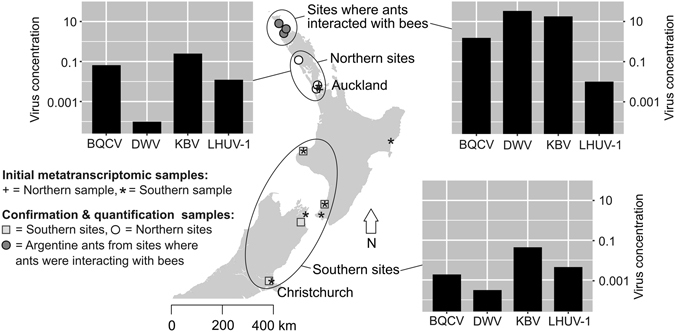
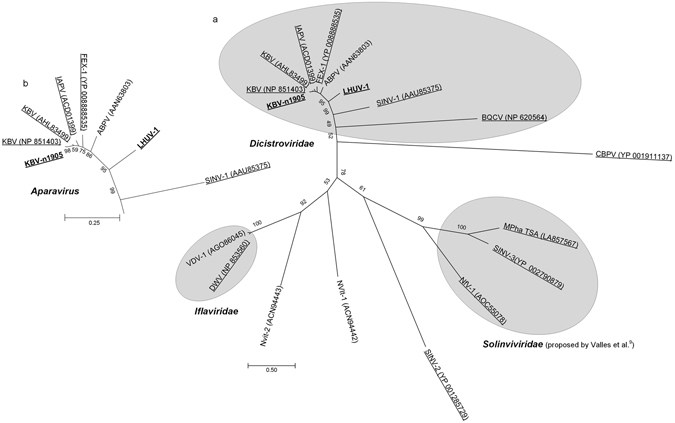
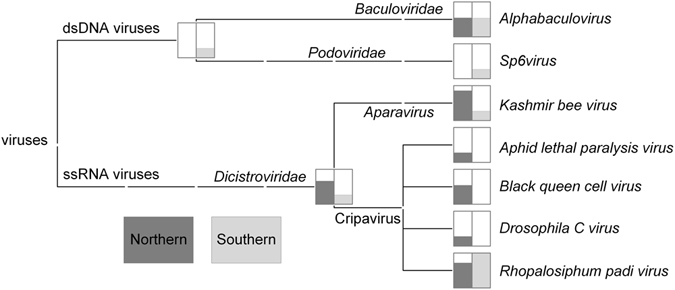
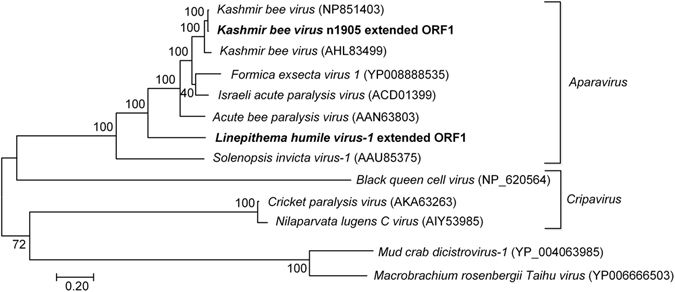
Social insects host a diversity of viruses. We examined New Zealand populations of the globally widely distributed invasive Argentine ant (Linepithema humile) for RNA viruses. We used metatranscriptomic analysis, which identified six potential novel viruses in the Dicistroviridae family. Of these, three contigs were confirmed by Sanger sequencing as Linepithema humile virus-1 (LHUV-1), a novel strain of Kashmir bee virus (KBV) and Black queen cell virus (BQCV), while the others were chimeric or misassembled sequences. We extended the known sequence of LHUV-1 to confirm its placement in the Dicistroviridae and categorised its relationship to closest relatives, which were all viruses infecting Hymenoptera. We examined further for known viruses by mapping our metatranscriptomic sequences to all viral genomes, and confirmed KBV, BQCV, LHUV-1 and Deformed wing virus (DWV) presence using qRT-PCR. Viral replication was confirmed for DWV, KBV and LHUV-1. Viral titers in ants were higher in the presence of honey bee hives. Argentine ants appear to host a range of' honey bee' pathogens in addition to a virus currently described only from this invasive ant. The role of these viruses in the population dynamics of the ant remain to be determined, but offer potential targets for biocontrol approaches.
社会性昆虫体内携带着多种病毒。我们对分布广泛的入侵物种新西兰阿根廷蚂蚁(Linepithema humile)进行了研究,以寻找其体内的 RNA 病毒。我们采用了宏转录组学分析,发现了六类潜在的新型病毒,它们都属于双翅目病毒科。其中三个连续序列通过 Sanger 测序被证实为 Linepithema humile virus-1(LHUV-1)、一种新型的 Kashmir bee virus(KBV)和 Black queen cell virus(BQCV),而其他序列则为嵌合体或组装错误。我们进一步扩展了 LHUV-1 的已知序列,以确定其在双翅目病毒科中的位置,并对其与亲缘关系最近的病毒进行分类,这些病毒都感染膜翅目昆虫。我们通过将宏转录组序列映射到所有病毒基因组上,进一步寻找已知病毒,并通过 qRT-PCR 确认了 KBV、BQCV、LHUV-1 和 Deformed wing virus(DWV)的存在。我们还证实了 DWV、KBV 和 LHUV-1 的复制。在存在蜜蜂蜂箱的情况下,蚂蚁体内的病毒滴度更高。阿根廷蚂蚁除了目前仅从这种入侵蚂蚁中描述的病毒外,似乎还携带一系列“蜜蜂”病原体。这些病毒在蚂蚁种群动态中的作用尚待确定,但它们为生物防治方法提供了潜在的目标。