Department of Psychiatry, University of Texas Southwestern Medical Center, Dallas, TX, USA.
Program in Neuroscience, University of Texas Southwestern Medical Center, Dallas, TX, USA.
Mol Psychiatry. 2018 Mar;23(3):621-628. doi: 10.1038/mp.2017.112. Epub 2017 Jun 13.
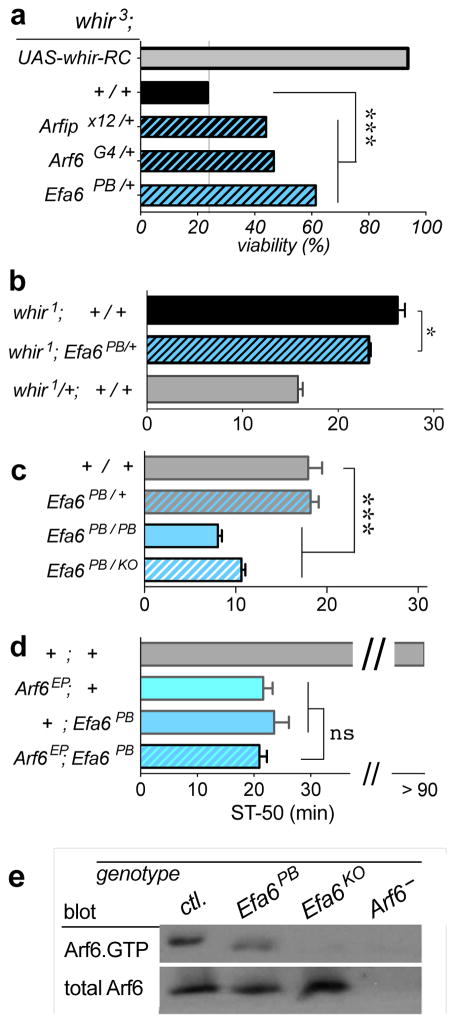
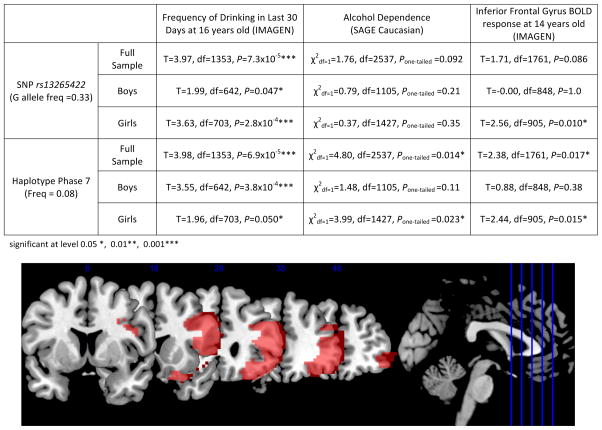
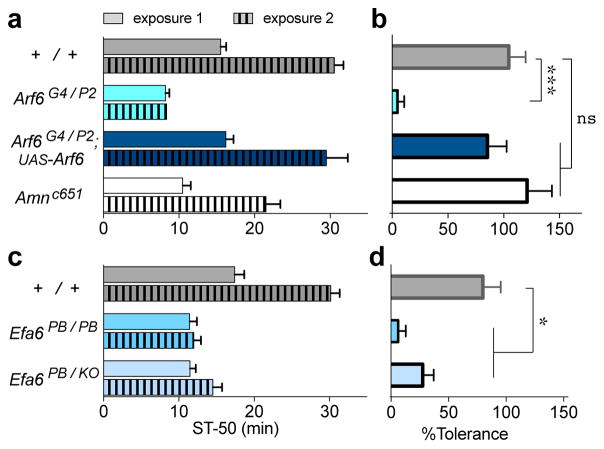
Ubiquitously expressed genes have been implicated in a variety of specific behaviors, including responses to ethanol. However, the mechanisms that confer this behavioral specificity have remained elusive. Previously, we showed that the ubiquitously expressed small GTPase Arf6 is required for normal ethanol-induced sedation in adult Drosophila. Here, we show that this behavioral response also requires Efa6, one of (at least) three Drosophila Arf6 guanine exchange factors. Ethanol-naive Arf6 and Efa6 mutants were sensitive to ethanol-induced sedation and lacked rapid tolerance upon re-exposure to ethanol, when compared with wild-type flies. In contrast to wild-type flies, both Arf6 and Efa6 mutants preferred alcohol-containing food without prior ethanol experience. An analysis of the human ortholog of Arf6 and orthologs of Efa6 (PSD1-4) revealed that the minor G allele of single nucleotide polymorphism (SNP) rs13265422 in PSD3, as well as a haplotype containing rs13265422, was associated with an increased frequency of drinking and binge drinking episodes in adolescents. The same haplotype was also associated with increased alcohol dependence in an independent European cohort. Unlike the ubiquitously expressed human Arf6 GTPase, PSD3 localization is restricted to the brain, particularly the prefrontal cortex (PFC). Functional magnetic resonance imaging revealed that the same PSD3 haplotype was also associated with a differential functional magnetic resonance imaging signal in the PFC during a Go/No-Go task, which engages PFC-mediated executive control. Our translational analysis, therefore, suggests that PSD3 confers regional specificity to ubiquitous Arf6 in the PFC to modulate human alcohol-drinking behaviors.
普遍表达的基因与多种特定行为有关,包括对乙醇的反应。然而,赋予这种行为特异性的机制仍然难以捉摸。此前,我们表明普遍表达的小 GTPase Arf6 是成年果蝇正常乙醇诱导镇静所必需的。在这里,我们表明这种行为反应也需要 Efa6,即至少三种果蝇 Arf6 鸟嘌呤核苷酸交换因子之一。与野生型果蝇相比,未经乙醇处理的 Arf6 和 Efa6 突变体对乙醇诱导的镇静敏感,并且在重新暴露于乙醇时缺乏快速耐受。与野生型果蝇不同,Arf6 和 Efa6 突变体都喜欢含有酒精的食物,而无需事先接触乙醇。对 Arf6 的人类同源物和 Efa6 的同源物(PSD1-4)的分析表明,PSD3 中单个核苷酸多态性 (SNP) rs13265422 的次要 G 等位基因,以及包含 rs13265422 的单倍型,与青少年饮酒和狂饮发作的频率增加有关。同一单倍型也与另一个独立的欧洲队列中酒精依赖的增加有关。与普遍表达的人类 Arf6 GTPase 不同,PSD3 的定位仅限于大脑,特别是前额叶皮层 (PFC)。功能磁共振成像显示,相同的 PSD3 单倍型也与 Go/No-Go 任务期间 PFC 中功能磁共振成像信号的差异相关,该任务涉及 PFC 介导的执行控制。因此,我们的转化分析表明,PSD3 赋予 PFC 中普遍存在的 Arf6 以调节人类饮酒行为的区域特异性。