Vap Alexander R, Schon Jason M, Moatshe Gilbert, Cruz Raphael S, Brady Alex W, Dornan Grant J, Turnbull Travis Lee, LaPrade Robert F
The Steadman Clinic, Vail, Colorado, USA.
Steadman Philippon Research Institute, Vail, Colorado, USA.
Orthop J Sports Med. 2017 May 31;5(5):2325967117708190. doi: 10.1177/2325967117708190. eCollection 2017 May.
A subset of patients have clinical internal and/or external knee rotational instability despite no apparent injury to the cruciate or collateral ligaments.
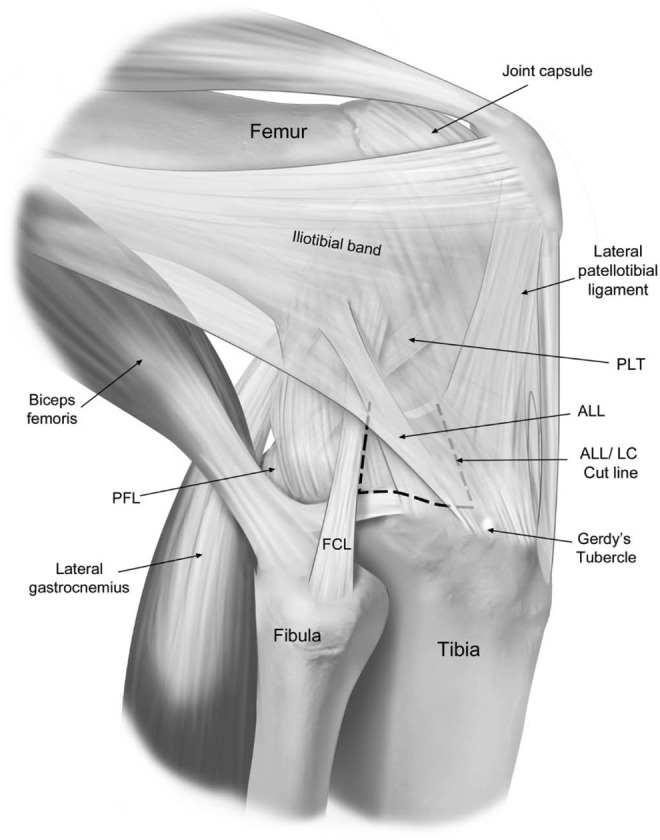
PURPOSE/HYPOTHESIS: The purpose of this study was to assess the effect of sequentially cutting the posterolateral, anterolateral, posteromedial, and anteromedial structures of the knee on rotational stability in the setting of intact cruciate and collateral ligaments. It was hypothesized that cutting of the iliotibial band (ITB), anterolateral ligament and lateral capsule (ALL/LC), posterior oblique ligament (POL), and posteromedial capsule (PMC) would significantly increase internal rotation, while sectioning of the anteromedial capsule (AMC) and the popliteus tendon and popliteofibular ligament (PLT/PFL) would lead to a significant increase in external knee rotation.
Controlled laboratory study.
Ten pairs (N = 20) of cadaveric knees were assigned to 2 sequential cutting groups (group 1: posterolateral-to-posteromedial [PL → PM] and group 2: posteromedial-to-posterolateral [PM → PL]). Specimens were subjected to applied 5-N·m internal and external rotation torques at knee flexion angles of 0°, 30°, 60°, and 90° while intact and after each cut state. Rotational changes were measured and compared with the intact and previous cut states.
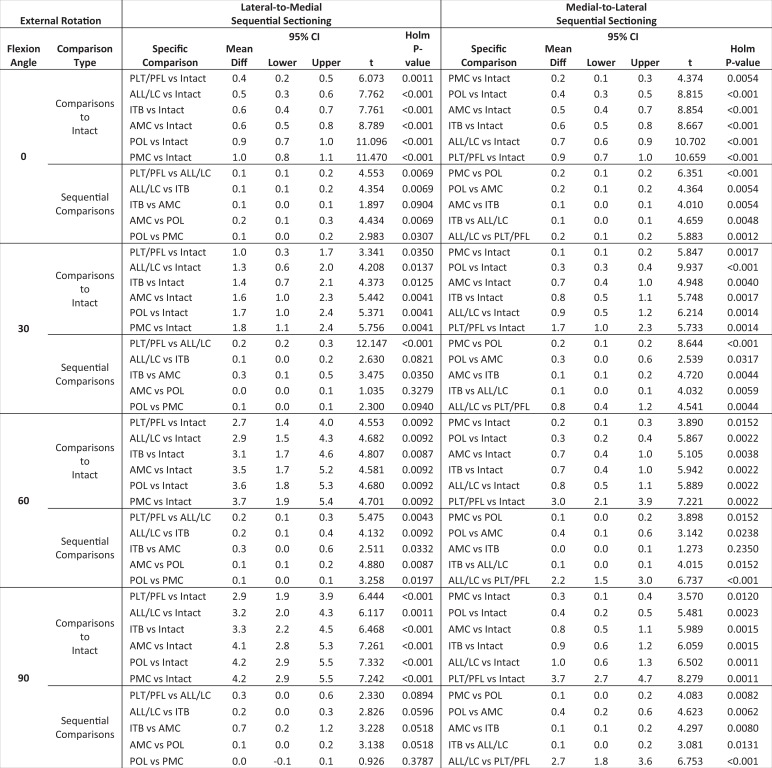
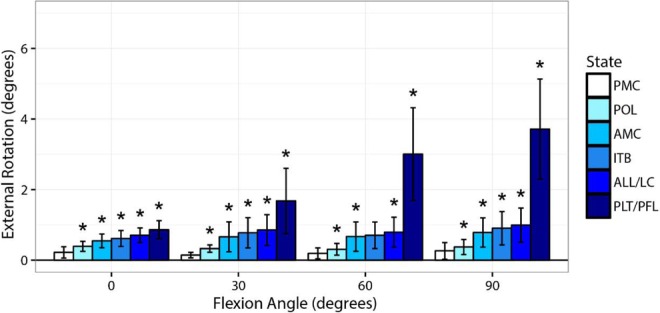
Sectioning of the ITB significantly increased internal rotation at 60° and 90° by 5.4° and 6.2° in group 1 (PL → PM) and 3.5° and 3.8° in group 2 (PM → PL). PLT/PFL complex sectioning significantly increased external rotation at 60° and 90° by 2.7° and 2.9° in group 1 (PL → PM). At 60° and 90° in group 2 (PM → PL), ALL/LC sectioning produced significant increases in internal rotation of 3.1° and 3.5°, respectively. In group 2 (PM → PL), POL sectioning produced a significant increase in internal rotation of 2.0° at 0°. AMC sectioning significantly increased external rotation at 30° to 90° of flexion with a magnitude of change of <1° in both groups 1 (PL → PM) and 2 (PM → PL).
Collectively, the anterolateral corner structures provided primary internal rotation control of the knee from 60° to 90° of knee flexion in knees with intact cruciate and collateral ligaments. The ITB was the most significant primary stabilizer of internal rotation. The POL had a primary role for internal rotational stability at full extension. The PLT/PFL complex was a primary stabilizer for external rotation of the knee at 60° and 90°.
This study delineates the primary and secondary roles of the ITB, ALL/LC, POL, and PLT/PFL to rotatory stability of the knee and provides new information to understand knee rotational instabilities.
尽管交叉韧带和侧副韧带无明显损伤,但仍有一部分患者存在临床可见的膝关节内旋和/或外旋不稳定。
目的/假设:本研究的目的是评估在交叉韧带和侧副韧带完整的情况下,依次切断膝关节的后外侧、前外侧、后内侧和前内侧结构对旋转稳定性的影响。研究假设切断髂胫束(ITB)、前外侧韧带和外侧关节囊(ALL/LC)、后斜韧带(POL)以及后内侧关节囊(PMC)会显著增加内旋,而切断前内侧关节囊(AMC)、腘肌腱和腘腓韧带(PLT/PFL)会导致膝关节外旋显著增加。
对照实验室研究。
将十对(N = 20)尸体膝关节分为两个顺序切断组(第1组:从后外侧到后内侧[PL→PM],第2组:从后内侧到后外侧[PM→PL])。在膝关节处于完整状态以及每次切断后,于0°、30°、60°和90°的膝关节屈曲角度施加5 N·m的内旋和外旋扭矩。测量旋转变化,并与完整状态和先前切断状态进行比较。
在第1组(PL→PM)中,切断ITB在60°和90°时分别使内旋显著增加5.4°和6.2°,在第2组(PM→PL)中分别增加3.5°和3.8°。在第1组(PL→PM)中,切断PLT/PFL复合体在60°和90°时分别使外旋显著增加2.7°和2.9°。在第2组(PM→PL)的60°和90°时,切断ALL/LC分别使内旋显著增加3.1°和3.5°。在第2组(PM→PL)中,在0°时切断POL使内旋显著增加2.0°。切断AMC在两组(第1组[PL→PM]和第2组[PM→PL])的30°至90°屈曲时均显著增加外旋,变化幅度均<1°。
总体而言,在交叉韧带和侧副韧带完整的膝关节中,前外侧角结构在膝关节屈曲60°至90°时提供主要的内旋控制。ITB是内旋最重要的主要稳定器。POL在完全伸展时对内旋稳定性起主要作用。PLT/PFL复合体是膝关节在60°和90°时外旋的主要稳定器。
本研究阐明了ITB、ALL/LC、POL和PLT/PFL对膝关节旋转稳定性的主要和次要作用,并为理解膝关节旋转不稳定提供了新信息。