Borin Thaiz F, Shankar Adarsh, Angara Kartik, Rashid Mohammad H, Jain Meenu, Iskander Asm, Ara Roxan, Lebedyeva Iryna, Korkaya Hasan, Achyut Bhagelu R, Arbab Ali S
Georgia Cancer Center, Augusta University, Augusta, GA, United States of America.
Department of Chemistry and Physics, Augusta University, Augusta, GA, United States of America.
PLoS One. 2017 Jun 13;12(6):e0178830. doi: 10.1371/journal.pone.0178830. eCollection 2017.
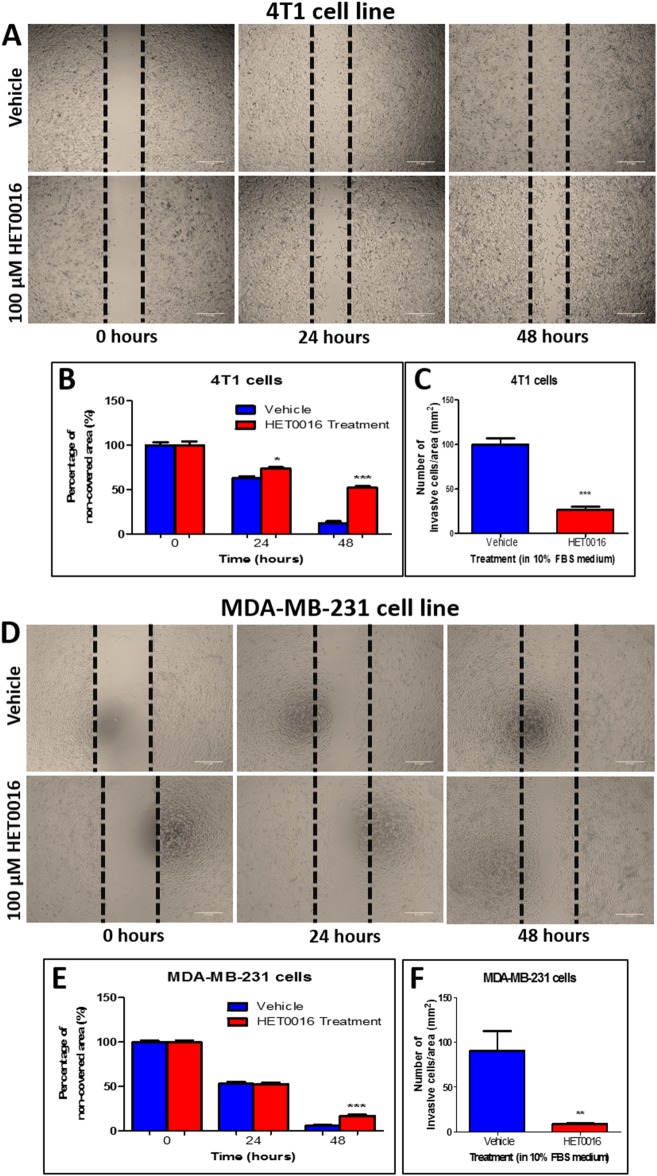
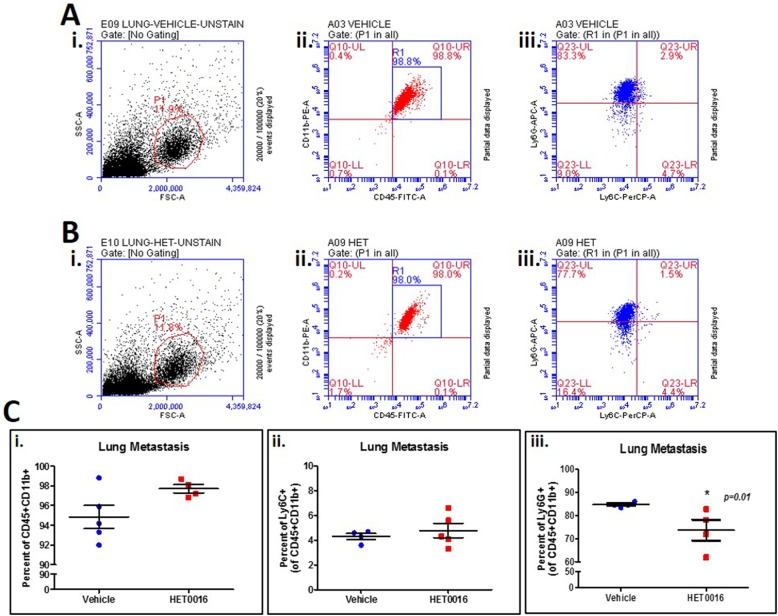
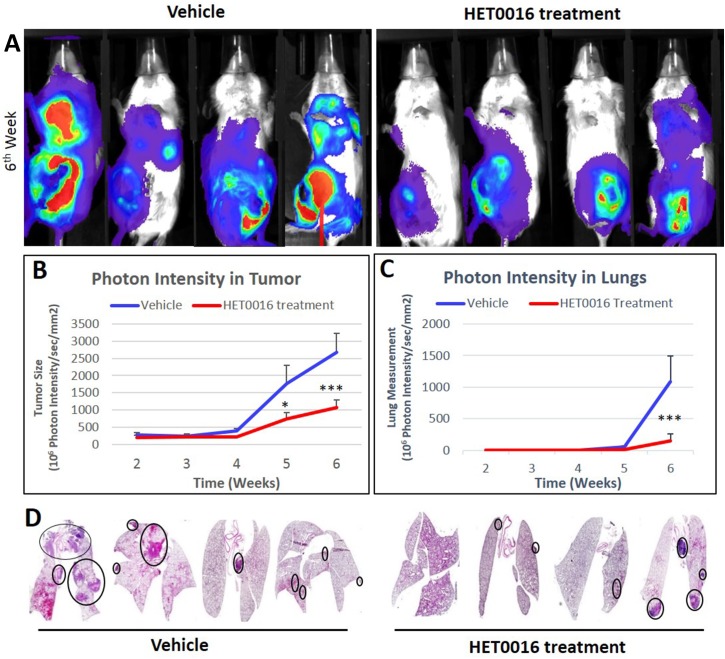
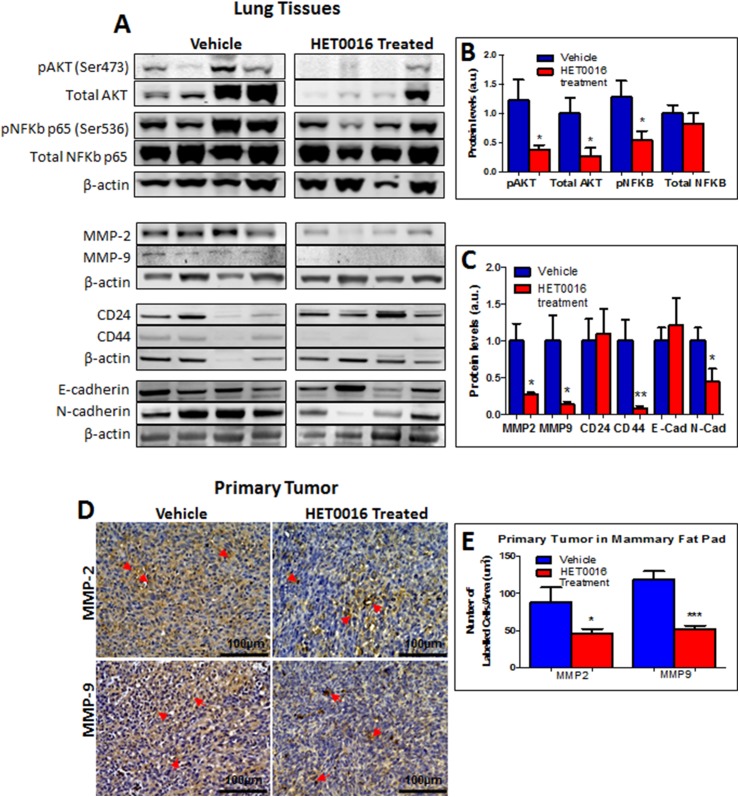
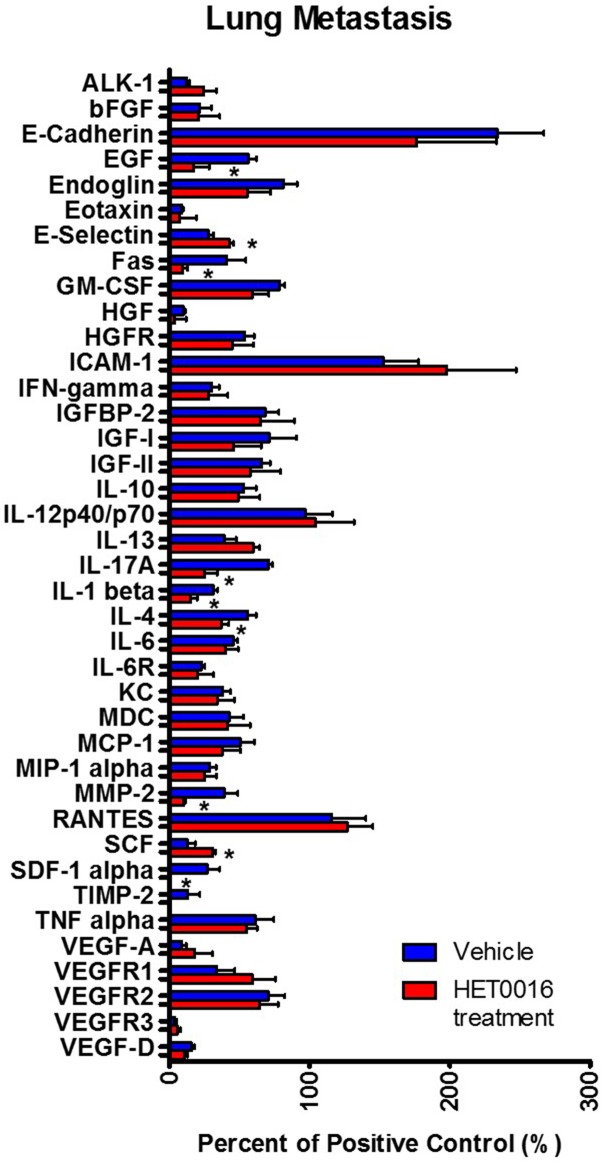
Distant metastasis is the primary cause of death in the majority of the cancer types. Recently, much importance has been given to tumor microenvironment (TME) in the development of invasive malignant tumors, as well as the metastasis potential. The ability of tumor cells to modulate TME and to escape immune-mediated attack by releasing immunosuppressive cytokines has become a hallmark of breast cancer. Our study shows the effect of IV formulation of HET0016 (HPßCD-HET0016) a selective inhibitor of 20-HETE synthesis, administered intravenously in immune-competent in vivo mouse model of murine breast cancer. 4T1 luciferase positive cells were implanted to the mammary fat pad in Balb/c mice. Treatment started on day 15, and was administered for 5 days a week for 3 weeks. The development of metastasis was detected via optical imaging. Blood, spleen, lungs, bone marrow and tumor were collected for flow cytometry, to investigate changes in myeloid-derived suppressive cells (MDSCs) populations and endothelial phenotype. Tumor and lungs were collected for protein analysis. Our results show that HPßCD-HET0016: (1) decreased tumor volume and lung metastasis compared to the vehicle group; (2) reduced migration and invasion of tumor cells and levels of metalloproteinases in the lungs of animals treated with HPßCD-HET0016 via PI3K/AKT pathway; and (3) decreased expression of pro-inflammatory cytokines, growth factors and granulocytic MDSCs population in the lung microenvironment in treated animals. Thus, HPßCD-HET0016 showed potential in treating lung metastasis in a preclinical mouse model and needs further investigations on TME.
远处转移是大多数癌症类型的主要死亡原因。最近,肿瘤微环境(TME)在侵袭性恶性肿瘤的发展以及转移潜能方面受到了高度重视。肿瘤细胞通过释放免疫抑制细胞因子来调节TME并逃避免疫介导攻击的能力已成为乳腺癌的一个标志。我们的研究显示了静脉注射HET0016(HPβCD - HET0016)的效果,HET0016是一种20 - HETE合成的选择性抑制剂,在具有免疫活性的小鼠乳腺癌体内模型中进行静脉给药。将4T1荧光素酶阳性细胞植入Balb/c小鼠的乳腺脂肪垫。在第15天开始治疗,每周给药5天,持续3周。通过光学成像检测转移的发生情况。收集血液、脾脏、肺、骨髓和肿瘤用于流式细胞术分析,以研究髓源性抑制细胞(MDSCs)群体和内皮细胞表型的变化。收集肿瘤和肺组织进行蛋白质分析。我们的结果表明,HPβCD - HET0016:(1)与载体组相比,减小了肿瘤体积并减少了肺转移;(2)通过PI3K/AKT途径降低了HPβCD - HET0016处理的动物肺中肿瘤细胞的迁移和侵袭以及金属蛋白酶水平;(3)降低了治疗动物肺微环境中促炎细胞因子、生长因子的表达以及粒细胞MDSCs群体。因此,HPβCD - HET0016在临床前小鼠模型中显示出治疗肺转移的潜力,并且需要对TME进行进一步研究。