Shankar Adarsh, Borin Thaiz F, Iskander Asm, Varma Nadimpalli Rs, Achyut Bhagelu R, Jain Meenu, Mikkelsen Tom, Guo Austin M, Chwang Wilson B, Ewing James R, Bagher-Ebadian Hassan, Arbab Ali S
Tumor Angiogenesis Laboratory, Cancer Center, Georgia Regents University, Augusta, GA, USA.
Laboratory of Molecular Investigation of Cancer (LIMC), Faculty of Medicine of Sao Jose do Rio Preto, Sao Jose do Rio Preto, Brazil.
Onco Targets Ther. 2016 Mar 9;9:1205-19. doi: 10.2147/OTT.S93790. eCollection 2016.
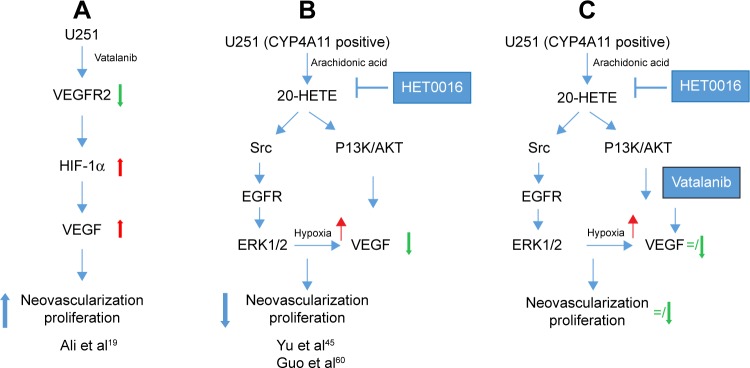
Due to the hypervascular nature of glioblastoma (GBM), antiangiogenic treatments, such as vatalanib, have been added as an adjuvant to control angiogenesis and tumor growth. However, evidence of progressive tumor growth and resistance to antiangiogenic treatment has been observed. To counter the unwanted effect of vatalanib on GBM growth, we have added a new agent known as N-hydroxy-N'-(4-butyl-2 methylphenyl)formamidine (HET0016), which is a selective inhibitor of 20-hydroxyeicosatetraenoic acid (20-HETE) synthesis. The aims of the studies were to determine 1) whether the addition of HET0016 can attenuate the unwanted effect of vatalanib on tumor growth and 2) whether the treatment schedule would have a crucial impact on controlling GBM.
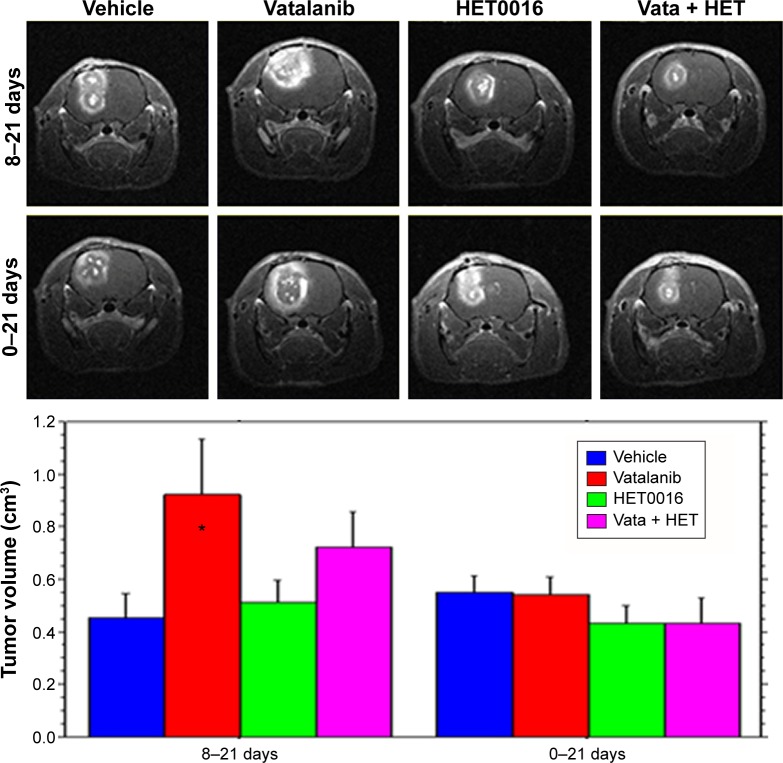
U251 human glioma cells (4×10(5)) were implanted orthotopically. Two different treatment schedules were investigated. Treatment starting on day 8 (8-21 days treatment) of the tumor implantation was to mimic treatment following detection of tumor, where tumor would have hypoxic microenvironment and well-developed neovascularization. Drug treatment starting on the same day of tumor implantation (0-21 days treatment) was to mimic cases following radiation therapy or surgery. There were four different treatment groups: vehicle, vatalanib (oral treatment 50 mg/kg/d), HET0016 (intraperitoneal treatment 10 mg/kg/d), and combined (vatalanib and HET0016). Following scheduled treatments, all animals underwent magnetic resonance imaging on day 22, followed by euthanasia. Brain specimens were equally divided for immunohistochemistry and protein array analysis.
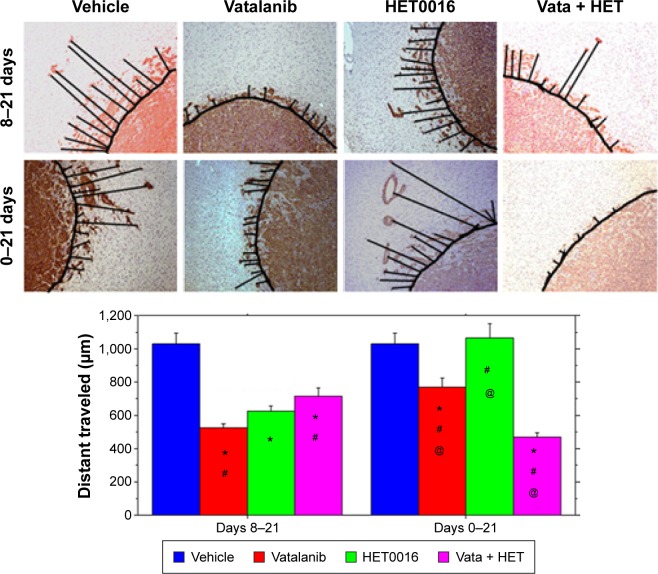
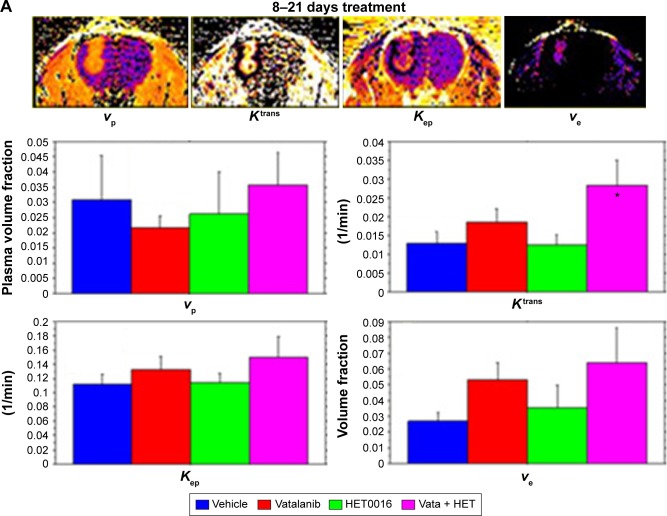
Our results demonstrated a trend that HET0016, alone or in combination with vatalanib, is capable of controlling the tumor growth compared with that of vatalanib alone, indicating attenuation of the unwanted effect of vatalanib. When both vatalanib and HET0016 were administered together on the day of the tumor implantation (0-21 days treatment), tumor volume, tumor blood volume, permeability, extravascular and extracellular space volume, tumor cell proliferation, and cell migration were decreased compared with that of the vehicle-treated group.
HET0016 is capable of controlling tumor growth and migration, but these effects are dependent on the timing of drug administration. The addition of HET0016 to vatalanib may attenuate the unwanted effect of vatalanib.
由于胶质母细胞瘤(GBM)具有血管增生的特性,已添加抗血管生成药物(如瓦他拉尼)作为辅助治疗,以控制血管生成和肿瘤生长。然而,已观察到肿瘤进展生长及对抗血管生成治疗产生耐药性的证据。为对抗瓦他拉尼对GBM生长产生的不良影响,我们添加了一种名为N-羟基-N'-(4-丁基-2-甲基苯基)甲脒(HET0016)的新型药物,它是20-羟基二十碳四烯酸(20-HETE)合成的选择性抑制剂。本研究的目的是确定:1)添加HET0016是否能减轻瓦他拉尼对肿瘤生长的不良影响;2)治疗方案对控制GBM是否有至关重要的影响。
将U251人胶质瘤细胞(4×10⁵个)原位植入。研究了两种不同的治疗方案。在肿瘤植入后第8天开始治疗(8 - 21天治疗),以模拟肿瘤检测后的治疗情况,此时肿瘤会有缺氧微环境和发育良好的新血管形成。在肿瘤植入当天开始药物治疗(0 - 21天治疗),以模拟放疗或手术后的情况。有四个不同的治疗组:溶剂对照组、瓦他拉尼(口服给药50 mg/kg/d)、HET0016(腹腔注射给药10 mg/kg/d)以及联合用药组(瓦他拉尼和HET0016)。按计划治疗后,所有动物在第22天接受磁共振成像检查,随后实施安乐死。将脑标本平均分成两份用于免疫组织化学和蛋白质阵列分析。
我们的结果显示出一种趋势,即与单独使用瓦他拉尼相比,HET0016单独使用或与瓦他拉尼联合使用能够控制肿瘤生长,这表明减轻了瓦他拉尼的不良影响。当在肿瘤植入当天同时给予瓦他拉尼和HET0016(0 - 21天治疗)时,与溶剂对照组相比,肿瘤体积、肿瘤血容量、通透性、血管外和细胞外间隙体积、肿瘤细胞增殖以及细胞迁移均有所减少。
HET0016能够控制肿瘤生长和迁移,但这些作用取决于给药时间。在瓦他拉尼中添加HET0016可能会减轻瓦他拉尼的不良影响。