Bjersand Kathrine, Seidal Tomas, Sundström-Poromaa Inger, Åkerud Helena, Skirnisdottir Ingiridur
Department of Women's and Children's Health, Uppsala University, Uppsala, Sweden.
Department of Pathology, Halmstad Medical Center Hospital, Halmstad, Sweden.
PLoS One. 2017 Jun 13;12(6):e0179363. doi: 10.1371/journal.pone.0179363. eCollection 2017.
To evaluate the prognostic effect of the Heterogeneous nuclear ribonucleoprotein type M (HNRPM) and Solute carrier 1A5 (SLC1A5) in FIGO-stages I-II epithelial ovarian cancer.
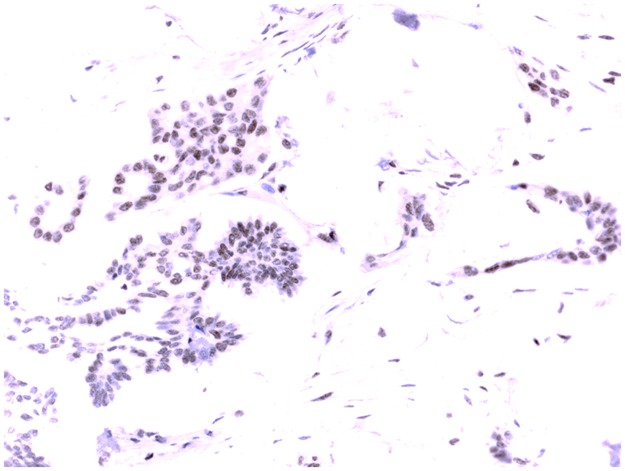
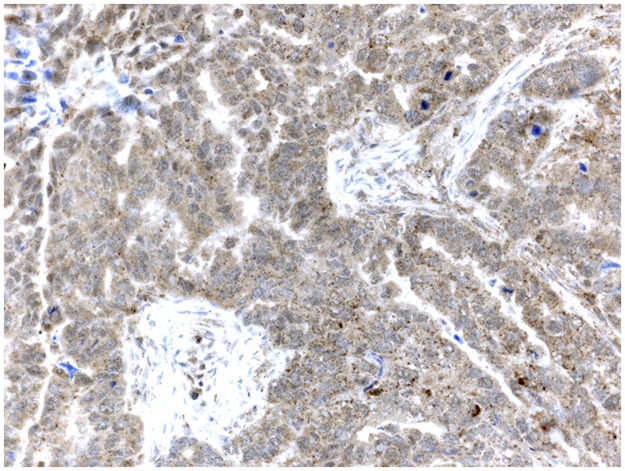
A retrospective cohort study was designed to investigate the prognostic effect of HNRPM and SLC1A5, and the association with clinical-pathologic characteristics in 131 patients with FIGO-stages I-II epithelial ovarian cancer. Tissue microarrays were constructed and protein levels were assessed by immunohistochemistry (IHC).
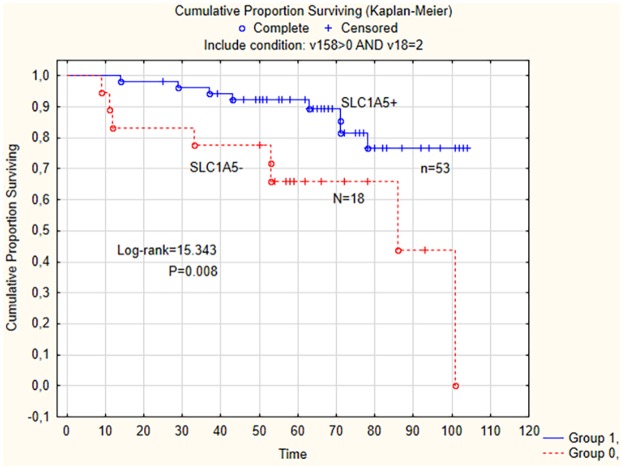
Positive HRNPM status was associated with positive staining for PUMA (P = 0.04), concomitant PUMA and p21 staining (P = 0.005), and VEGF-R2 (P = 0.003). Positive SLC1A5 staining was associated with positive staining of p27 (P = 0.030), PUMA (P = 0.039), concomitant PUMA and p27 staining, and VEGF-R2 (P = 0.039). In non-serous tumors (n = 72), the SLC1A5 positivity was associated with recurrent disease (P = 0.01). In a multivariable logistic regression analysis FIGO-stage (OR = 12.4), tumor grade (OR = 5.1) and SLC1A5 positivity (OR = 0.1) were independent predictive factors for recurrent disease. Disease-free survival (DFS) in women with SLC1A5-positive non-serous tumors was 92% compared with of 66% in patients with SLC1A5-negative non-serous tumors (Log-rank = 15.343; P = 0.008). In Cox analysis with DFS as endpoint, FIGO-stage (HR = 4.5) and SLC1A5 status (HR = 0.3) were prognostic factors.
As the proteins HRNPM and SLC1A5 are associated with the cell cycle regulators p21 or p27, the apoptosis regulators PTEN and PUMA, and the VEGF-R2 it is concluded that both proteins have role in the pathogenesis of ovarian cancer. In patients with non-serous ovarian cancer SLC1A5 protects from recurrent disease, presumably by means of biological mechanisms that are unrelated to cytotoxic drug sensitivity.
评估核不均一核糖核蛋白M型(HNRPM)和溶质载体1A5(SLC1A5)在国际妇产科联盟(FIGO)I-II期上皮性卵巢癌中的预后作用。
设计一项回顾性队列研究,以调查131例FIGO I-II期上皮性卵巢癌患者中HNRPM和SLC1A5的预后作用及其与临床病理特征的相关性。构建组织芯片并通过免疫组织化学(IHC)评估蛋白水平。
HRNPM阳性状态与PUMA阳性染色(P = 0.04)、PUMA和p21共染色(P = 0.005)以及VEGF-R2阳性染色(P = 0.003)相关。SLC1A5阳性染色与p27阳性染色(P = 0.030)、PUMA阳性染色(P = 0.039)、PUMA和p27共染色以及VEGF-R2阳性染色(P = 0.039)相关。在非浆液性肿瘤(n = 72)中,SLC1A5阳性与疾病复发相关(P = 0.01)。在多变量逻辑回归分析中,FIGO分期(OR = 12.4)、肿瘤分级(OR = 5.1)和SLC1A5阳性(OR = 0.1)是疾病复发的独立预测因素。SLC1A5阳性非浆液性肿瘤女性的无病生存期(DFS)为92%,而SLC1A5阴性非浆液性肿瘤患者为66%(对数秩检验= 15.343;P = 0.008)。以DFS为终点的Cox分析中,FIGO分期(HR = 4.5)和SLC1A5状态(HR = 0.3)是预后因素。
由于蛋白HRNPM和SLC1A5与细胞周期调节因子p21或p27、凋亡调节因子PTEN和PUMA以及VEGF-R2相关,得出这两种蛋白在卵巢癌发病机制中均起作用的结论。在非浆液性卵巢癌患者中,SLC1A5可预防疾病复发,可能是通过与细胞毒性药物敏感性无关的生物学机制实现的。