Chretien Anne-Sophie, Fauriat Cyril, Orlanducci Florence, Galseran Claire, Rey Jerome, Bouvier Borg Gaelle, Gautherot Emmanuel, Granjeaud Samuel, Hamel-Broza Jean-François, Demerle Clemence, Ifrah Norbert, Lacombe Catherine, Cornillet-Lefebvre Pascale, Delaunay Jacques, Toubert Antoine, Gregori Emilie, Luche Herve, Malissen Marie, Arnoulet Christine, Nunes Jacques A, Vey Norbert, Olive Daniel
Team Immunity and Cancer, Centre de Recherche en Cancérologie de Marseille (CRCM), Inserm, U1068; CNRS, UMR7258, Institut Paoli-Calmettes; Aix-Marseille University, UM 105, Marseille, France.
Immunomonitoring platform, Institut Paoli-Calmettes, Marseille, France.
Front Immunol. 2017 May 29;8:573. doi: 10.3389/fimmu.2017.00573. eCollection 2017.
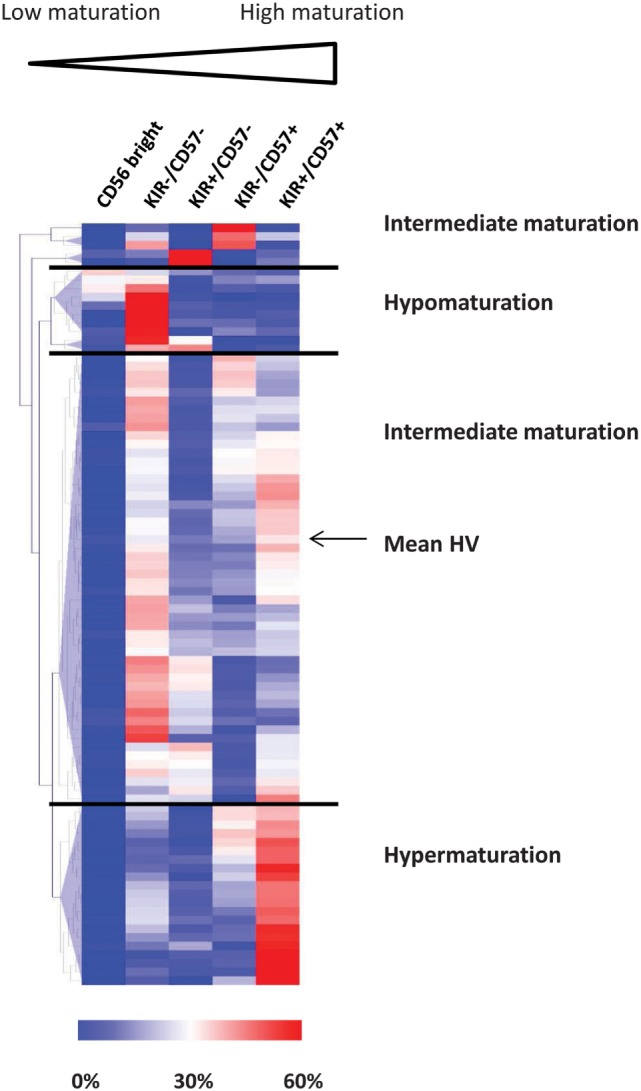
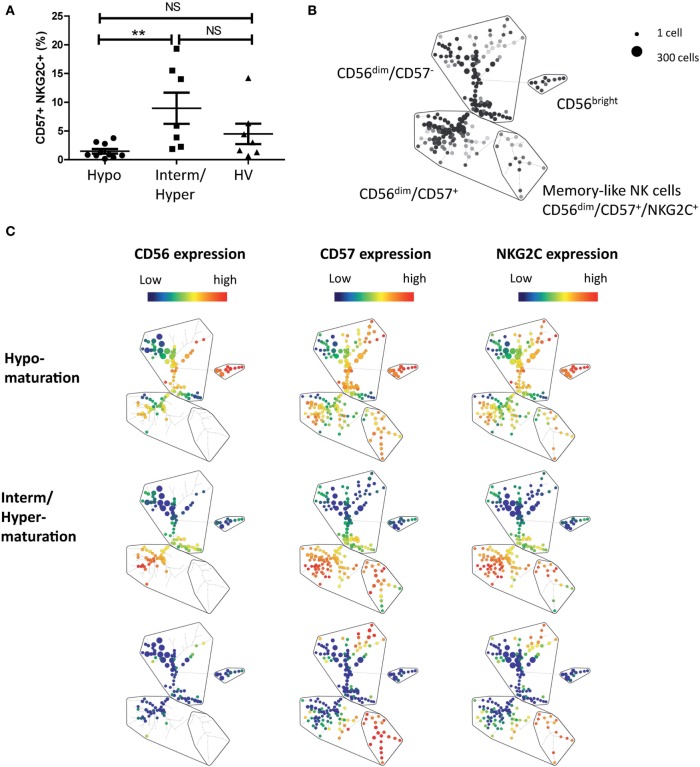
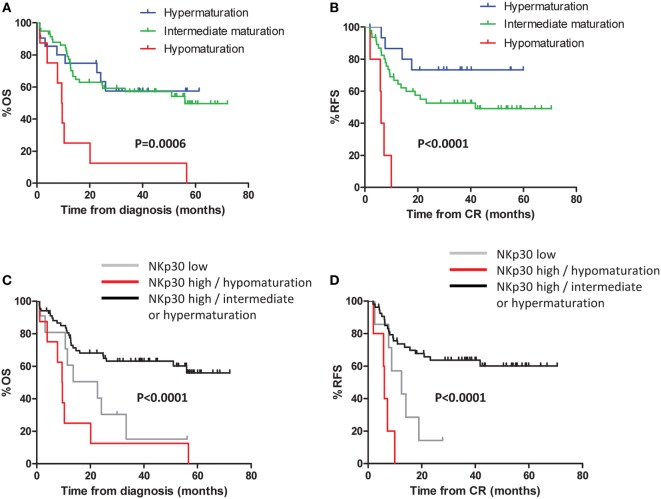
Accumulating evidence highlights natural killer (NK) cell parameters as potential prognostic factors in cancer patients, which provides a strong rationale for developing therapeutic strategies aiming at restoring NK cell. However, reaching this point warrants better characterization of tumor-induced NK cell alterations. Our group recently reported heterogeneous NK maturation in acute myeloid leukemia (AML) patients. However, the clinical significance of such observations remained to be assessed on a larger cohort of patients. NK maturation based on expression of CD56, CD57, and KIR was assessed by flow cytometry in newly diagnosed AML patients ( = 87 patients from GOELAMS-LAM-IR-2006 multicenter trial). Clinical outcome was evaluated with regard to NK maturation profiles. Unsupervised integrated analysis of NK maturation markers confirmed the existence of three distinct groups of patients [hypomaturation (24.1%), intermediate maturation (66.7%), and hypermaturation (9.2%)]. In univariate analysis, significant differences in overall survival (OS) ( = 0.0006) and relapse-free survival (RFS) ( < 0.0001) were observed among these different groups. Patients with hypomaturation profile had reduced OS, with 3-year OS rates of 12.5 vs 57.1 and 57.4% for patients with intermediate and hypermaturation, respectively. Consistently, patients with hypomaturation profile had reduced RFS, with 3-year RFS rates of 0 vs 52.6 and 73.3% for patients with intermediate and hypermaturation, respectively. In multivariate Cox regression models, NK hypomaturation remained significantly associated with reduced OS and RFS, independent of other factors [hazard ratio (HR) = 4.15, = 0.004 and HR = 8.23, = 0.003, respectively]. NK maturation defects were further explored by mass cytometry and revealed that NK hypomaturation profile is associated with a reduced frequency of memory-like NK cells. In conclusion, besides classical alterations of NK triggering and inhibitory receptors expression in AML, we confirm that the homeostasis of NK maturation can be modified in the context of AML, notably with a deep maturation blockade in almost 10% patients.
越来越多的证据表明,自然杀伤(NK)细胞参数是癌症患者潜在的预后因素,这为制定旨在恢复NK细胞功能的治疗策略提供了有力依据。然而,要实现这一目标,需要更好地了解肿瘤诱导的NK细胞改变。我们的研究小组最近报道了急性髓系白血病(AML)患者中NK细胞成熟的异质性。然而,这些观察结果的临床意义仍有待在更大规模的患者队列中进行评估。通过流式细胞术对新诊断的AML患者(来自GOELAMS-LAM-IR-2006多中心试验的87例患者)基于CD56、CD57和KIR表达评估NK细胞成熟情况。根据NK细胞成熟谱评估临床结局。对NK细胞成熟标志物进行无监督综合分析,确认存在三组不同的患者[低成熟组(24.1%)、中等成熟组(66.7%)和高成熟组(9.2%)]。在单因素分析中,这些不同组之间的总生存期(OS)(P = 0.0006)和无复发生存期(RFS)(P < 0.0001)存在显著差异。低成熟谱的患者OS降低,3年OS率分别为12.5%,而中等成熟组和高成熟组患者分别为57.1%和57.4%。同样,低成熟谱的患者RFS降低,3年RFS率分别为0,而中等成熟组和高成熟组患者分别为52.6%和73.3%。在多变量Cox回归模型中,NK细胞低成熟仍然与OS和RFS降低显著相关,独立于其他因素[风险比(HR)分别为4.15,P = 0.004和HR = 8.23,P = 0.003]。通过质谱流式细胞术进一步探索NK细胞成熟缺陷,发现NK细胞低成熟谱与记忆样NK细胞频率降低有关。总之,除了AML中NK细胞触发和抑制性受体表达的经典改变外,我们证实AML背景下NK细胞成熟的稳态可被改变,特别是在近10%的患者中存在深度成熟阻滞。