Jones Roy W, Lebrec Jeremie, Kahle-Wrobleski Kristin, Dell'Agnello Grazia, Bruno Giuseppe, Vellas Bruno, Argimon Josep M, Dodel Richard, Haro Josep Maria, Wimo Anders, Reed Catherine
aRICE (The Research Institute for the Care of Older People), Royal United Hospital, Bath, UK.
bEli Lilly Deutschland GmbH, Bad Homburg, Germany.
Dement Geriatr Cogn Dis Extra. 2017 Mar 20;7(1):87-100. doi: 10.1159/000461577. eCollection 2017 Jan-Apr.
BACKGROUND/AIMS: We assessed whether cognitive and functional decline in community-dwelling patients with mild Alzheimer disease (AD) dementia were associated with increased societal costs and caregiver burden and time outcomes.
Cognitive decline was defined as a ≥3-point reduction in the Mini-Mental State Examination and functional decline as a decrease in the ability to perform one or more basic items of the Alzheimer's Disease Cooperative Study Activities of Daily Living Inventory (ADCS-ADL) or ≥20% of instrumental ADL items. Total societal costs were estimated from resource use and caregiver hours using 2010 costs. Caregiver burden was assessed using the Zarit Burden Interview (ZBI); caregiver supervision and total hours were collected.
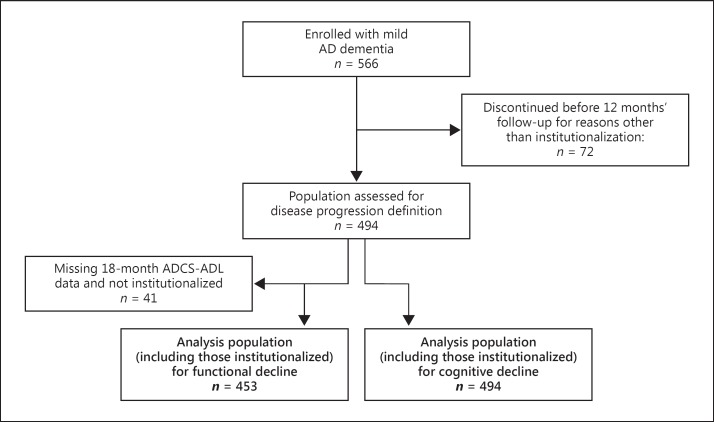
Of 566 patients with mild AD enrolled in the GERAS study, 494 were suitable for the current analysis. Mean monthly total societal costs were greater for patients showing functional (+61%) or cognitive decline (+27%) compared with those without decline. In relation to a typical mean monthly cost of approximately EUR 1,400 at baseline, this translated into increases over 18 months to EUR 2,254 and 1,778 for patients with functional and cognitive decline, respectively. The number of patients requiring supervision doubled among patients showing functional or cognitive decline compared with those not showing decline, while caregiver total time increased by 70 and 33%, respectively and ZBI total score by 5.3 and 3.4 points, respectively.
Cognitive and, more notably, functional decline were associated with increases in costs and caregiver outcomes in patients with mild AD dementia.
背景/目的:我们评估了社区中轻度阿尔茨海默病(AD)痴呆患者的认知和功能衰退是否与社会成本增加、照料者负担及时间结果相关。
认知衰退定义为简易精神状态检查表得分降低≥3分,功能衰退定义为阿尔茨海默病协作研究日常生活活动量表(ADCS-ADL)中一项或多项基本项目能力下降或工具性ADL项目下降≥20%。使用210年成本,根据资源使用情况和照料者时长估算社会总成本。使用扎里特负担访谈量表(ZBI)评估照料者负担;收集照料者监督情况和总时长。
在GERAS研究纳入的566例轻度AD患者中,494例适合当前分析。与无衰退的患者相比,出现功能衰退(+61%)或认知衰退(+27%)的患者平均每月社会总成本更高。相对于基线时约1400欧元的典型平均每月成本,这意味着功能衰退和认知衰退患者在18个月内分别增至2254欧元和1778欧元。与未出现衰退的患者相比,出现功能或认知衰退的患者中需要监督的人数增加了一倍,而照料者总时长分别增加了70%和33%,ZBI总分分别增加了5.3分和3.4分。
轻度AD痴呆患者的认知衰退,更显著的是功能衰退,与成本增加和照料者结果相关。